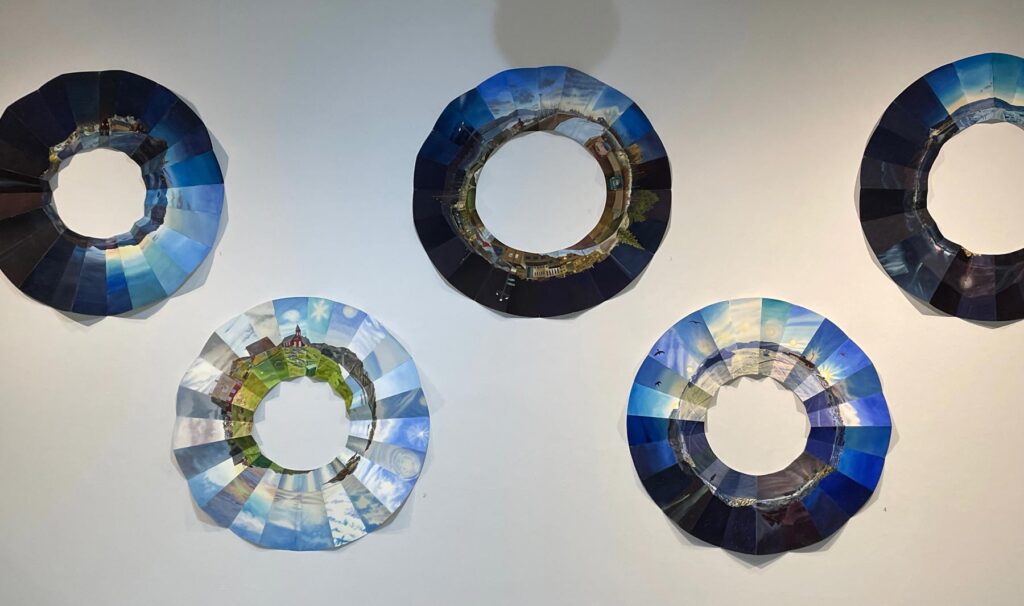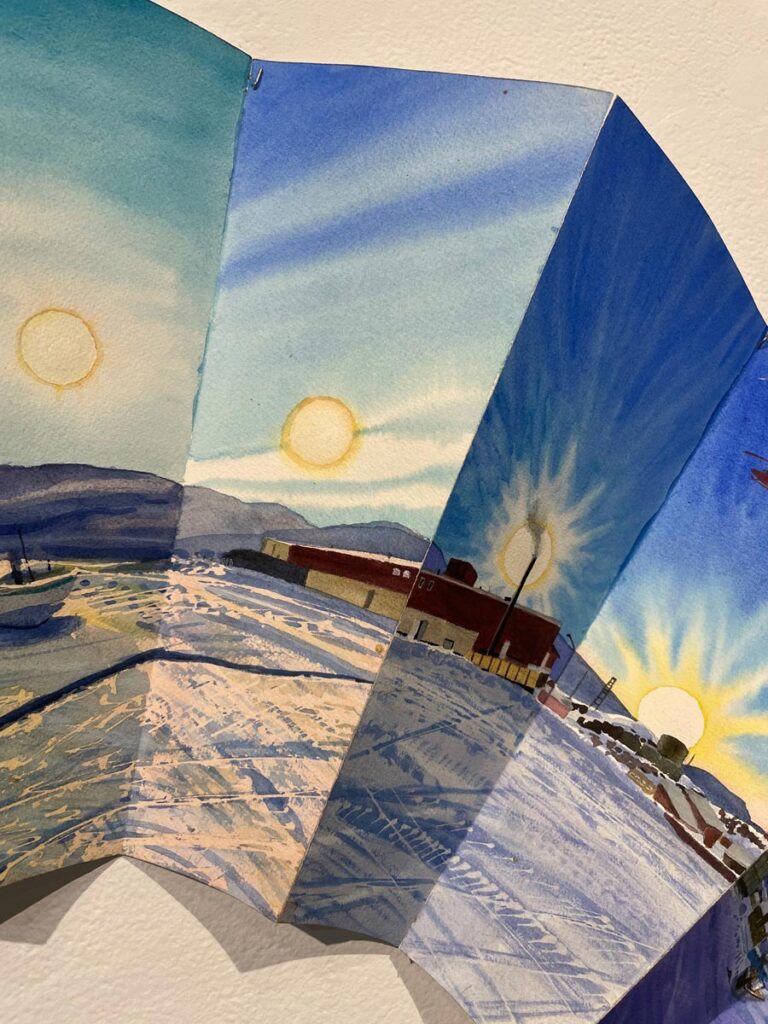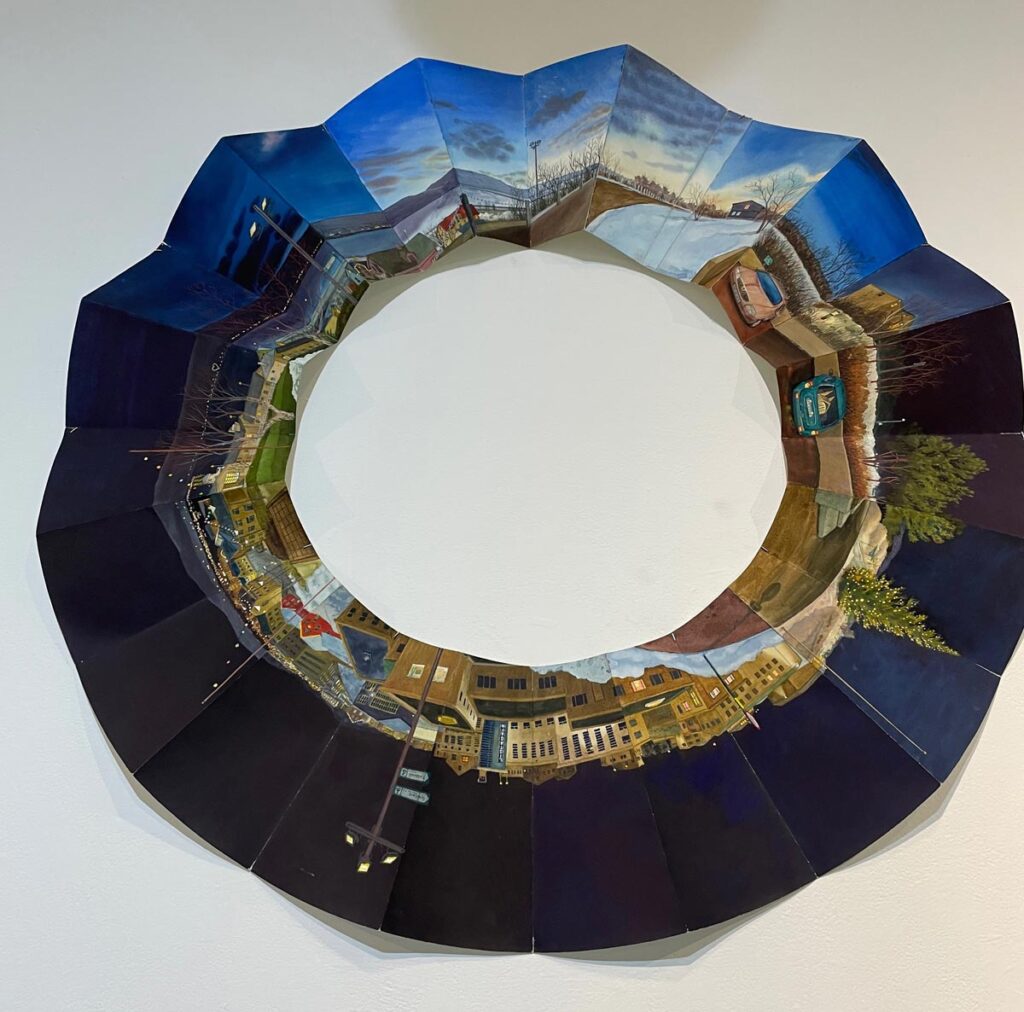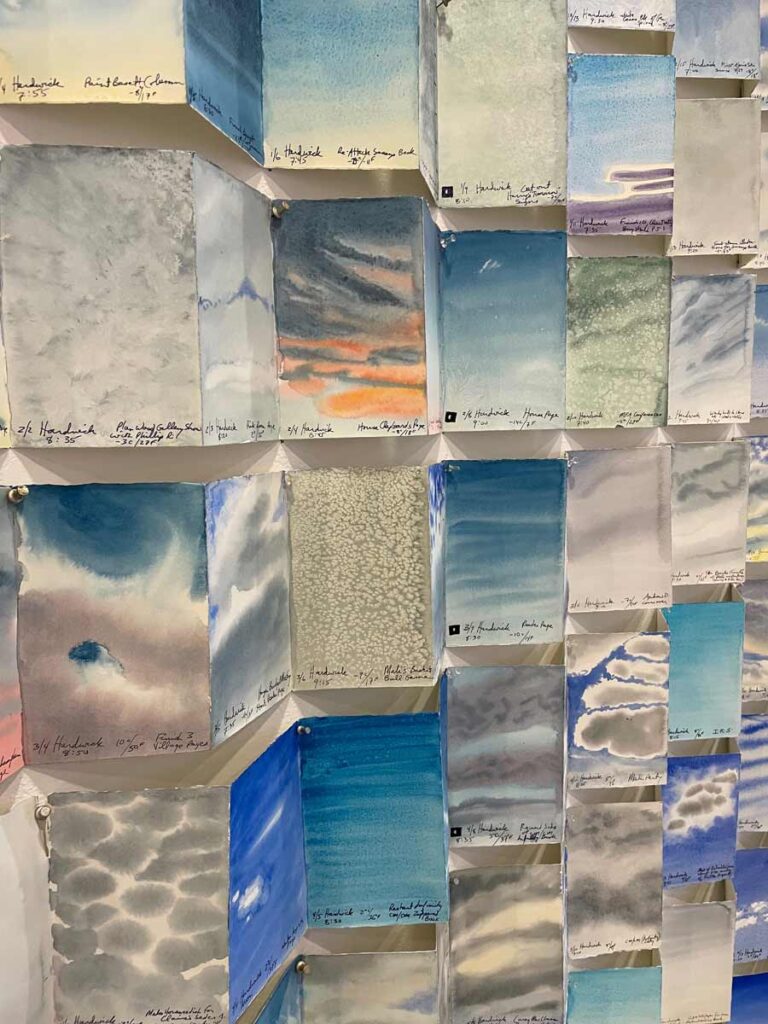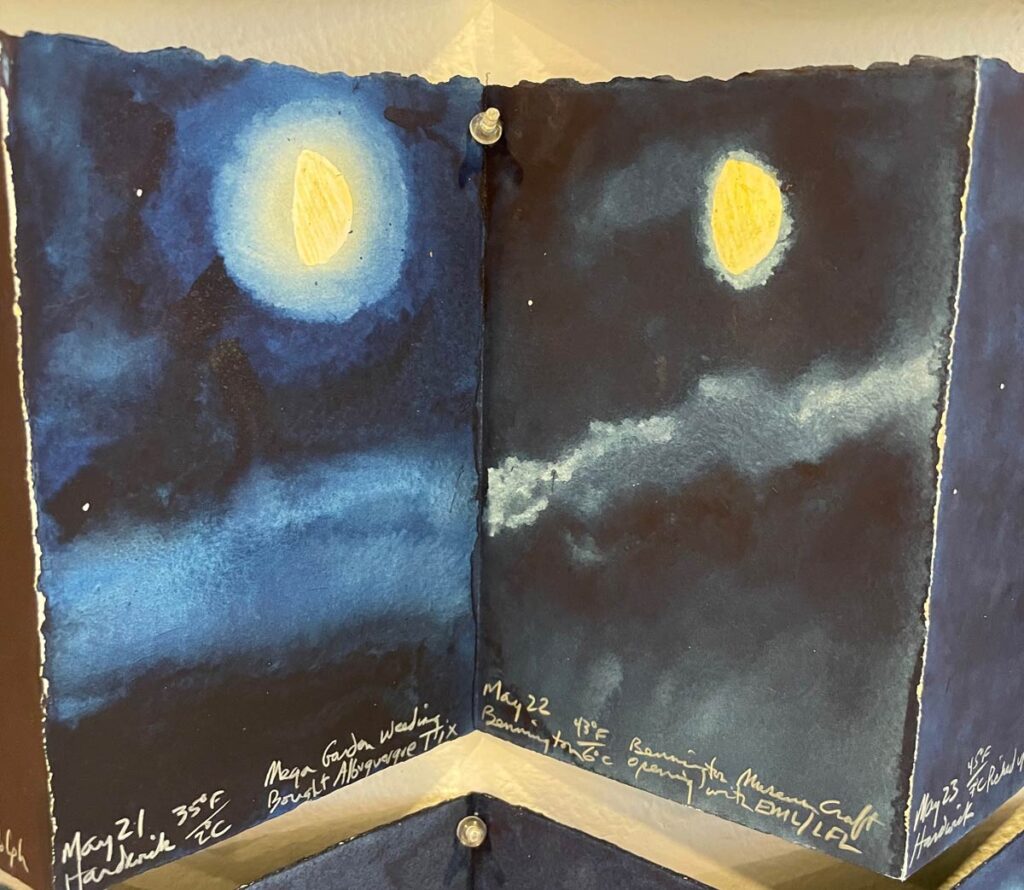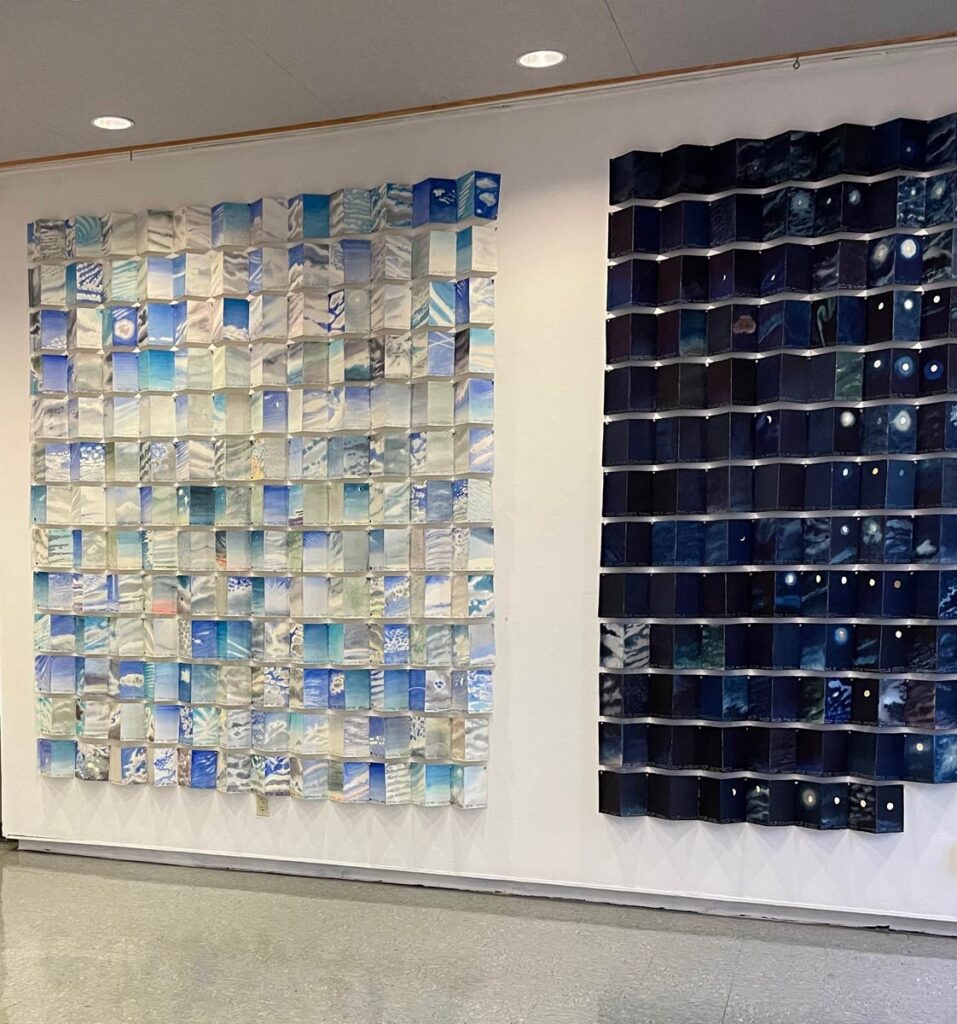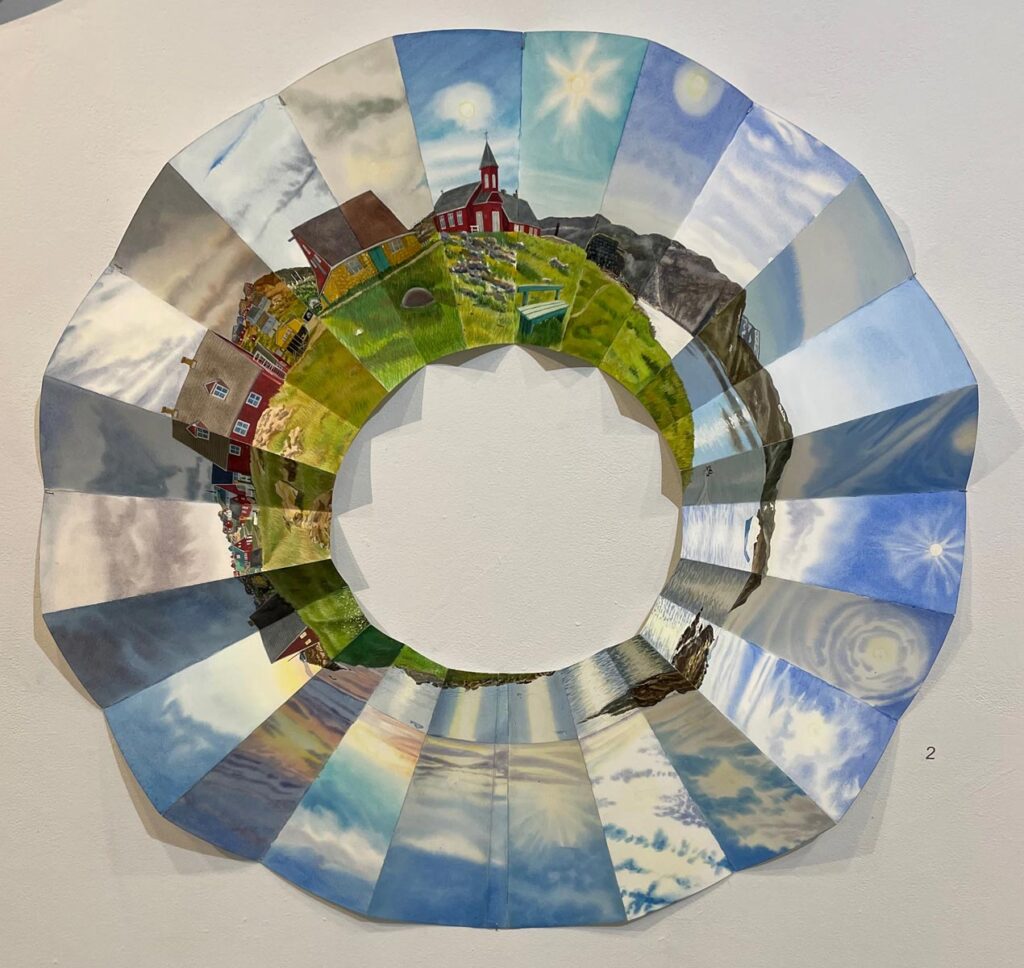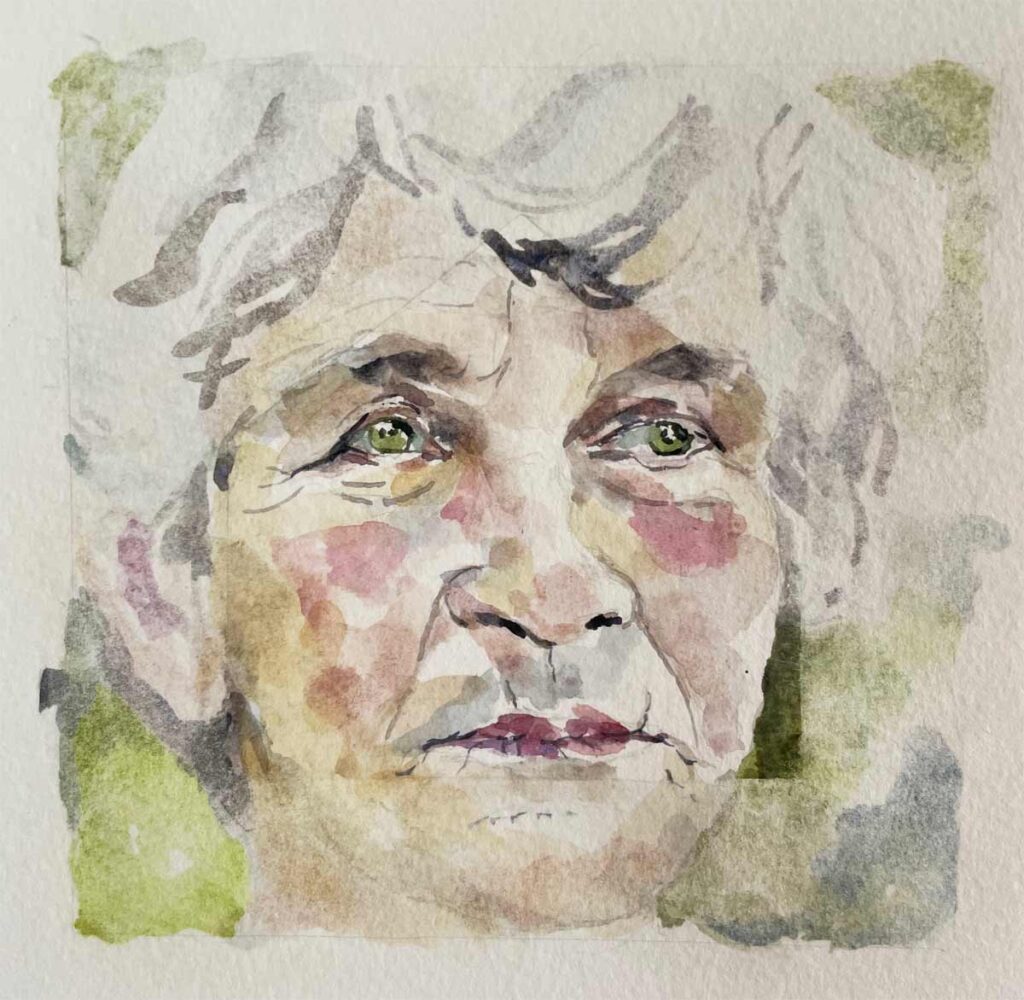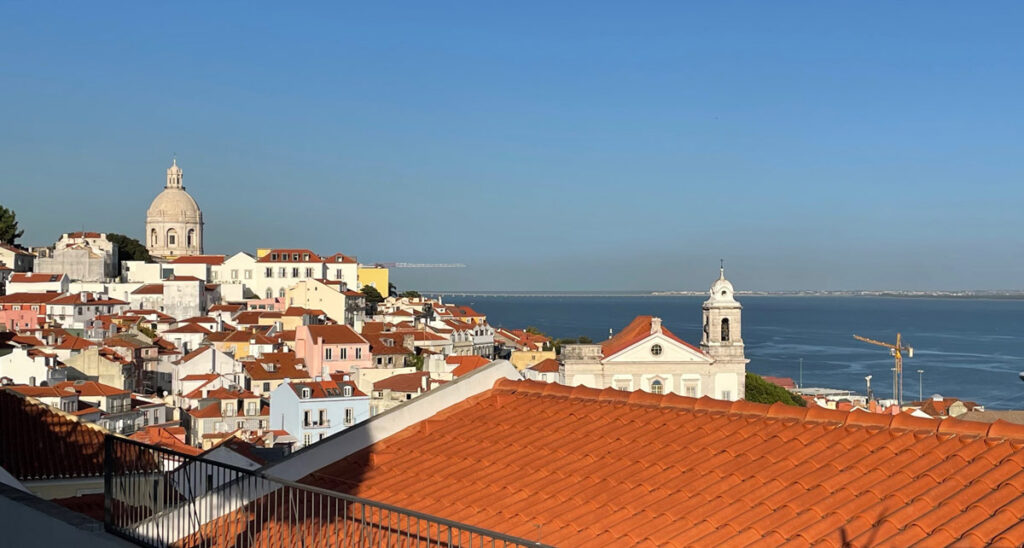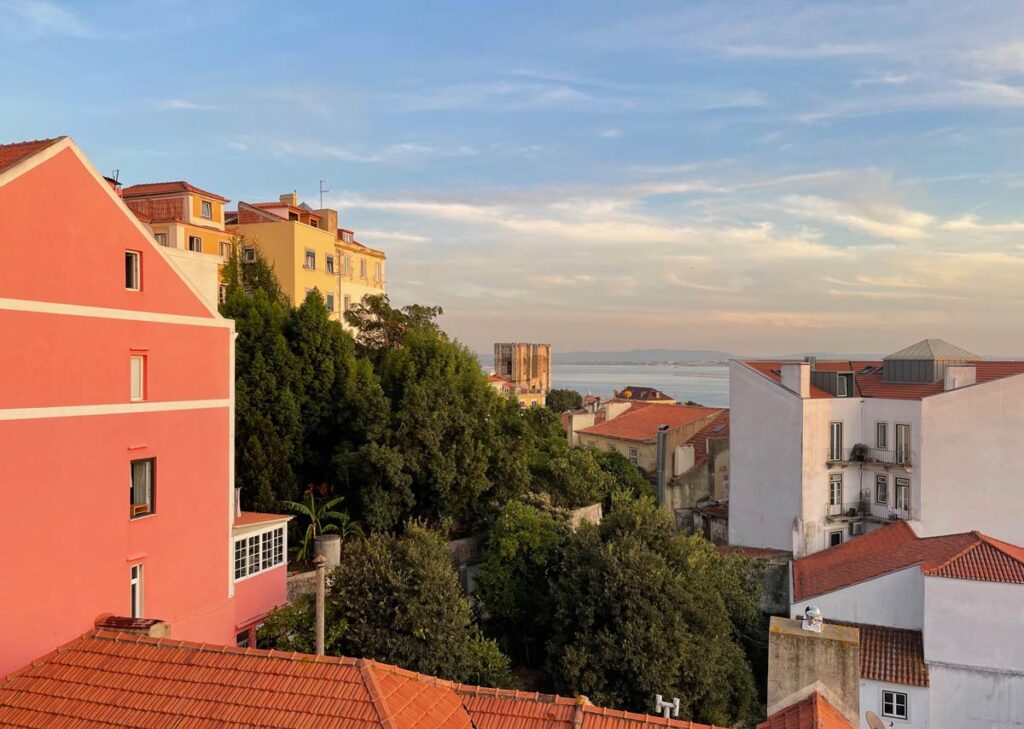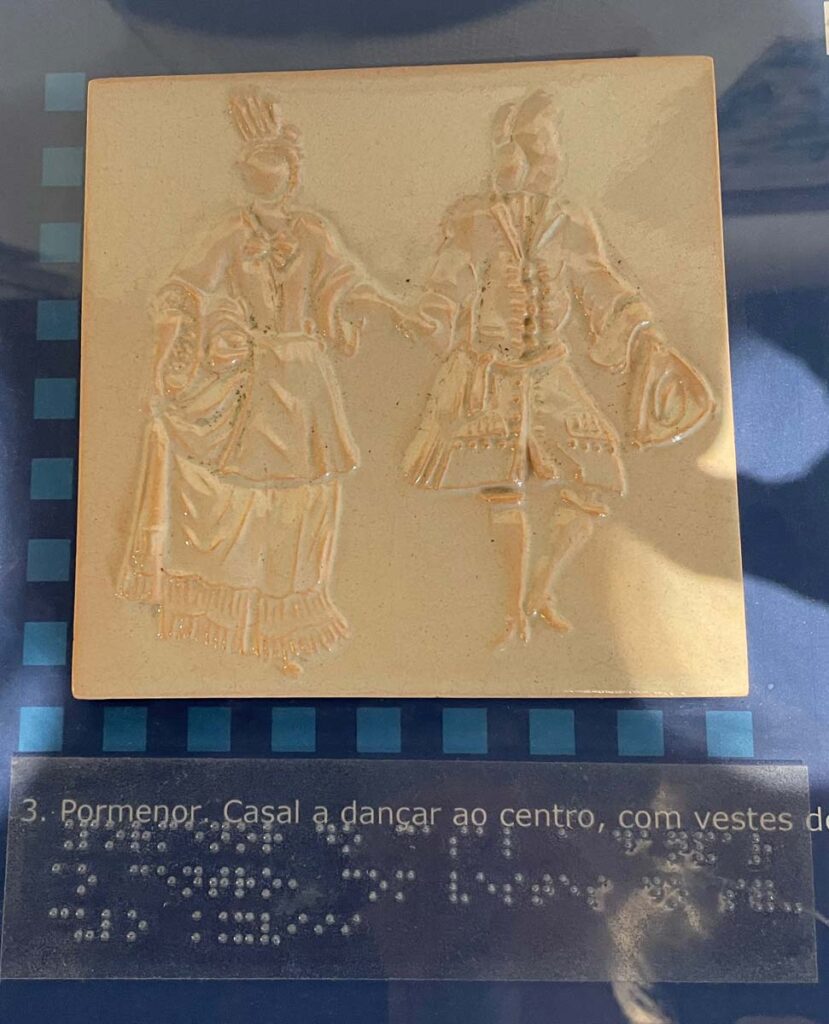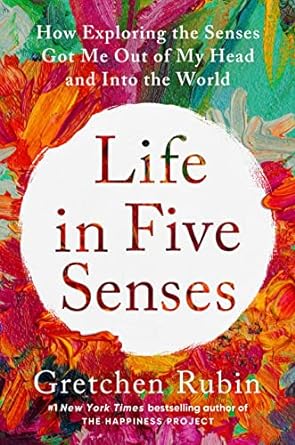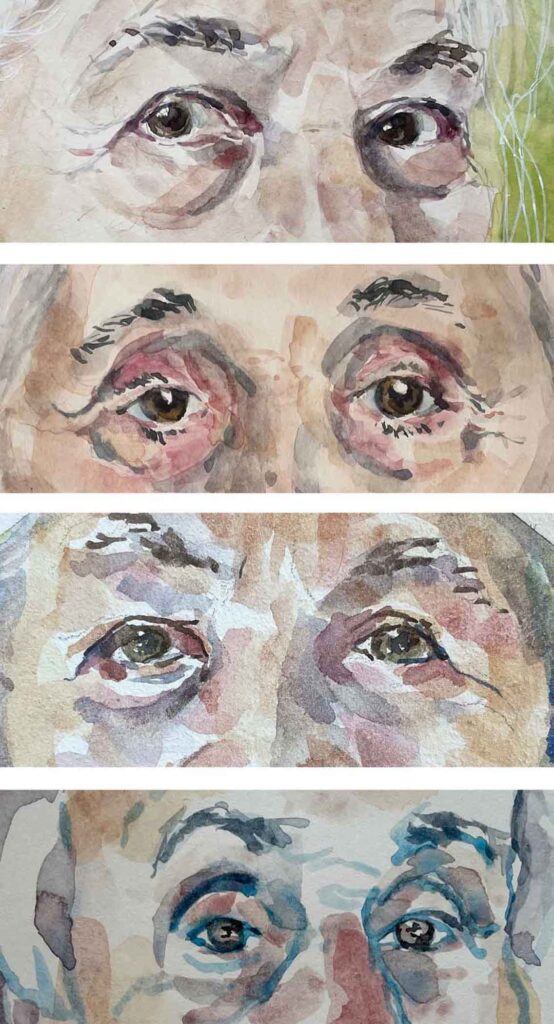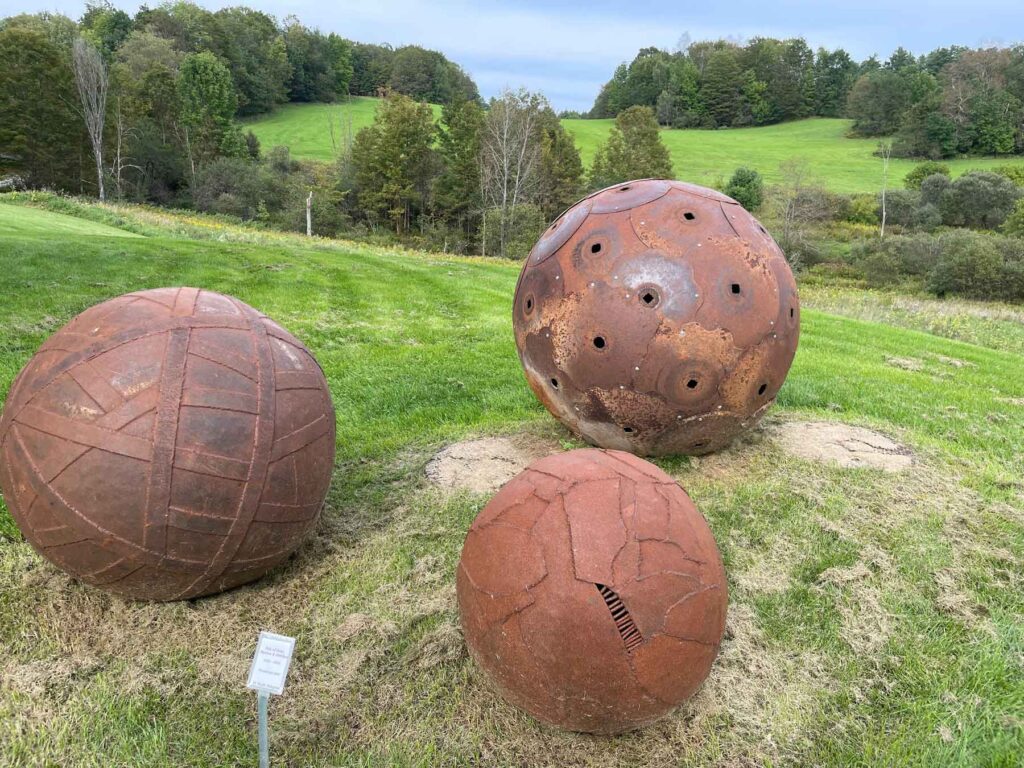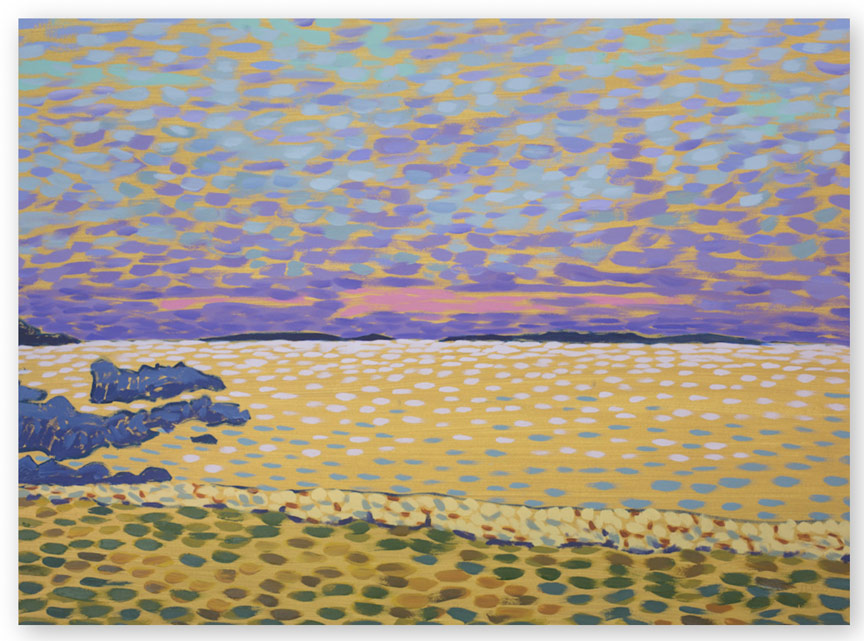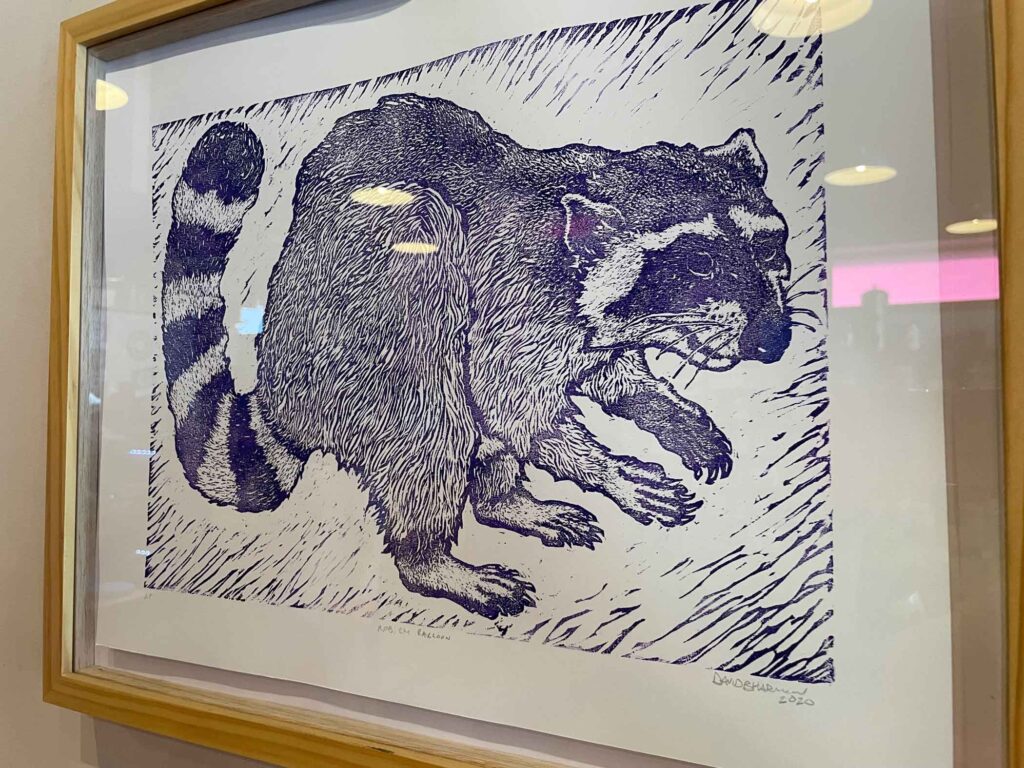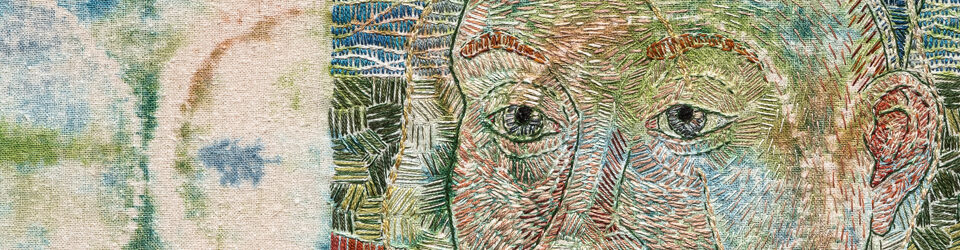
Looking to the right as you walk out of our driveway and head further up the hill, there is a sizable break between the trees. Framed by foliage on either side, it’s a window out into the distance — a lookout different from our own view, and a place from which to watch the weather come and go and to mark the changes, week by week, throughout the year.
Depending what sniffs are on Quinn’s mind and how anxious she is to keep moving, I often stand there for a moment, soaking up the colors and light of that particular time on that specific day. It’s never boring, no matter the season.
For the last couple of weeks we have begun to see evidence of the start of fall. It’s such an iconic moment to catch “the turn”, visible in the slightest touches of orange or red poking through all the green. It won’t be long until this hillside, except for the evergreens, is a fiery display of reds, oranges and yellows. Another episode of dog-walk TV, at its best.
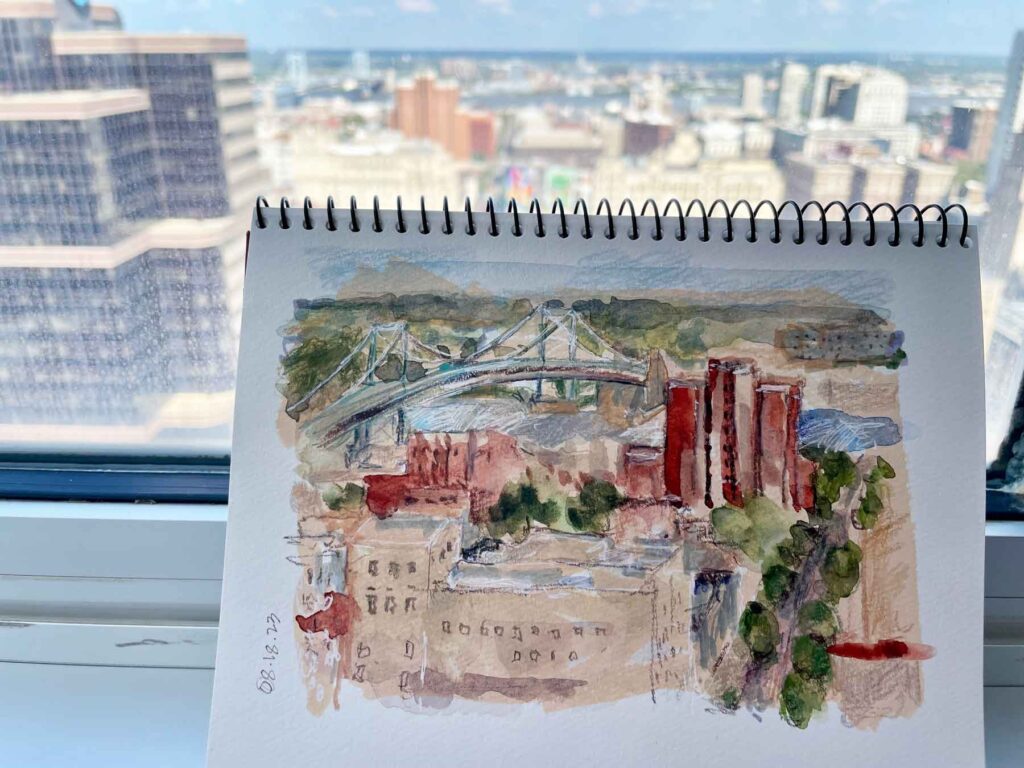
There’s nothing quite like a wedding to put a shine on the world. We’re just back from Philadelphia where family togetherness, perfect weather and a healthy dose of art made for a very special long weekend.
First stop: Blick.
In my world, a trip to Blick is a major highlight during any city visit. With my very patient husband and daughter in tow, I made a beeline there to stock up. There’s no match for wandering the aisles and fingering the goods in person, and it was nice to have a few new things to try out in the hotel room between planned activities.
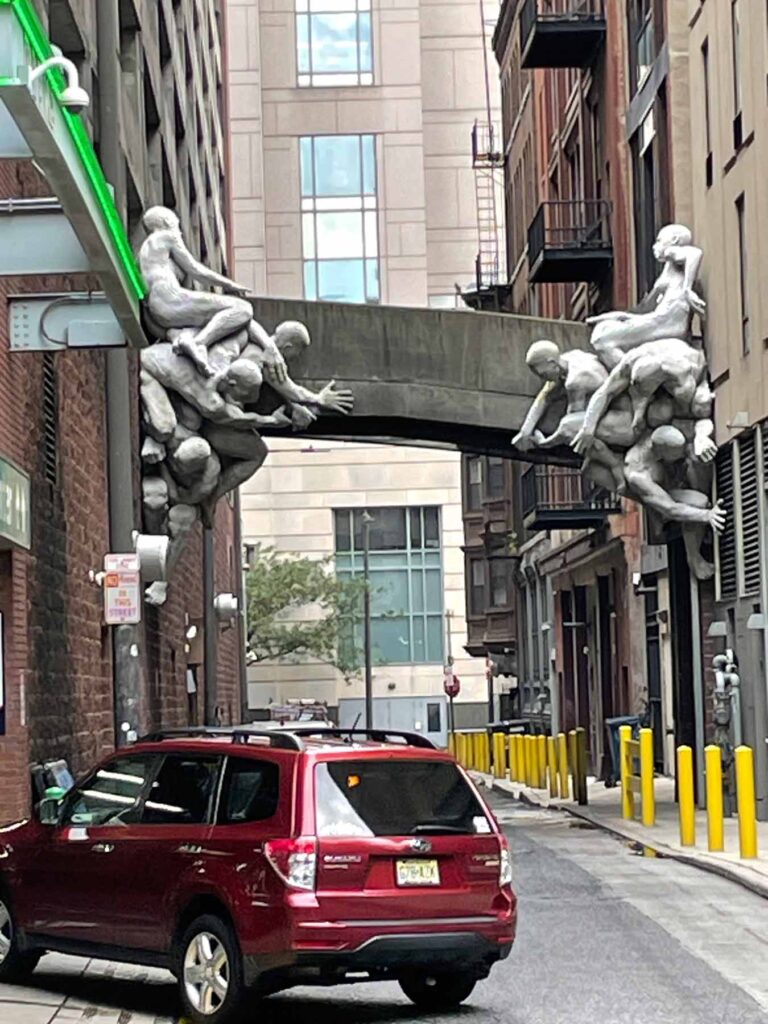
Nevermind the Phillies, Eagles, 76ers, & Flyers, IMHO one of Philly’s best claims to fame is that it’s home to one of the largest public art collections in the country. When we lived in Bucks County, 30 miles north of the city, life was too busy with raising kids to dive into the Philadelphia art scene as deeply as we might have – but what a pleasure to have a chance to enjoy it now.
The city’s 63 year old Percent for Art Ordinance mandates that any new City construction or major renovation project must include site-specific public art worth one percent of the total budget. So if you don’t have time to visit one of Philadelphia’s numerous stellar museums on your next trip, rest assured you’ll get an eyeful merely walking or driving from place to place.
Gratefully, this visit there was also time to check out a couple of museums.
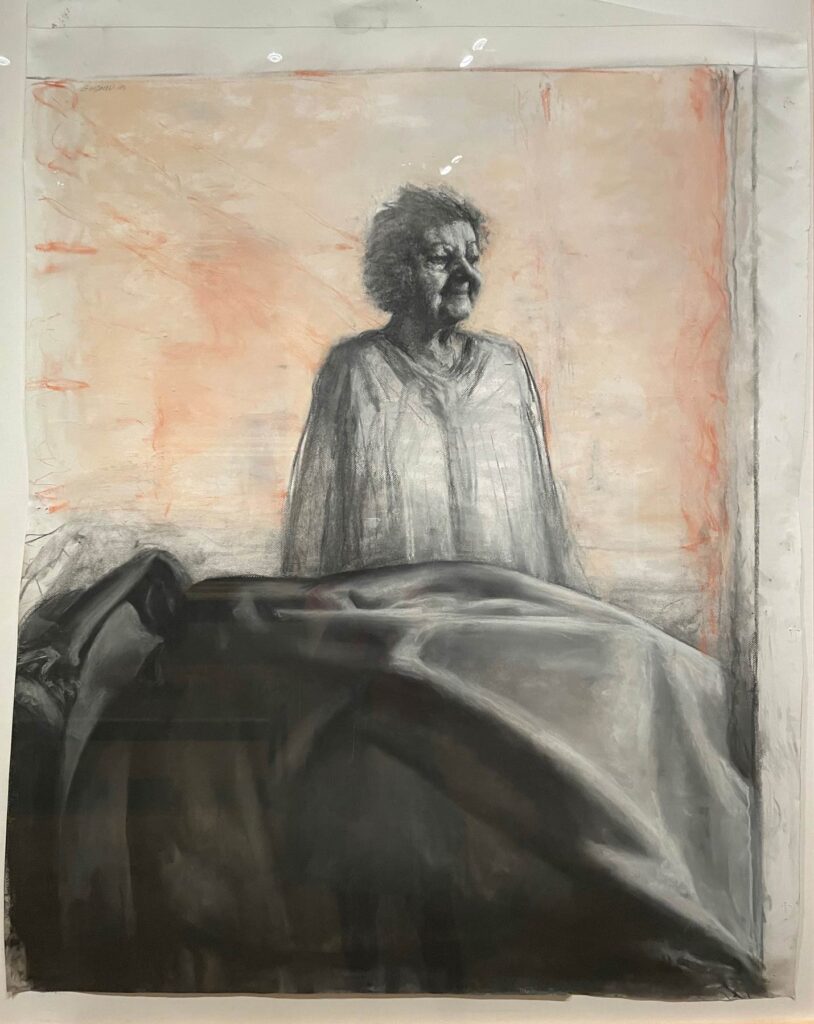
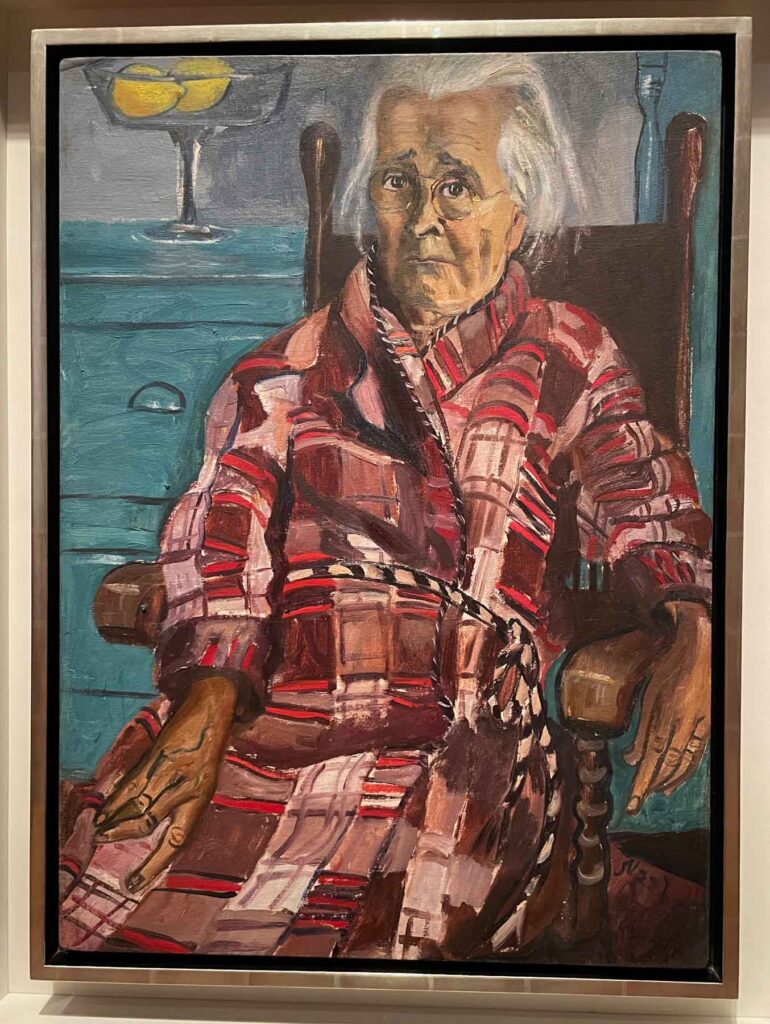
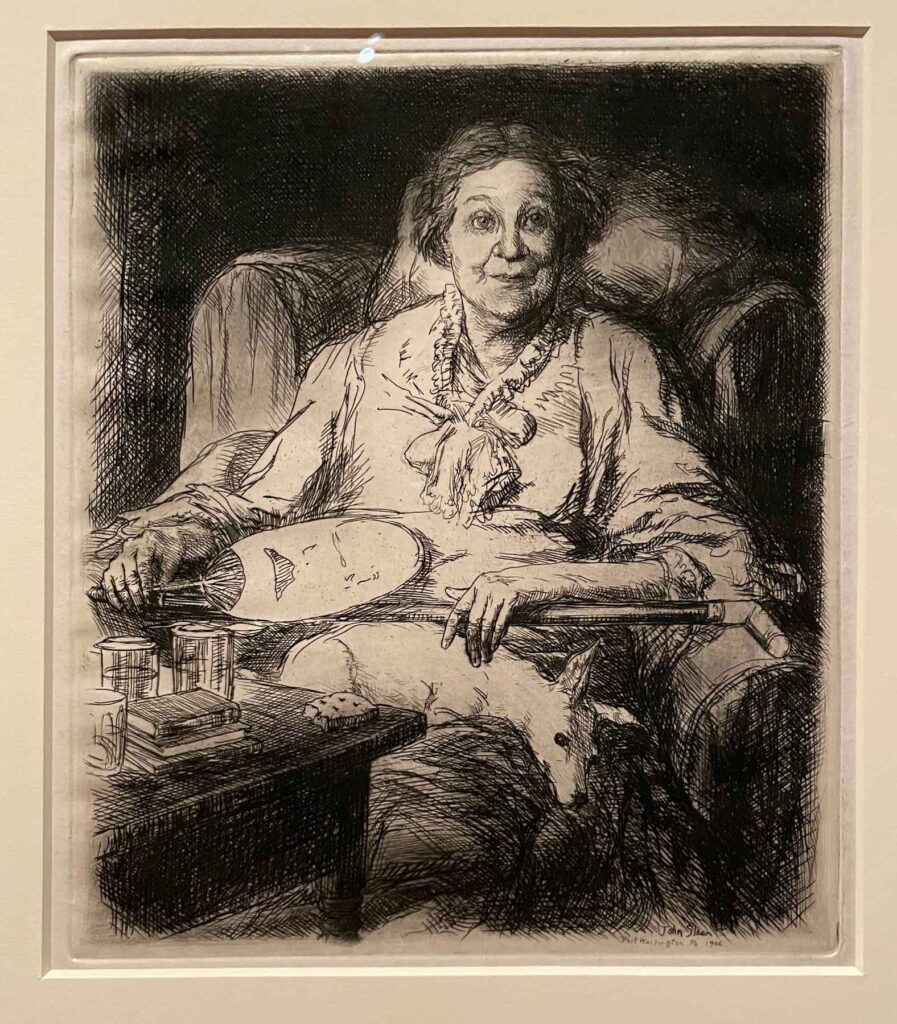
The Philadelphia Museum of Art is currently showing The Artist’s Mother: Whistler & Philadelphia, a fortuitous discovery considering my current direction.
In addition to Whistler’s cornerstone painting, “Arrangement in Grey and Black No. 1”(don’t miss this fun NPR piece about it), it was a treat to see other masters’ approach to portraying elder women. The emotional element between artist and sitter adds a bonus layer to each work.
If you’ve never seen Whistler’s painting in person, you should. She has the loveliest rosy cheeks and, much like the Mona Lisa, appears so much warmer than any reproduction seems able to convey.
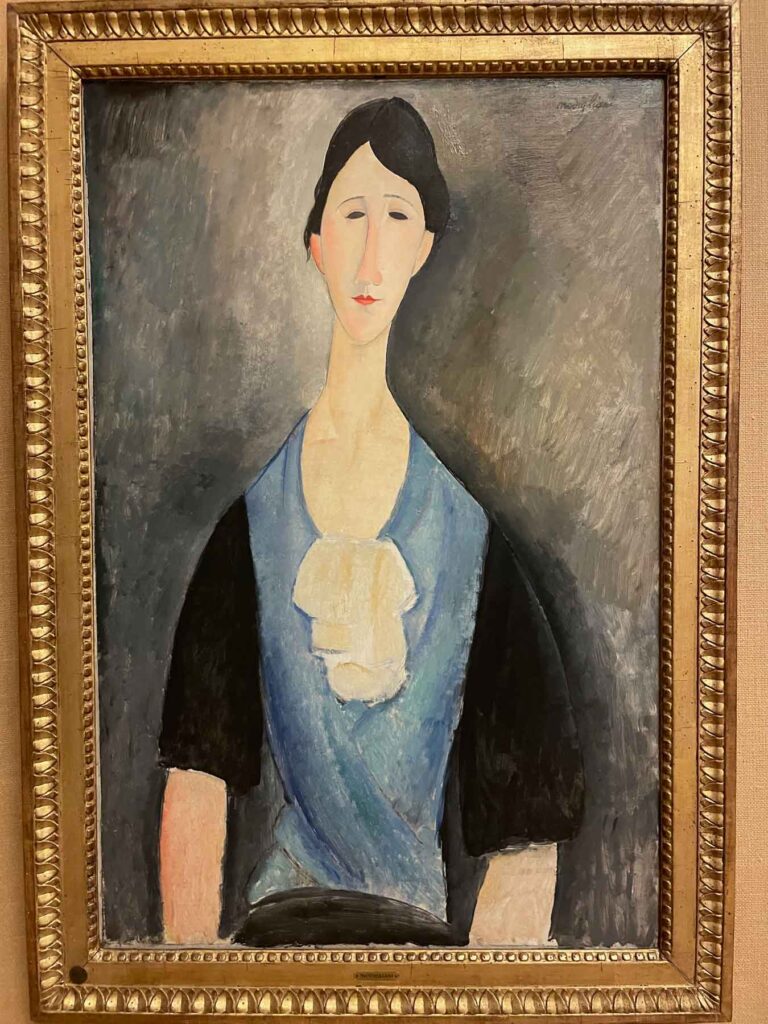
And to cap it all off, my sister-in-law arranged for a fantastic docent-led tour for interested wedding guests at The Barnes Foundation the day of the big event. Founder Albert C. Barnes was a bit of an odd duck, as is evidenced by the way he insisted his collection be displayed into perpetuity. But there is no denying that the collection is spectacular, and it’s interesting to take into consideration his aims and perspective as you wander through the galleries. There were plenty of stunning portraits to absorb among the many other treasures.
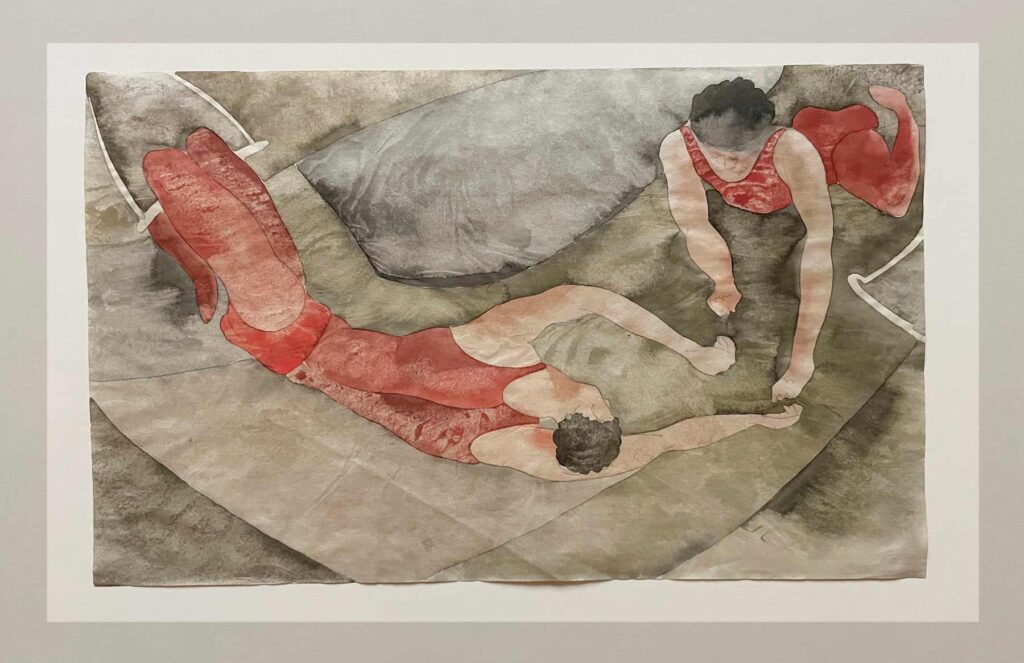
And on a slightly different note, I was grateful for the chance to revisit this small watercolor by Charles Demuth – a painting that has remained a favorite in memory from my last visit to The Foundation over a decade ago.
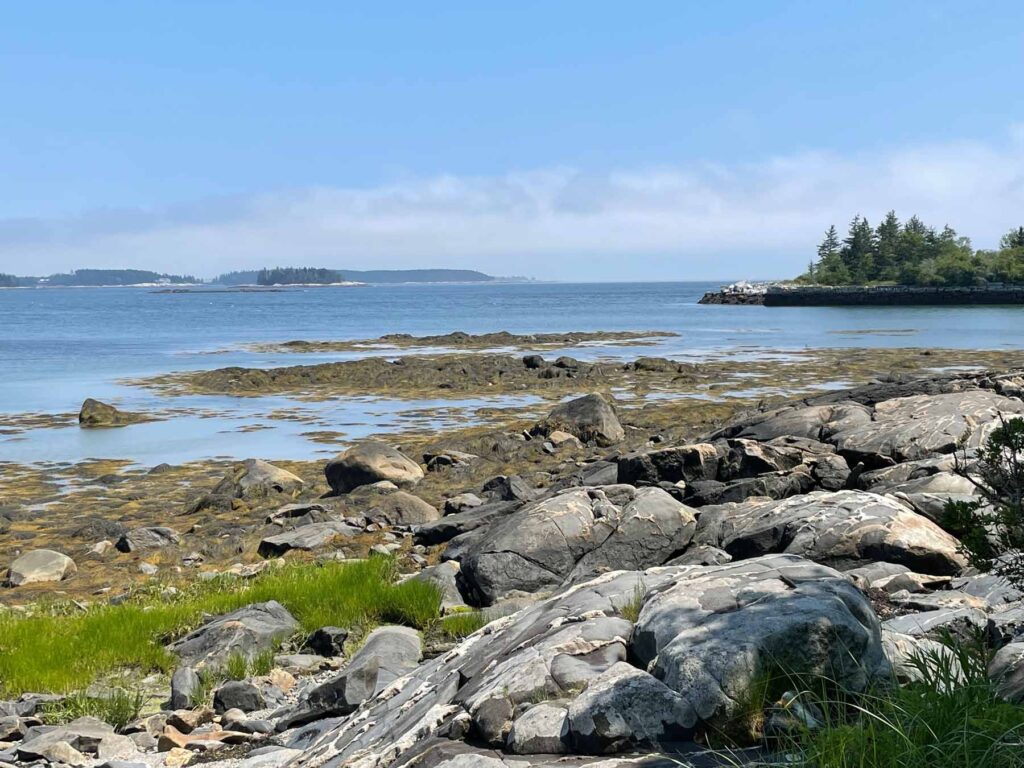
I’m not sure how we did it, but when we planned this year’s trip to Maine last winter we somehow landed on what might have been the best week of the summer; we only had to pay one day of rain tax. Considering what a soggy season it has been across New England, that’s really saying something.
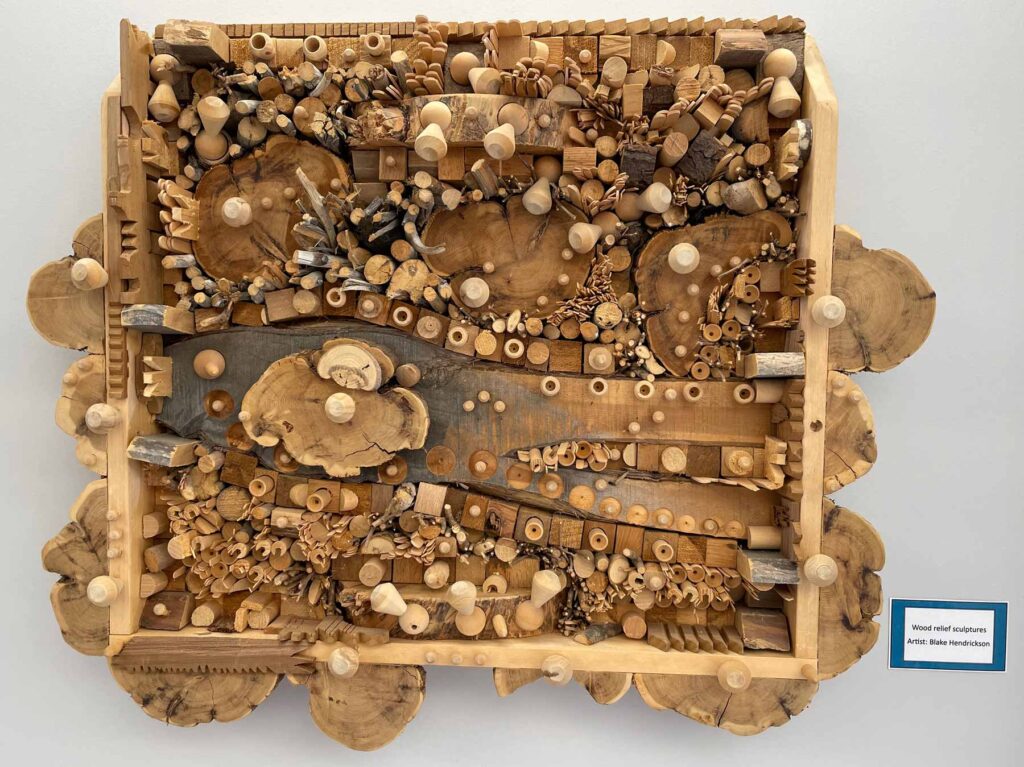
Before we leave, I usually have 1 or 2 specific shows in mind I want to see, but it never fails that unexpected creative treats pop up along the way. Here’s a bit of a tasting menu of what caught my eye.
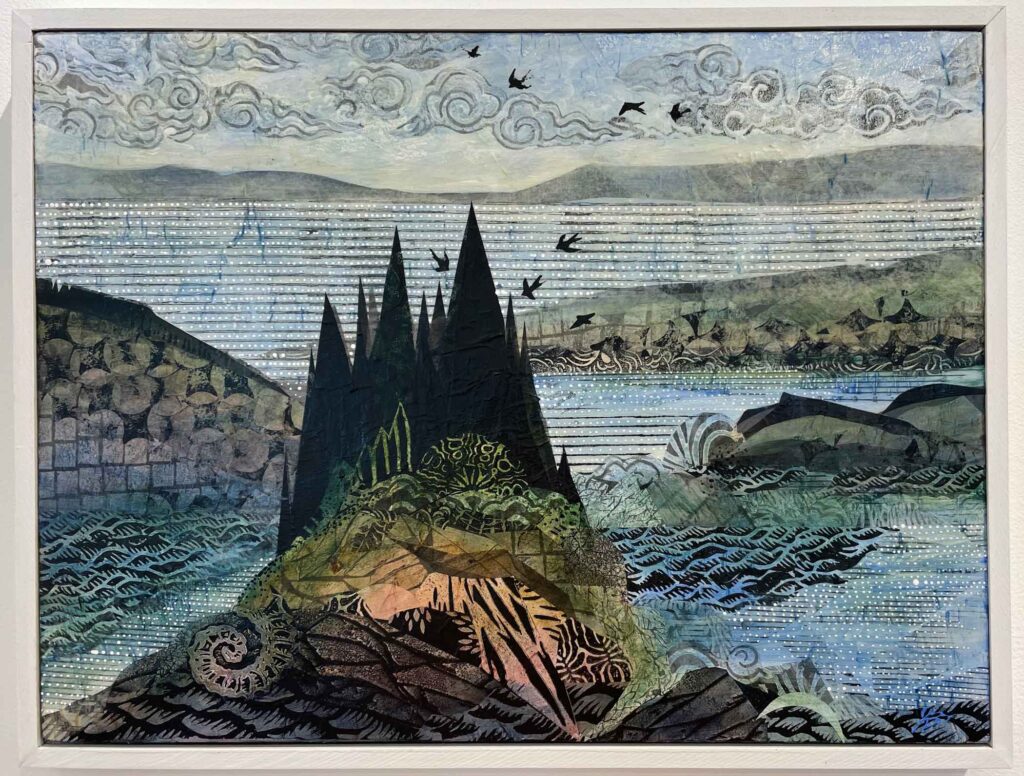
Archipelago is a Rockland art & craft gallery filled with the work of Maine artists. Its mission is to support creative island and working waterfront communities. Currently, they are highlighting the work of Kelly Desrosiers: acrylic collage that looked (to me) like fabric.
Bird Island by Kelly Desrosiers, Acrylic Collage
The Farnsworth Museum is a gem that always has something terrific on view.
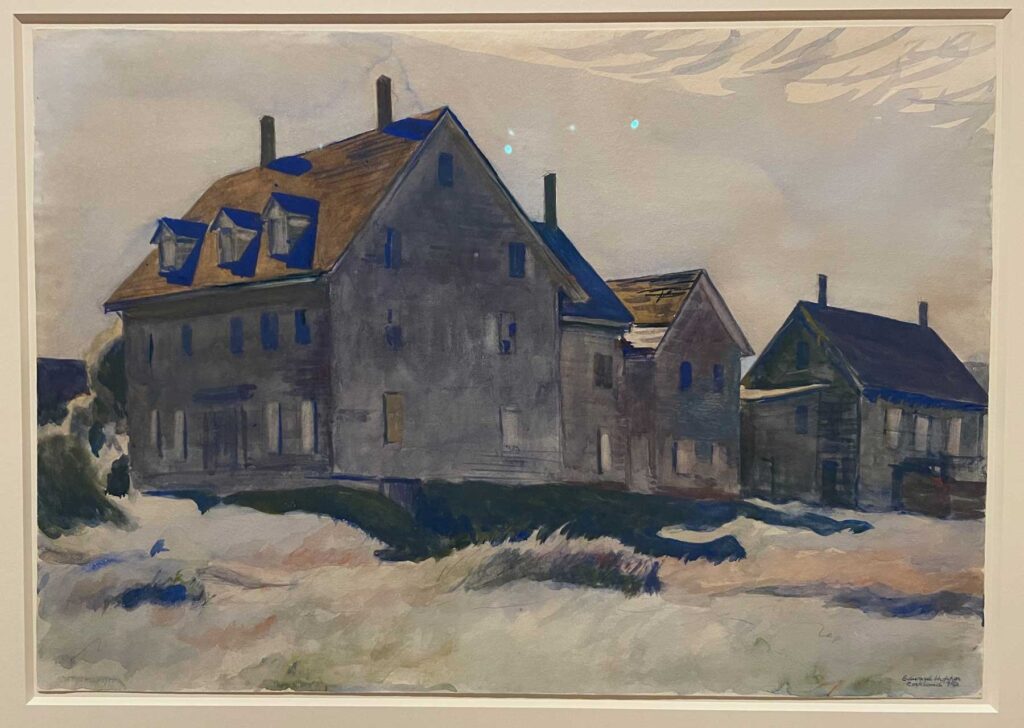
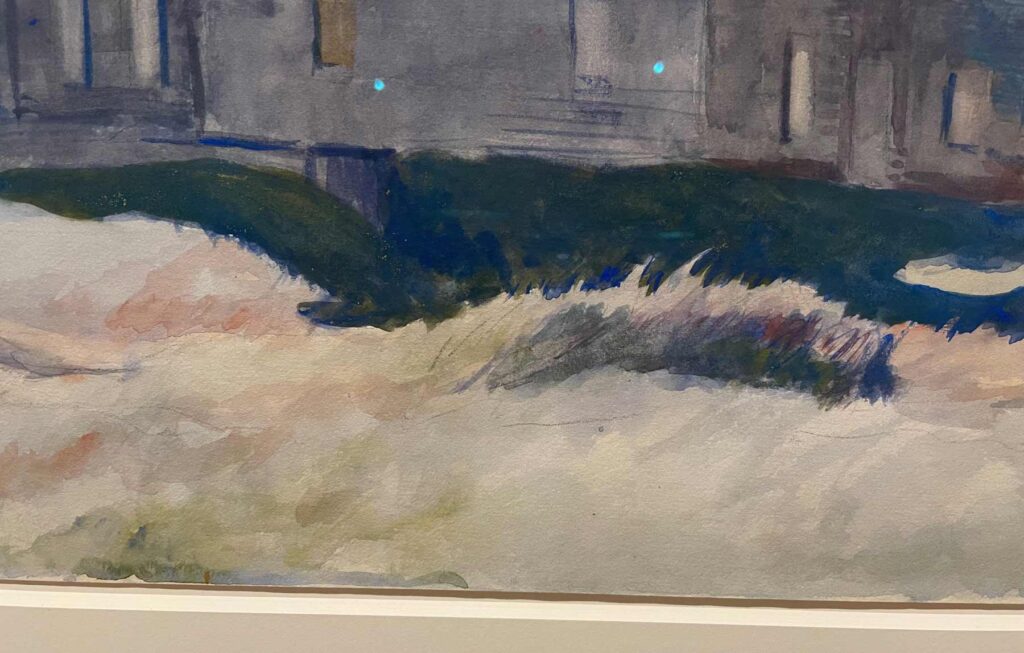
Edward Hopper, Haunted House 1926, Watercolor, gouache, pastel and graphite on paper
One of their current exhibits, “Edward Hopper and Andrew Wyeth: Rockland, ME”, blew me away. Beautifully curated, it finds strong parallels between works of two very different artists, made decades apart. The stars of the show are their subjects: Rockland, as a place, and the physical apparatuses of its historic industries. The overlap of the artists’ interpretations were both surprising and delightful.
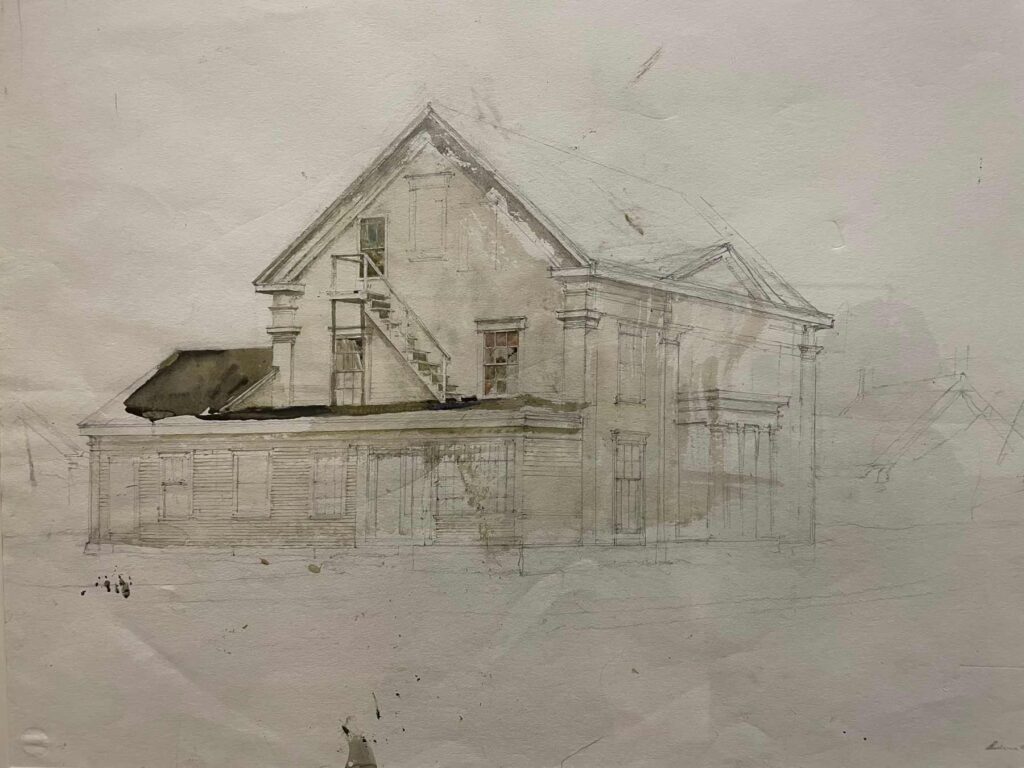
Andrew Wyeth, Untitled (Snow House), 1983, Watercolor on paper
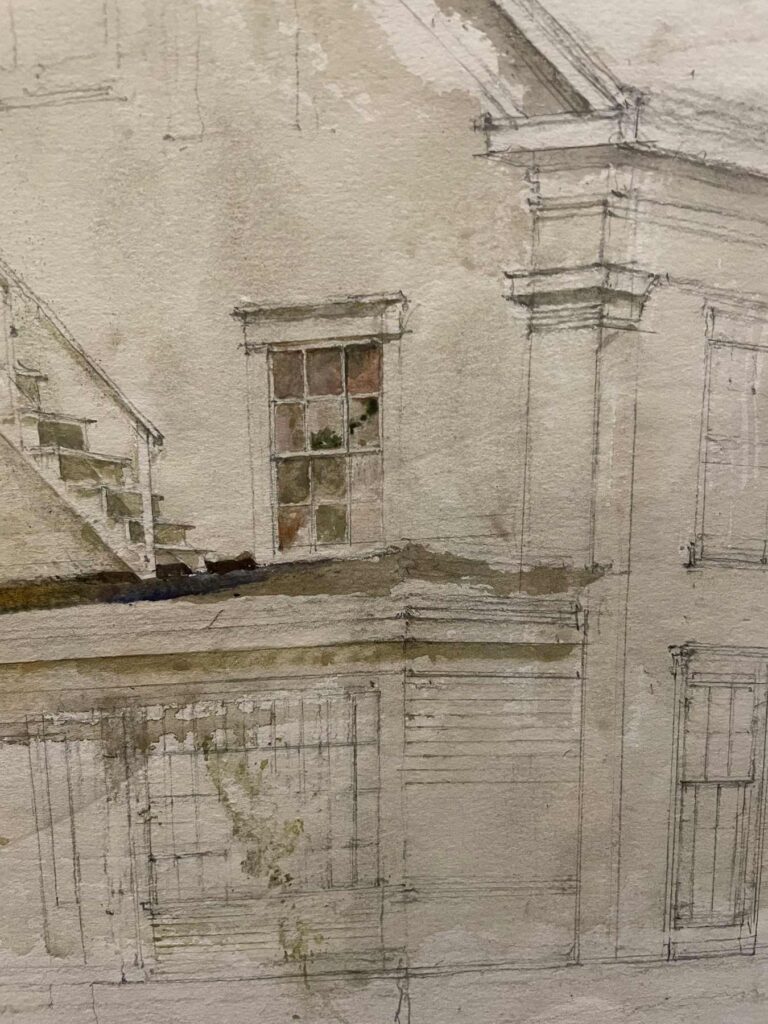
I always return to the fact that details are my kryptonite.
There is a world unto itself in the variation of color in each pane of glass Wyeth painted in this window.
This summer I’ve been experimenting in my sketchbook with layering assorted media, including gouache and soft pastels. So it was a treat to see how Hopper incorporated a variety of materials in this lyrically beautiful passage of grass in the foreground of “Haunted House”.
A couple of other gems at the Farnsworth I couldn’t resist sharing:
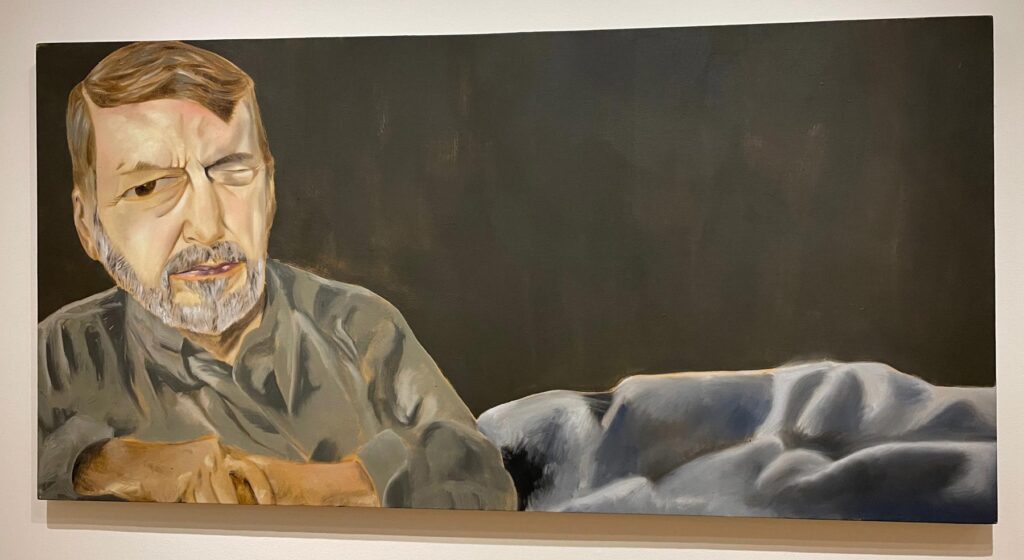
Francesco Clemente, Robert Creeley, 2002, Oil on linen, Gift of the Alex Katz Foundation Any and every portrait is intriguing to me these days.
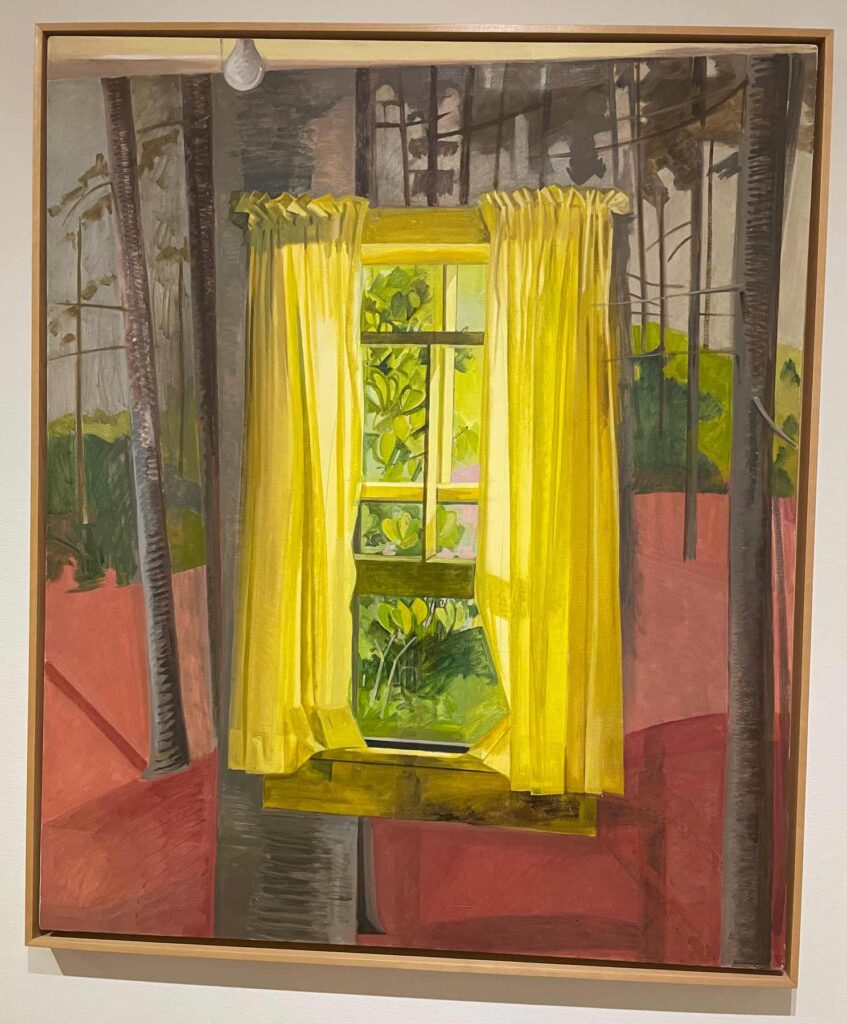
Lois Dodd, The Painted Room, 1982, Oil on linen The ambiguity of Dodd’s depiction of this room’s painted mural, framing the window, framing the real outdoors, sets the stage for all sorts of imaginings.
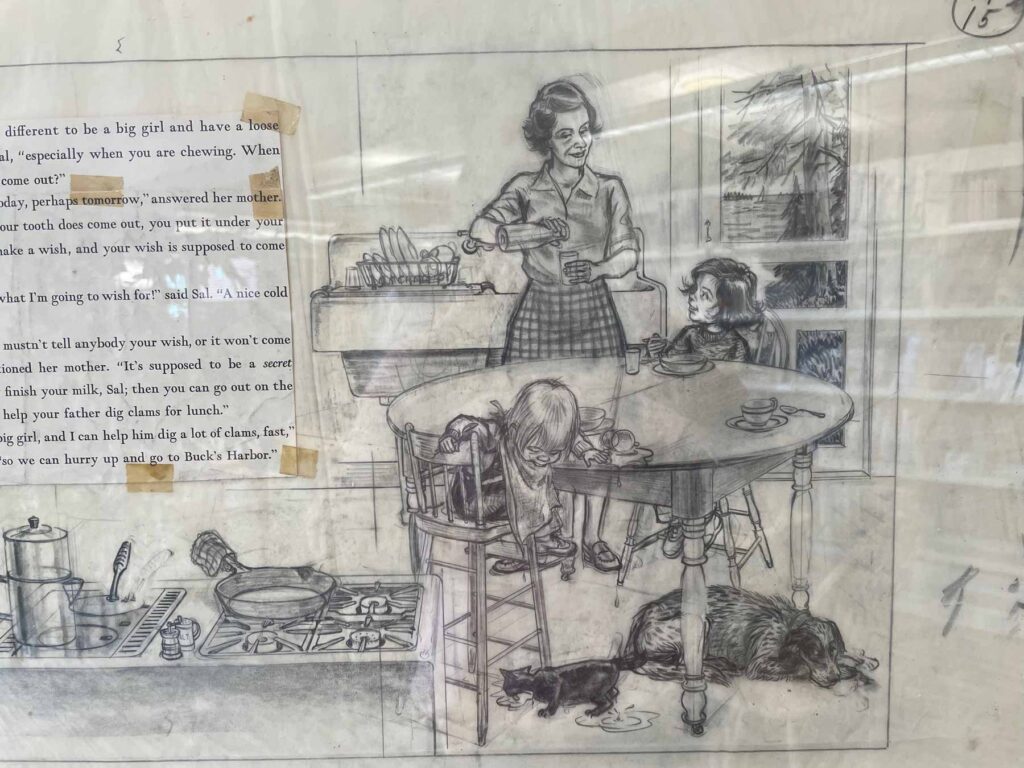
I was lucky that one of my Maine buddies alerted me in advance to the (Brunswick) Curtis Memorial Library’s exhibition of Robert McCloskey’s original illustrations of some of his most iconic and best loved books.
Forgive the reflections.
Most kids from Maine know all about Blueberries for Sal. For those of us who grew up in the state and summered in an old-fashioned, down-to-earth Maine cottage on the coast (not the fancy McMansion-type dwellings built by people from away), everything about this book is comfortingly familiar (except the bears).
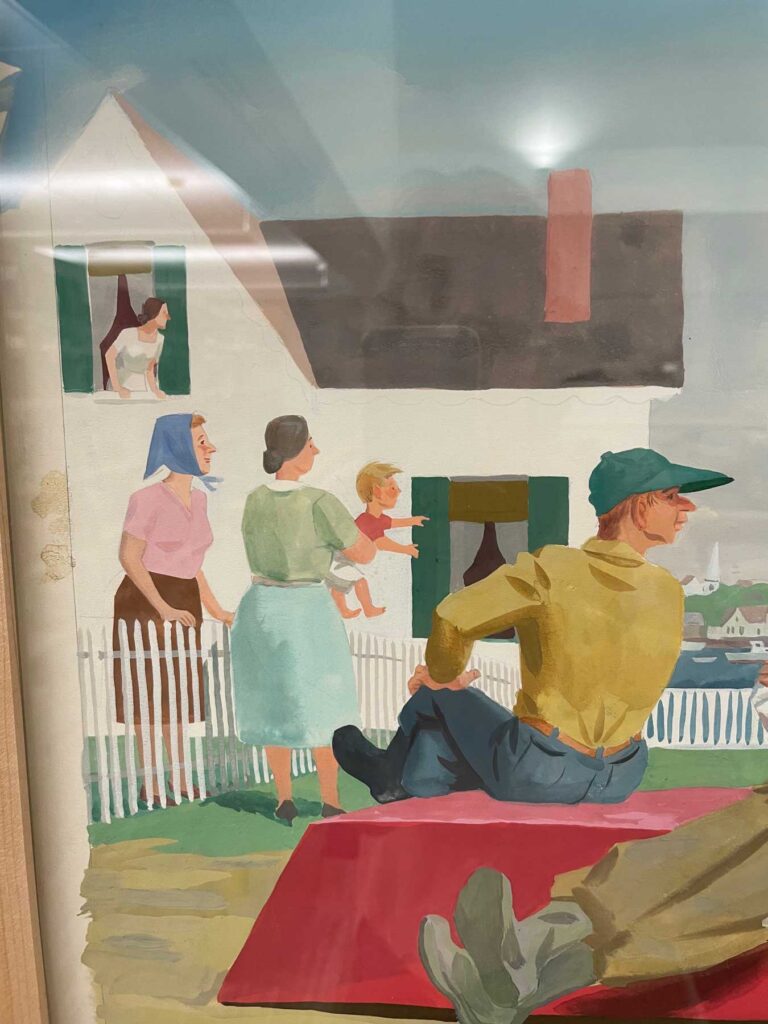
When I look at art, it’s invariably with an eye toward what I can learn from someone else’s expertise. This detail from one of the illustrations in McCloskey’s Burt Dow, Deep-Water Man is a masterclass on being concise without sacrificing detail.
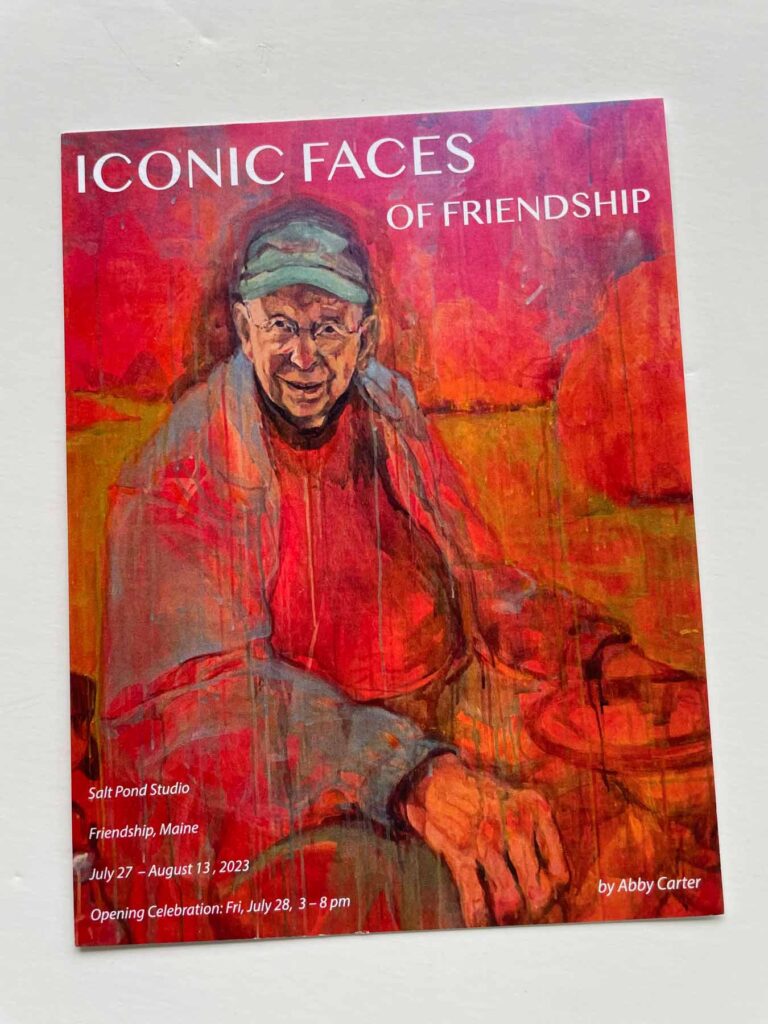
And finally, the cherry on top of the vacation cake was discovering this local exhibit of portraits by Abby Carter. Beautiful work honoring community.
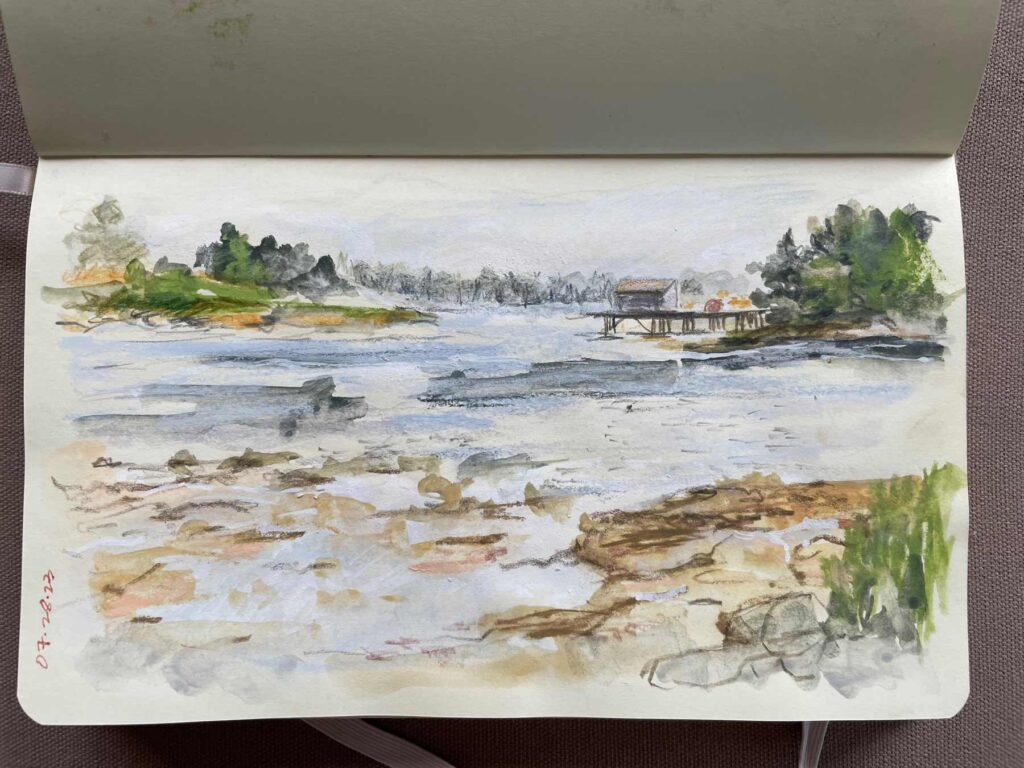
One last Maine note: There’s always time around the edges to do a bit of sketching. I’ve been very happy to learn that soft pastels can be wetted and painted like watercolors.
I’m taking a bit of a respite this week to recharge and reinvigorate. But first, an update.
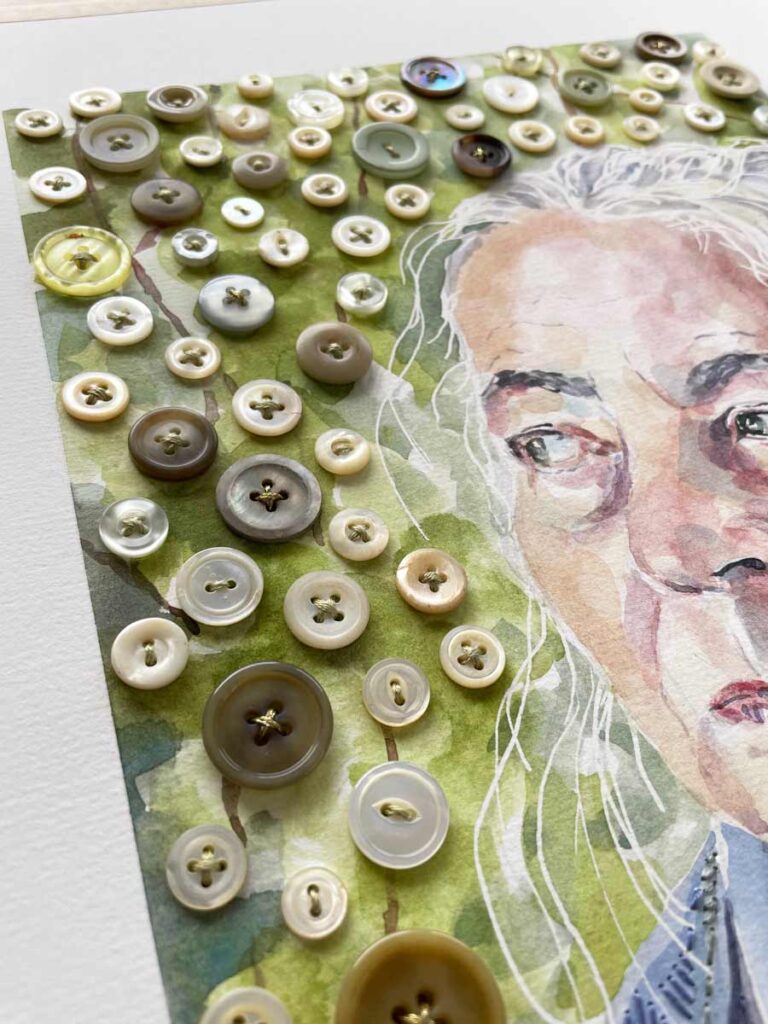
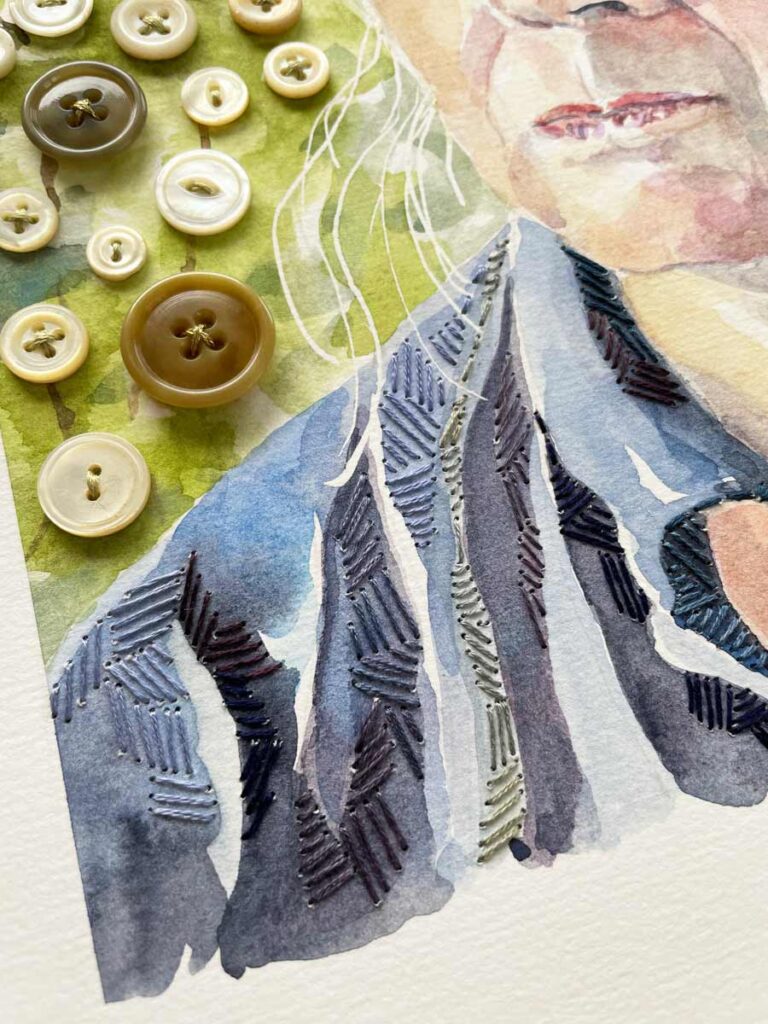
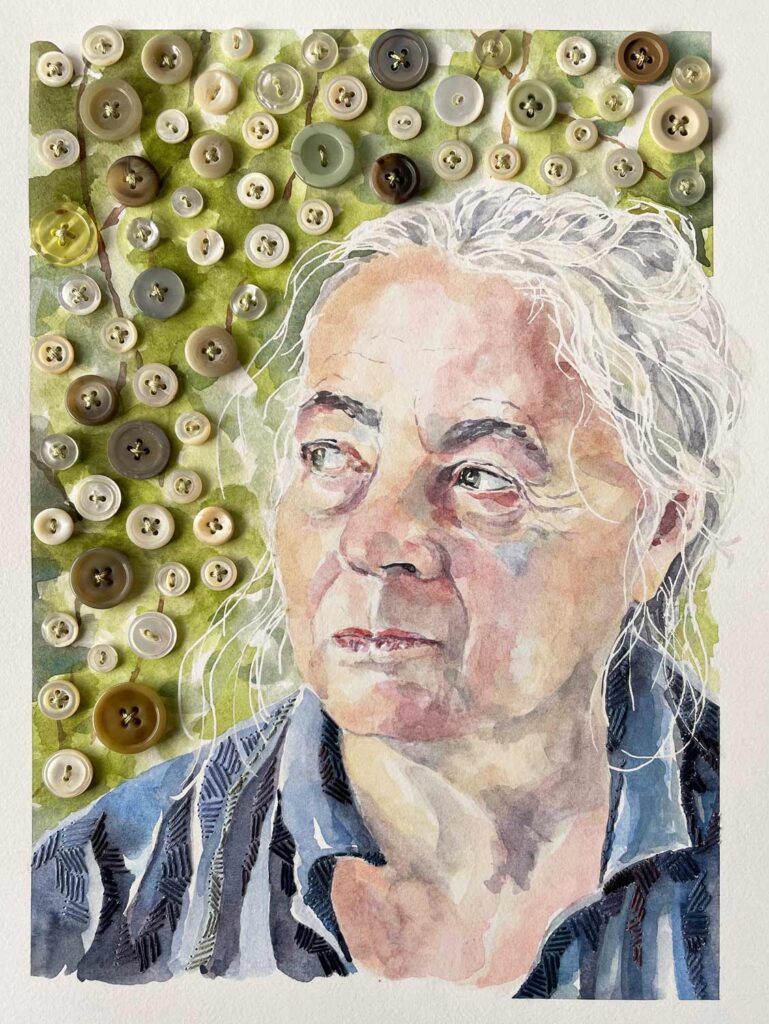
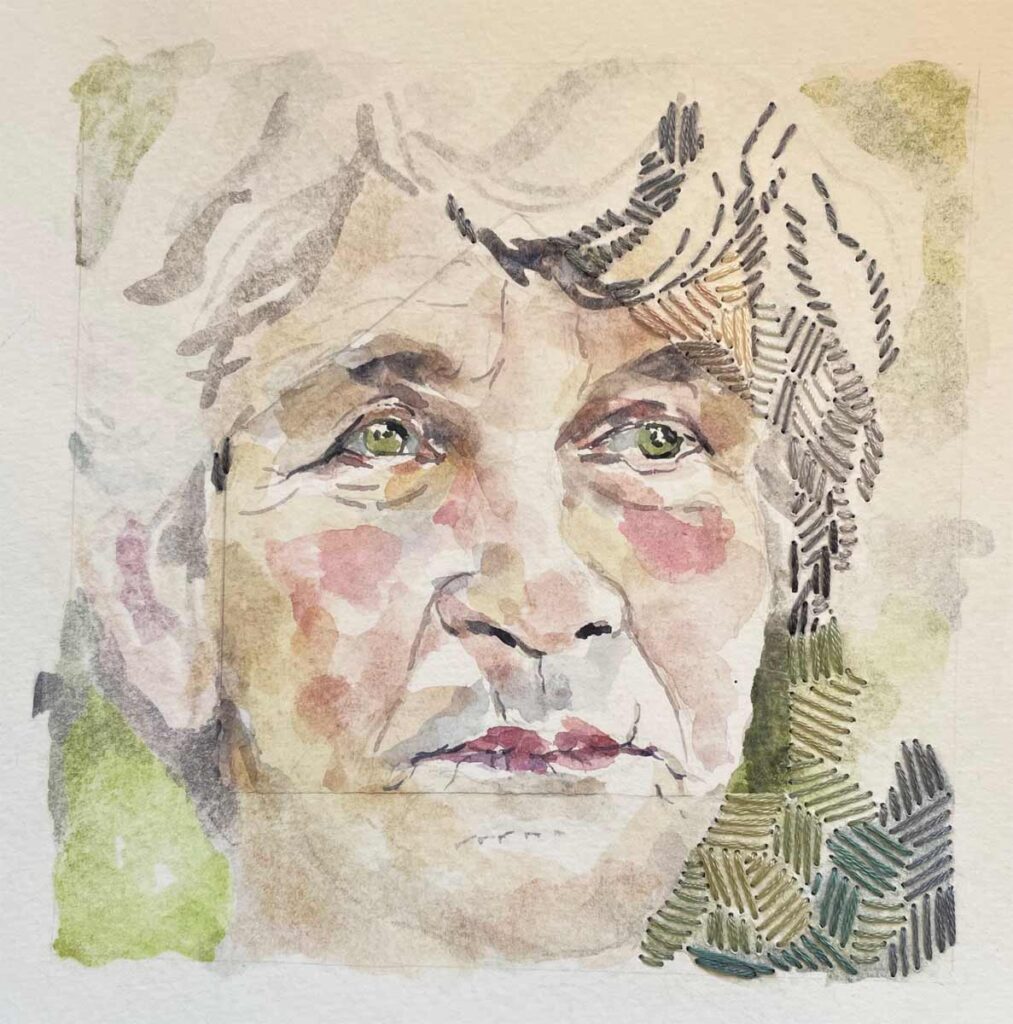
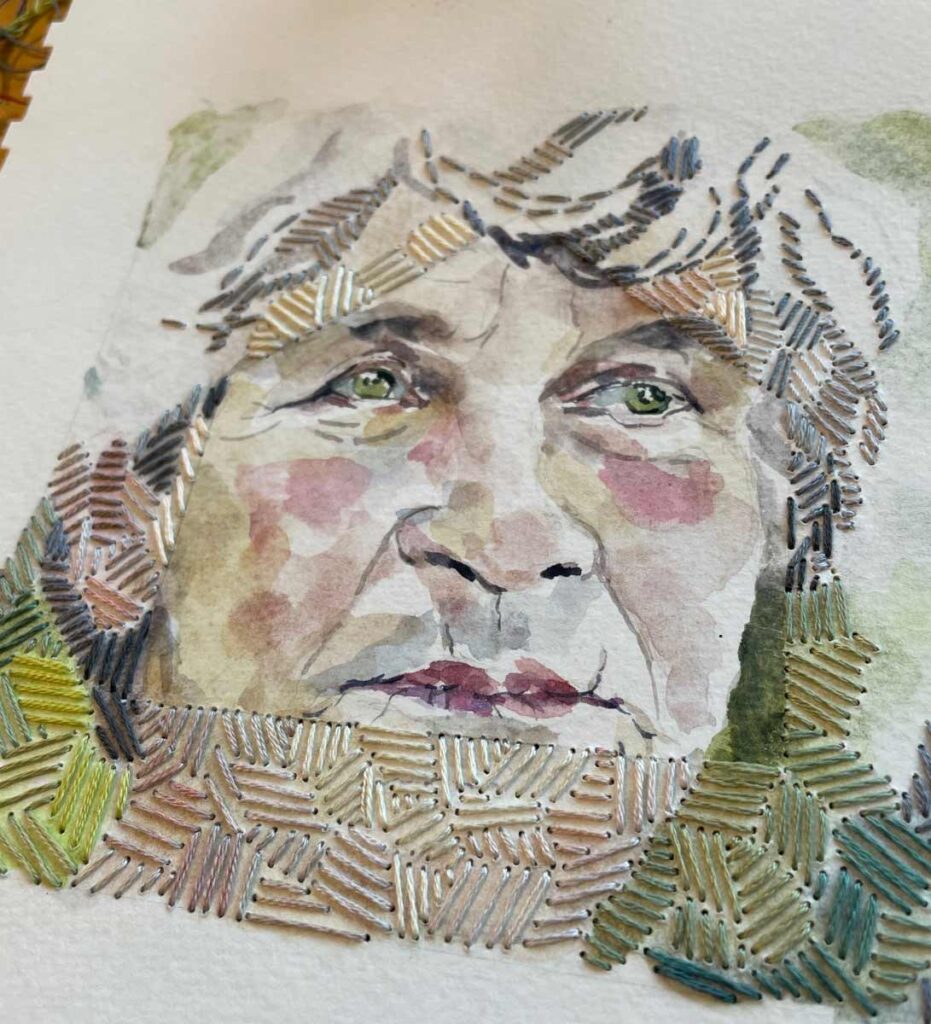
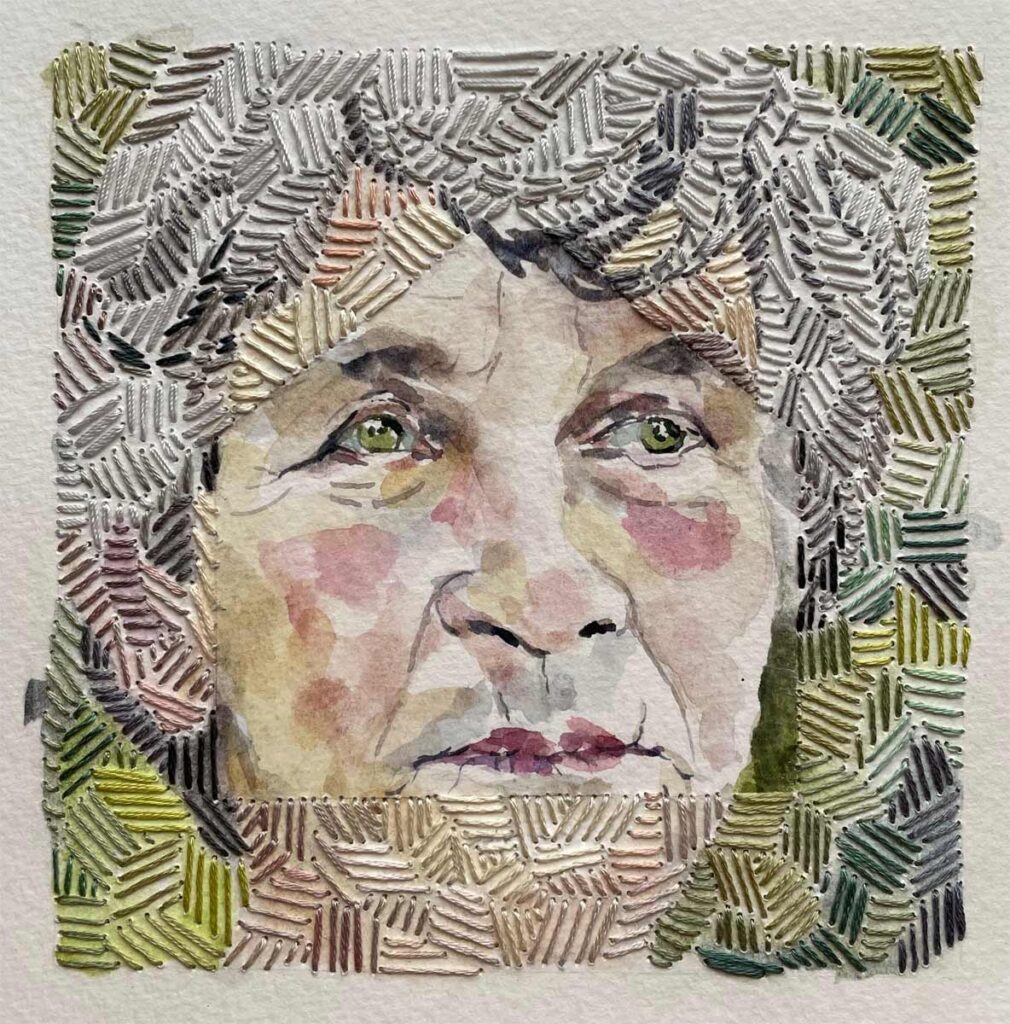
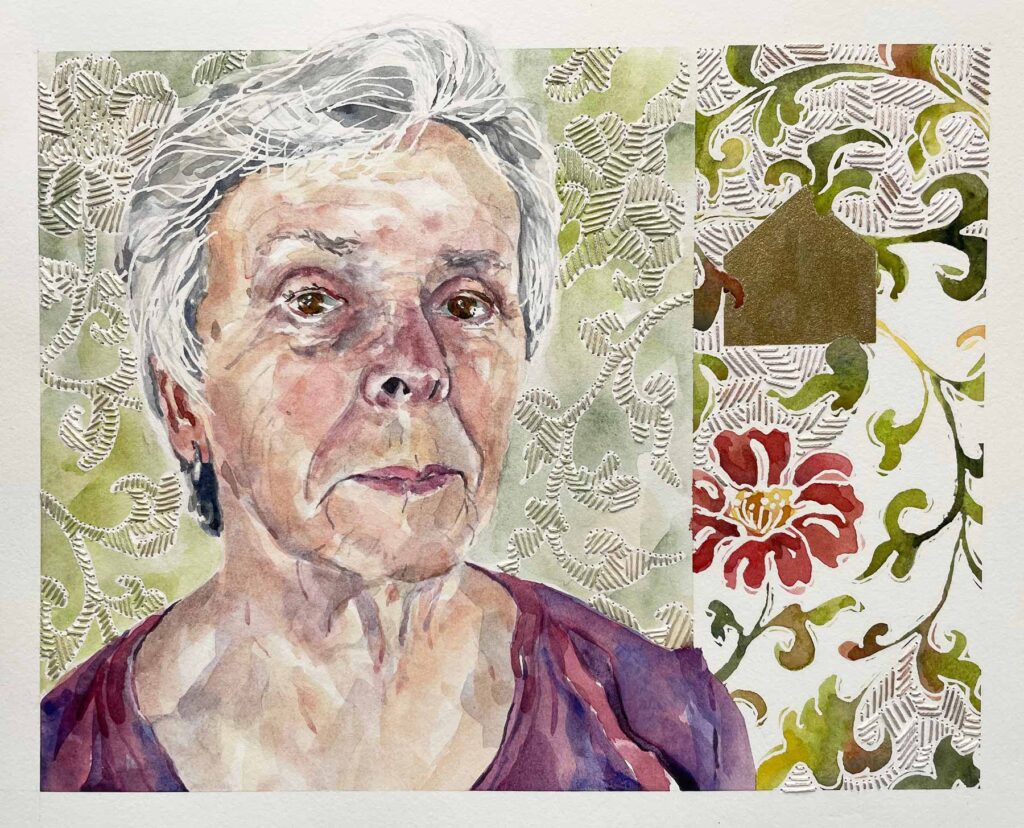
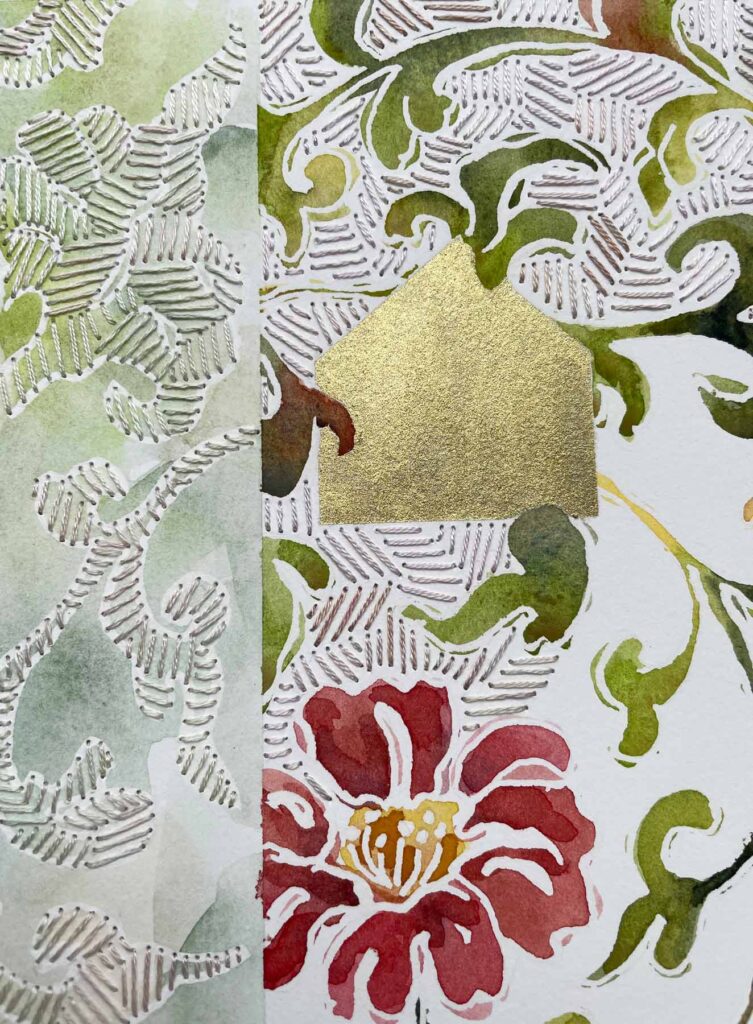
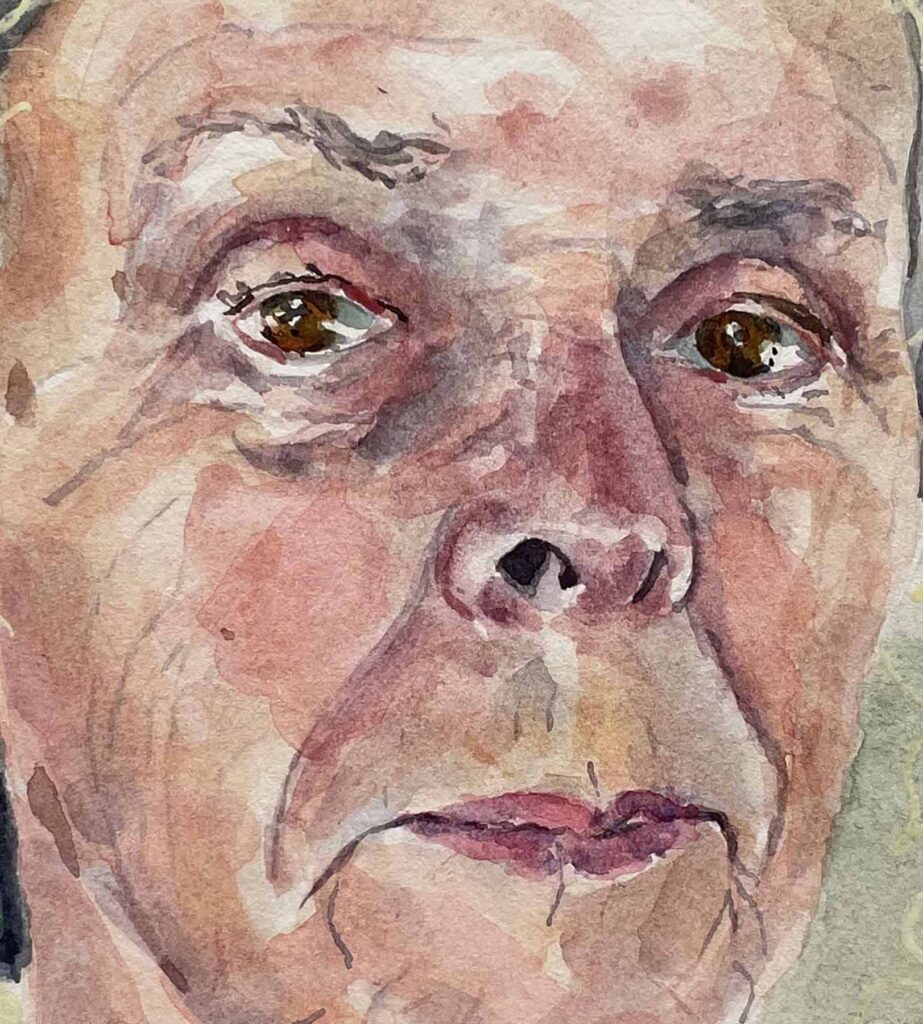
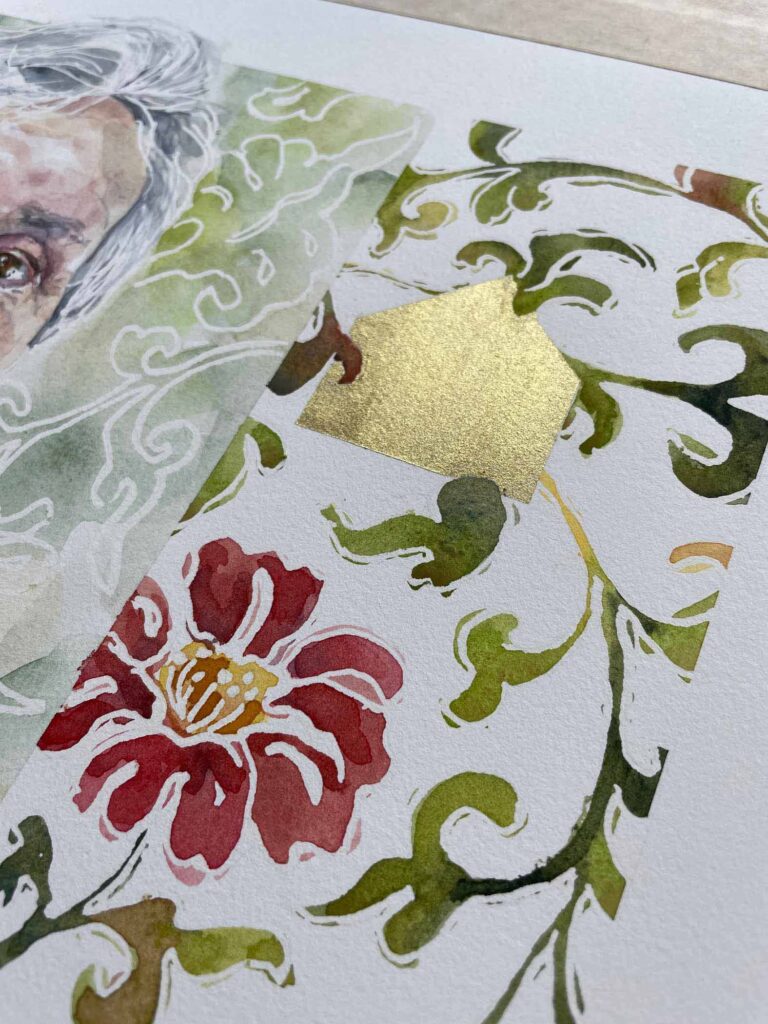
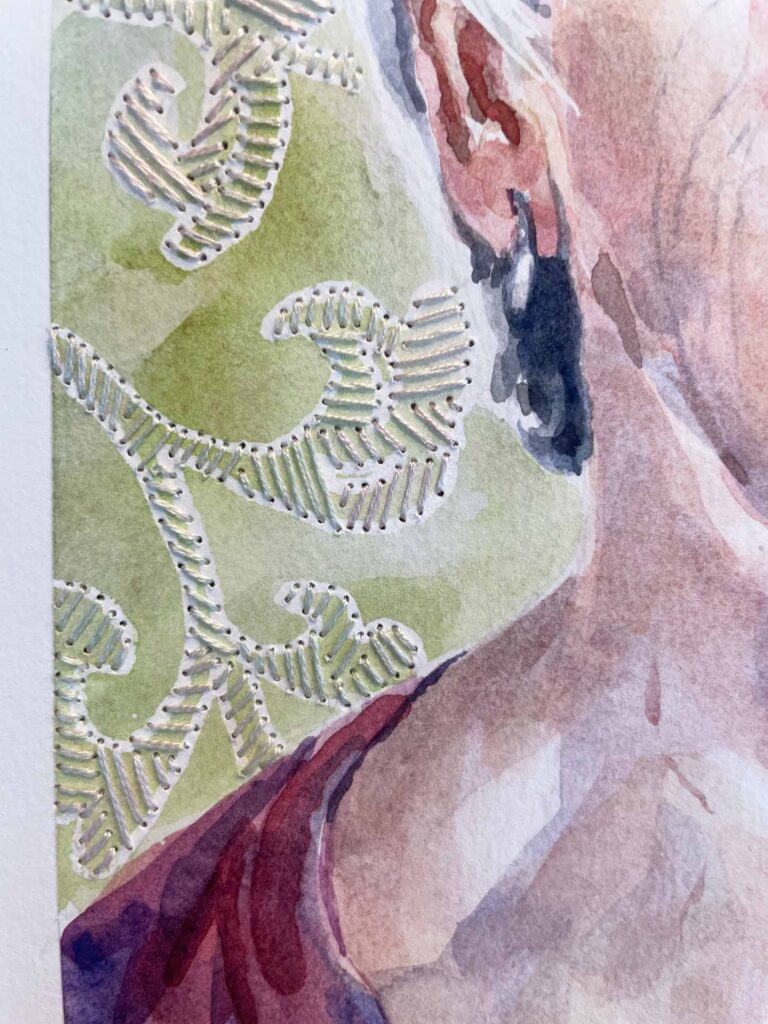
The portrait that I shared briefly at the end of my last post is now in its last phase. The paint work is finished and the embroidery is well underway.
First pass
I’m loving the variety of processes involved in these works – first, because there’s a certain challenge to pulling everything together, and secondly, because it’s so satisfying to see the piece materialize as each stage builds upon the one before.
In many respects this whole process is parallel to my my previous stitched-then-dyed-then-stitched work, it’s just that the scales are tipped more toward drawing/painting with much less stitching. The up side is that since these latest pieces move along so much more quickly, I can learn from, and then move on to the next piece to respond to, my mistakes – and my successes – without the huge lag time inherent in the textile works.
Happy accidents lead to fortuitous discoveries. Working on a dry run practice sheet for this section, I stumbled upon the fact that carelessly letting the paint extended outside the masked lines resulted in a flavor of batik. Hmmm, that opens the door to lots of possibilities. This is exactly the kind of discovery referred to above, which I can act on and explore more quickly because this piece is almost done.
And now my request:
I need of models for this series honoring the strength, wisdom and resilience of women of a certain age. If you (or someone you know) fit the bill, live in the central Vermont area and wouldn’t mind giving me 15-20 minutes of your time to take a quick series of head and shoulder photos of you to use as inspiration, please contact me. ehwfram@gmail.com
If you’re shy about having your picture taken, it may help to know that my painted results never turn out to be exact representations of my models – so it won’t be a portrait of you. Rather, your image would be a jumping off point. I’ve come to think of this process as something akin to literary historical fiction … based on fact, but with plenty of artistic license.
I would really like to continue with this series so thanks for considering, and I hope you’ll be in touch.
Oh – and be sure to come back next time for the full reveal of the finished piece!
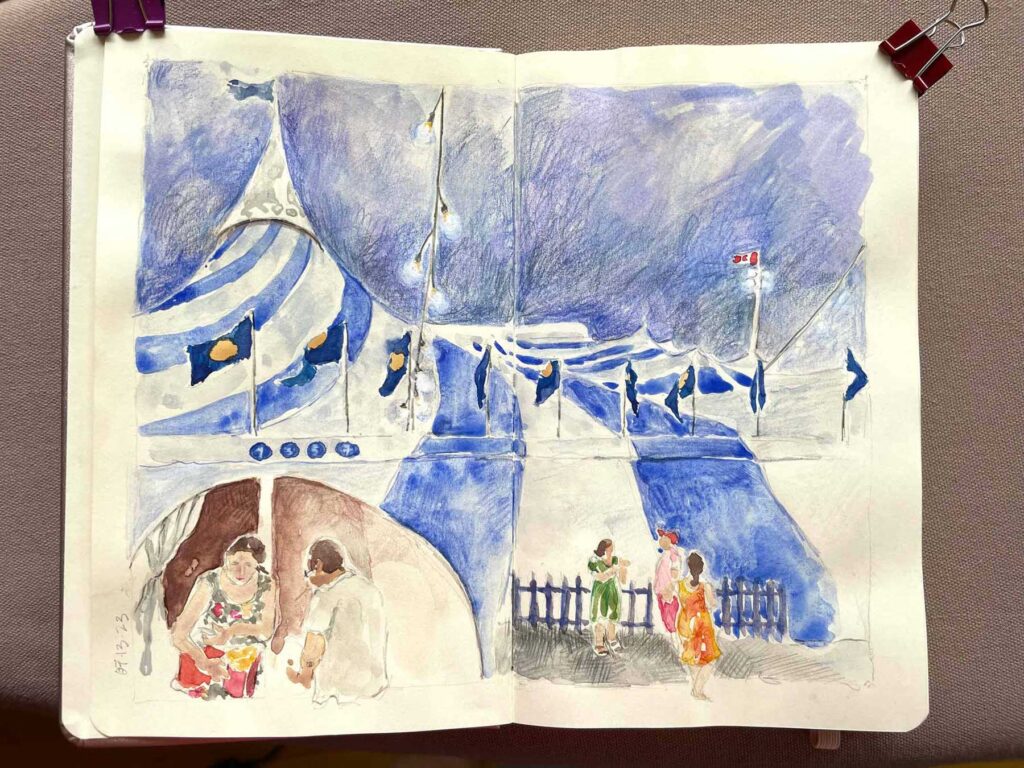
I’m not sure I could ever quite do justice to the dramatic blue of the sky and circus tent stripes in Montreal a couple of weeks ago, but Winsor Newton’s Cobalt Blue Deep gave me a fighting chance.
One of the joys of living where we do is being surrounded by woodland neighbors. For the most part they are shy, so we only hear them or see evidence of their presence. It’s a lucky day when we actually catch a fleeting glimpse of one of them going about their business.
4:37 AM, 05.05.2021 My husband has a game camera that he moves from place to place in our woods. In the wee hours of an early May morning a couple of years ago, he captured video of a bear, fox, raccoon, fisher cat and porcupine, all making their rounds at different times during the same night. We loved that they all chose to cross one of his bridges, rather than keeping their feet on the ground. Owls and pileated woodpeckers are less quiet and less elusive, but no less thrilling to see.
It was hard not to think of the animals who share their homes with us while visiting master carver Dempsey Bob’s retrospective “Wolves”, at the Montreal Museum of Fine Arts. The beauty and skill of his work is beyond spectacular. His poetic use of line interweaves forms with deceptive simplicity, conveying both depth of character and a seamless alliance between the conjoined animals.
Each wooden surface is burnished to the sleekness of glass, its smoothness amplified by the textural attributes of the other natural materials he incorporates.
Eagle Transformation Mask As one moves around to the left of the above mask, a transformation appears.
Wolf, Frog, Bear, Eagle, Hawk, Raven, Shark, Killer Whale, Salmon and Beaver are all central characters in the cultural stories Bob’s pieces relay. The incorporation of sea lion whiskers, fur, hair, abalone and operculum shells — gifts from the animals themselves — add to the stunning beauty of these pieces while underscoring the native stories they reference.
As a viewer, I couldn’t help but feel reverence — for the work as well as for the creatures depicted. Intentional or not, Dempsey Bob’s art is a reminder of the essential role all creatures play in our collective histories and futures, and of the respect we owe them.
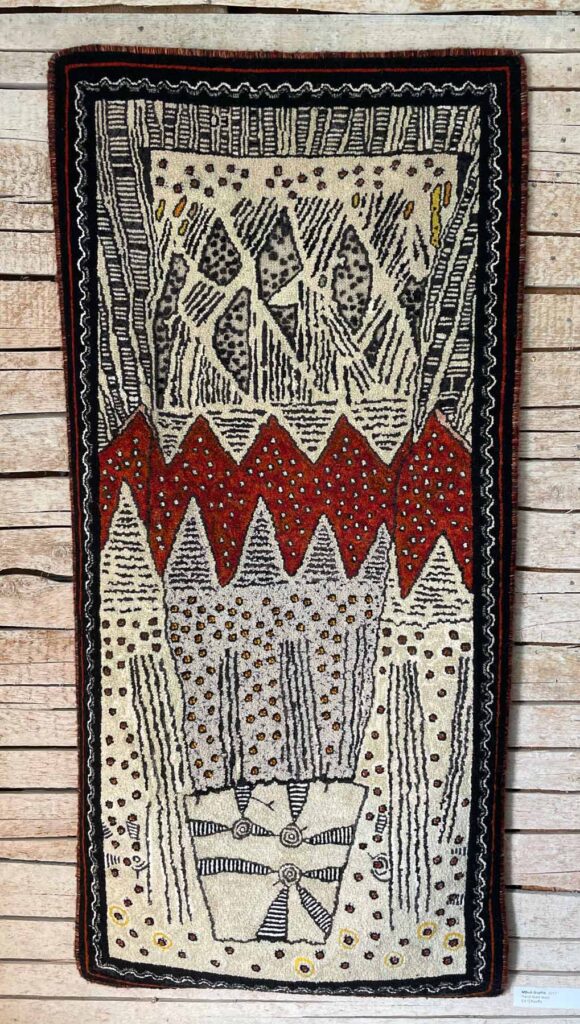
For more depth, this hour-long interview is filled with humor and history. Plus, in a segment that particularly resonated with me, Bob talks about the importance of drawing as a foundation for seeing and for making any type of art. To my mind, that’s the secret that says it all.
The learning continues, thanks to Summer’s slower pace. This month I’ve found myself taking a bit of a detour to focus on composition and value.
My impetus was a Substack entry from Urban Sketcher Suhita Shirodkar, linking to an Ian Roberts’ video about working outside your comfort zone. Watching it reminded me that I have a terrific book Roberts wrote called Mastering Composition. I pulled it out to flip through again and decided to take a stab at his “composition a day” exercise. Refreshers never hurt.
My sole tool has been an HB graphite pencil, making value an integral part of each composition. Repetitively sketching this way for a couple of weeks has made it glaringly obvious the degree to which I gravitate toward, and get caught within, a middle range of values. It’s clear I need to concentrate on pushing for darker darks and blacker blacks.
As an experiment, I converted images of my latest life paintings to black & white in Photoshop. It confirmed, as you can see below, that I need to pay closer attention to my values.
On the bright side, even if this is the only thing I learn this summer, I will consider the season a success.
✷
My latest art-related treat has been watching videos by artists Sandi Hester and Frances Ives who cover various aspects of their practices on YouTube and Patreon. One of the aspects I most enjoy is they each spend a fair amount of time talking about, experimenting with and swatching new materials, taking a deep dive into the differences between brands and applications.
A screenshot of Sandi Hester’s video “Favorite Color Pencils & Markers”
Regular hauls from Blick and Jackson’s (the UK equivalent to Blick) include all sorts of goodies. I fully acknowledge that for most, watching someone swatch a couple of fistfuls of colored pencils while elaborating on their minute differences might feel akin to joining Edmond Dantès at Chateau d’If (can you tell I’m reading The Count of Monte Cristo this summer?). But for this art nerd, it’s indescribably entertaining. I’m all for learning about the specific details and layering possibilities of unfamiliar materials before buying.
Needless to say, I just placed an order with Blick last weekend.
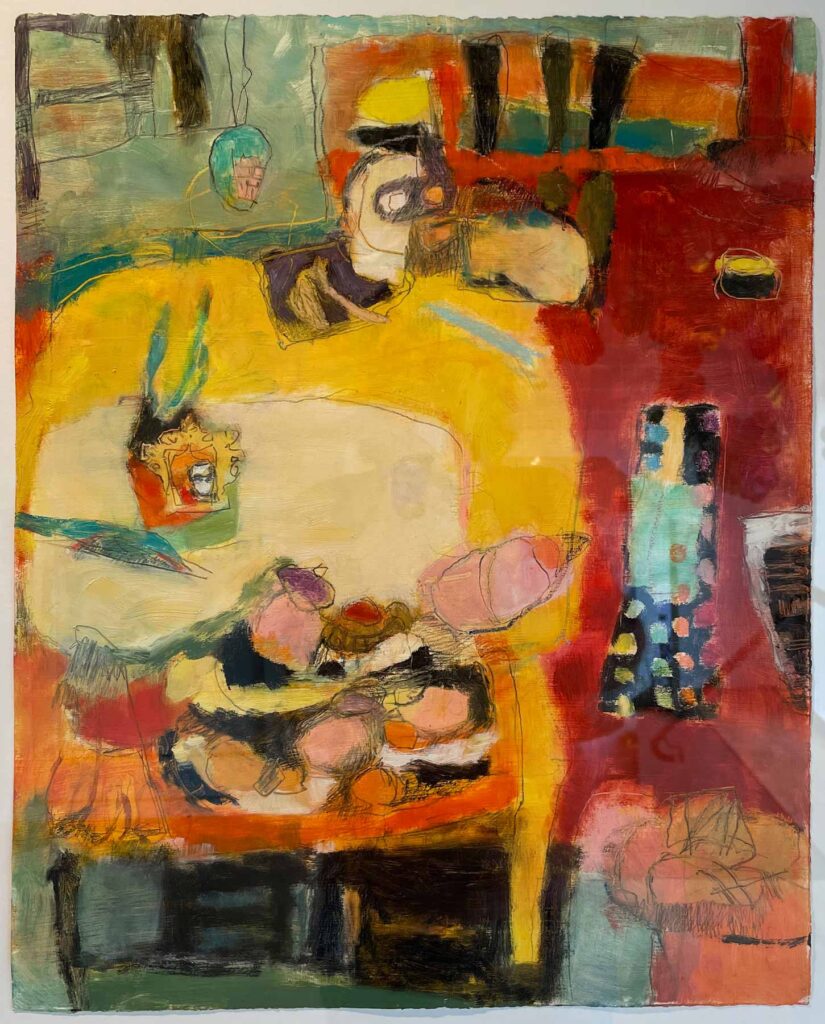
5-6 months out of the year our yard looks like some version of this.
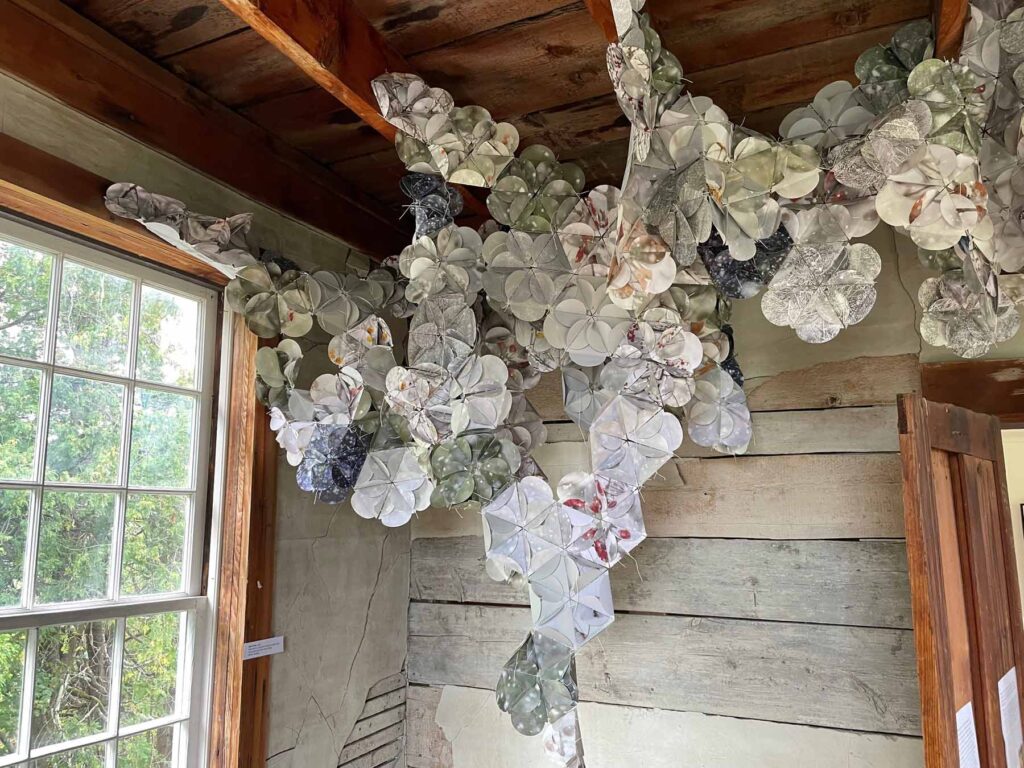
So is it any wonder that when June rolls around, I can’t get enough of it looking like this?!
I am drunk with color these days.
It’s been a fun exercise this week to create color mixes that mimic what’s in bloom right now. This type of sampling helps me to understand color more generally, and my chosen palette more specifically.
For those who, pardon the pun, like to get into the weeds of such things, I was a bit surprised at how many colors I used: 27 separate colors in making 28 samples of flowers, leaves and paving stones. To some degree, that feels very over the top and, considering 8 of those colors were only used in one color mix, there is definitely room to fine-tune if I were so inclined.
Overall though, most of the colors I used got a pretty good workout, recurring in many of the mixes – most of which were made up of two and very occasionally three paints. The exception was the paving stones. They all required various combinations of three primaries to achieve their neutral tones.
These colors are the backbone of my mixes. The biggest surprise for me is how versatile (and “popular”) the Cobalt Blue Deep turned out to be.
I find it really handy to have color-mix samples like this for reference, so I keep a book full of them that I refer to regularly. I try to make time when I buy a new paint color to play around with it to see how it interacts old favorites.
Without question, if you live in Northern New England life is better if you actually enjoy the subtle hues of late November into deepest winter. But let’s face it, it’ll be nice to return to these samples when the garden is asleep again, as a reminder of the eye-popping abundance of June.
Since we’re talking color… Have you been to the Vermont Arts Council Sculpture Garden in Montpelier to see the collaborative installation Elements of Shelter: Water, Fire, Wood, Earth, Metal? Spearheaded by Thea Alvin and Meg Reinhold, it’s a beautiful meditation on two of Vermont’s most immediate challenges: climate change and the housing crisis. The combination of paint with glass is particularly effective; the work absolutely glows in the sunshine. Plus, the craftsmanship of the pieces, including their timber frames, is gorgeous.
Read further about the installation and its creators in Seven Days. You can follow more of the creation process on Instagram: @theasunshine and @trilliumhandcrafts
First, check out artist Denise Gasser on the April 18th episode of the Art Juice podcast. Even better, if you know a creative young mom who’s at a stage where she feels like she can’t keep her head above her parenting duties long enough to create the work she wants & needs to make, share it with her. Then go one step further and include the link to Gasser’s blog post “A Love Letter to Every Busy, Tired, Creative Mom“.
While the gist of the podcast discussion surrounded social media and ways that it may be impacting and influencing our art, it wasn’t that aspect that caught my attention so much as when Gasser talked about her work as a facilitator. She mentors and inspires artist/mothers to continue with their art after motherhood despite feeling like there is no time (let alone an extra ounce of energy) for anything beyond being a parent.
In the video above, Denise shares how she worked through that issue herself with her series “Art After: Reconciling Art and Motherhood”. As a mother of four boys, the series was begun as a way to bring together, acknowledge and honor her dual roles as artist and as mom. Leaning into reality, she began making 5″ x 7″ paintings, working on each only until she was interrupted by her kids. On the back of each piece she documents the time spent on the painting and what interrupted her, as well as the number of the painting in the series.
More than 200 works later, she had the makings of a solo show. It’s such a great example of the empowering wisdom that taking even just one step a day will get you a lot farther after a week, a month, a year than not taking any steps at all.
And then, looking at the other end of the age spectrum, I happened upon the Legendary Grannie Gang on Instagram last week and was absolutely smitten. Lovers of knitting, superheroes and fearless grannies: you too will find photographer Susanne Krauss‘ irrepressibly joyful portraits irresistible. I think we could all benefit from a bit of Granny Power these days.
Our dog Quinn has the art of post-nap stretching down to a science.
We can’t help but admire and laugh at the languorous ease with which she lowers herself to the floor from her bed on the sofa, slowly and purposefully trailing her hind legs in order to fully stretch out her spine.
I spent our first morning exploring pattern, with the background of future portraits in mind.
Considering it’s beyond mid-May and I’m well out of my winter cocoon, I’ve been thinking about ways to figuratively emulate Quinn’s example in my practice this summer. It would be nice to shake out the cricks of habit and routine that have settled into place after months of being cozied-up inside.
Layers of color add complexity
A hopeful first step was jumping – no leaping – on-board at a friend’s suggestion that several of us take a long weekend for an artist’s retreat at her place on Martha’s Vineyard. In hindsight, there is a certain poetry in the parallel that runs between being situated on a physical island while simultaneously experiencing a metaphorical remove through focused making, discussion and inspiration.
Final spots of red could just as easily been added with thread
As with so many things, the benefits undoubtedly won’t fully surface for a while. No question, it can be quite fruitful to release some of the ideas that bang around within the confines of one’s own head, and then see how those thoughts reflect back in the light of others’ insights and responses. I have a lot to think about now that I’m home, and I know that it will take longer than the actual retreat to get to the nut of what I gleaned.
Later that same day we walked a trail that, in places, ran alongside beautiful old stone walls that are riddled with holes. They are unlike any I’ve ever seen in Vermont or Maine. Later, reading a book about the Vineyard, I learned that these walls, which snake all across this part of the island, are referred to as “lace walls” because of their unusual holes. Although my sample painting above was finished before seeing the walls up close, I can’t help but think of it now as an abstraction and reminder of Chilmark’s unique and ubiquitous boundary markers.
I’m feeling like I got a satisfying stretch for my brain and my practice, and am ready to move forward.
Trimming down what I brought with me took some thought because there is the very real temptation to bring everything. Bottom line: it doesn’t take much to create and settle into a transitory studio.
This summer I am planning to balance stitched studio portraits with more spontaneous versions that are painted from life in a group setting. The difference between the two is obvious, but I feel like each approach feeds the other in a way that ultimately benefits both, as well as my own learning arc.
Ready for a quick trip to the South?
Last week we visited Charleston, SC and Savannah, GA and, as on most travels, there was plenty of art to enjoy in the moment and to think about after coming home. Here are a few highlights from The Gibbes Museum of Art in Charleston, my favorite of the various art venues we visited.
These are still shots from a video within one of Filsoofi’s boxes. The viewer becomes participant in that the video subjects appear to be checking us out as closely as we are observing them.
What attracted me to The Gibbes Museum in the first place was their collection of miniature portraits. According to the museum’s literature, the first-ever American miniatures were painted in Charleston and the Gibbes collection holds over 600 works spanning from early colonial examples of the 18th century to the Revival Period of the late 19th and early 20th centuries.
They are remarkable!
H.F. Plowden Weston, by Charles Fraser, 1824
Miss Reynolds of Fenwick Hall, by Charles Fraser, 1835
Christopher Gustavus Memminger, by Charles Fraser, 1823 This gentleman looks so familiar to me! I think I’ve watched way too many Masterpiece period dramas.
Actor Jack Farthing
How wonderful to see Joseph Jackson’s sketchbook which held preliminary portraits that he may have used to impress perspective clients.
Moving on, there’s nothing quite like an independent bookstore for providing a sense of grounding when visiting a new locale. Curated shelves that reflect local pride in the history, authors and artists of a place reveal the rich undercurrent of a city in a way that generic travel books can’t begin to match.
If you’re willing to snoop around a bit, you never know what you might discover. A visit to Buxton Books in Charleston opened a couple of interesting doors for me.
I loved the art on the cover of this book of poetry by South Carolinian Marlanda Dekine, and had to find out more about Fletcher Williams III, the artist who created it. The piece is named “Westward”.
It turns out that Williams has a resume that extends far beyond book cover illustration. He is a multi-media artist living and working in Charleston, making identity-based art and is a rising star. With an academic foundation in psychology and anthropology, his artwork speaks to the history of Charleston and the culture of the Lowcountry, but not in the way one might expect.
Taking time to follow the interview links on Williams’ website gave me a much deeper understanding of both his artistic aims and the challenges he confronts. He is incredibly thoughtful and articulate. His discussion regarding having to navigate the complexities of feeling pressured to speak to the Black experience, while coping with narratives thrust upon him and his artwork that are not his own, was enlightening. While I don’t think one can ever fully grasp the underlying dynamics of a specific place unless one is a native, I found it fascinating (and important) to get a glimpse, via his interviews, beyond the usual tropes and assumptions.
And for those more interested in textiles, the other book that caught my attention was Embroidery: Threads and Stories from Alabama Chanin and the School of Making by Natalie Chanin. It was way too fat and heavy to bring home in my carry-on, but I snagged a Kindle edition and am looking forward to reading, rather than just flipping through this part autobiography, part “exploration into how sewing and embroidery relate to wider concerns of sustainability, community and women’s empowerment”.
Contains information related to marketing campaigns of the user. These are shared with Google AdWords / Google Ads when the Google Ads and Google Analytics accounts are linked together.
90 days
__utma
ID used to identify users and sessions
2 years after last activity
__utmt
Used to monitor number of Google Analytics server requests
10 minutes
__utmb
Used to distinguish new sessions and visits. This cookie is set when the GA.js javascript library is loaded and there is no existing __utmb cookie. The cookie is updated every time data is sent to the Google Analytics server.
30 minutes after last activity
__utmc
Used only with old Urchin versions of Google Analytics and not with GA.js. Was used to distinguish between new sessions and visits at the end of a session.
End of session (browser)
__utmz
Contains information about the traffic source or campaign that directed user to the website. The cookie is set when the GA.js javascript is loaded and updated when data is sent to the Google Anaytics server
6 months after last activity
__utmv
Contains custom information set by the web developer via the _setCustomVar method in Google Analytics. This cookie is updated every time new data is sent to the Google Analytics server.
2 years after last activity
__utmx
Used to determine whether a user is included in an A / B or Multivariate test.
18 months
_ga
ID used to identify users
2 years
_gali
Used by Google Analytics to determine which links on a page are being clicked
30 seconds
_ga_
ID used to identify users
2 years
_gid
ID used to identify users for 24 hours after last activity
24 hours
_gat
Used to monitor number of Google Analytics server requests when using Google Tag Manager