Category Archives: Process

Etudes

We’ve reached the mid-point!

Welcome to Week 3 of my Summer Stories Archival Sale!

The five pieces described below are 20% off in my web shop , now through 11:59pm July 31st. Find them under the category “Etudes”.
Use the coupon code Etudes20 at checkout.

But first, a quick check-in: I hope you are enjoying the stories I have been sharing this summer. Have you found anything surprising, relatable, confounding?
What I’ve discovered is that taking the time to look back helps me to see more clearly where I am going. And that is very rewarding.
Thanks for coming along for the ride.

Stand detail, textile collage, dye, applique, embroidery, quilting

Stand, detail ©2011 Elizabeth Fram

I’ve called this latest section of my sale “Etudes” because each of these small pieces was just that – a study. While the dictionary’s definition of “etude” refers to a musical composition, the creative intention remains the same regardless of medium or discipline: “a piece designed as an exercise to improve the technique or demonstrate the skill of the player”.

With the basic building blocks of fabric, dye, thread and a needle, possibilities are only limited by one’s imagination. I’ve come to appreciate that fully exploring assorted processes in order to push the nuances of their potential is as integral to my practice as the concepts I am hoping to illustrate.

After moving to Vermont we built a house, customizing it to our personal quirks, desires and environmental goals. Topmost for me was that it include a roomy studio with a sink. That humble sink has given me the freedom to stretch beyond the copied “prints” on fabric I had been making previously, and to begin to explore surface design through many variations of Shibori dye techniques.

The small pieces you see here were created with the intent of finding new ways to incorporate the results of resist-dye explorations with a variety of sewn construction techniques, hand-stitched quilting and embroidery. They represent a mere scratching-of-the-surface of investigating and celebrating the rich artistic possibilities of textiles.

For years, a large part of my self-imposed directive has been to push the distinct qualities inherent to cloth and thread, honoring and highlighting them within my work for their unique visual and textural characteristics, rather than attempting to mimic processes and imagery that can be much more easily accomplished with paint or other media.

I love how these small works speak not just to a moment within my personal artistic development, but also to how, despite their small size, they reference the abundant potential of seemingly modest materials.

Book Form, Textile collage, Dye, Applique, quilting, embroidery

Book Form ©2011 Elizabeth Fram, Silk & cotton fabrics, Dye, Discharge, Paint, hand appliqué, Hand and machine quilted, Hand embroidered, 15″H x 21″ W, SALE Price: $440.   If you’ve followed this blog for any amount of time you will know that reading is a huge part of my daily practice. This piece honors that love by using marks created with dye, paint and stitches, plus areas of pleated assembly, to mimic lines of text on a page beneath an open book.

Book Form, detail, Textile collage, Dye, Applique, quilting, embroidery

Book Form, detail © 2011 Elizabeth Fram The pattern on the black and gold fabric in the upper left corner was created by etching a design with a dull pencil into a styrofoam tray from a package of grocery store chicken. The resulting “plate” was rolled with textile paint and then used to create a mono-print on cotton.

Book Form, detail, Textile collage, Dye, Applique, quilting, embroidery

Book Form, detail © 2011 Elizabeth Fram  Black fabric, adorned with lines of masking tape and then sprayed with a diluted bleach solution created a lovely pattern of irregular lines once the tape was removed. Overlaying it with a sheer fabric allows that pattern to peek through, increasing a sense of depth. Lines of embroidered stitching follow the rhythm of the discharged pattern, also inferring a sense of text but with variations that imply handwritten rather than printed words.

❖ ❖ ❖


Stack, textile collage, quilting, embroidery, applique, dye

Stack ©2011 Elizabeth Fram, Silk & cotton fabrics, Wrapped-resist dye, Machine stitched, Hand quilted, Hand embroidered, 9″H x 9.5″W, SALE Price: $200.  The following 4 pieces are part of what I have informally called my “motion series”. They all imply some form of movement or stance. When I made them, I had just completed an online class in Shibori dyeing that taught me the basics of a variety of ways to create pattern on cloth via stitched, wrapped and clamped resists.

Stack, detail, textile collage, quilting, embroidery, applique, dye

Stack, detail ©2011 Elizabeth Fram  Combining samples of this newly dyed cloth with fabric from my stash brought me the same satisfaction as piecing together a puzzle. I particularly like the way the pleated sheer fabric on the left – which I had dyed separately – worked in tandem with the striated red and white arashi-dyed silk.

❖ ❖ ❖

Strut, textile collage, dye, applique, embroidery

Strut ©2011 Elizabeth Fram, Silk & cotton, Wrapped-resist dye, Hand appliqué, Hand quilted, Hand embroidered, 8.5″H x 8.5″W, SALE Price: $160  This piece is small but has a strong voice. Such is the power of color. For years, before I began trying my hand at surface design, I collected dupioni silks wherever I could find them, treasuring them for their saturated colors and iridescence. The confidence conveyed by these assertive hues is why I named this piece “Strut”.

Strut detail, textile collage, dye, applique, embroidery

Strut, detail ©2011 Elizabeth Fram  

Strut detail, textile collage, dye, applique, embroidery

Strut, detail ©2011 Elizabeth Fram  When I first began making art with cloth, I ran through every fabric department I came across, collecting anything with unusual characteristics and potential. The damask-like rectangle that morphs from orange to violet, in the upper right of this detail photo, was a length of synthetic that I believe was intended as a dress fabric. It was so unusual, but incredibly versatile. Somehow it seemed to “fit” in almost everything I made, until all I had left were tiny slivers to insert here and there. Not only did I use it for the colors on its right side, but it’s reversible back side was silver with the black pattern, and I used it as the underbelly of a mackerel in one of my earliest pieces. Follow this link and scroll to the bottom of the post to see that fish.

❖ ❖ ❖

Tumble, textile collage, dye, quilting, embroidery

Tumble ©2011 Elizabeth Fram, Silk & cotton, Clamped and wrapped-resist dye, Discharge, Hand appliqué, Hand quilted, Hand embroidered, 9.5″H x 9″W, SALE Price: $200   Clamped-resist is a dye technique where you take two objects of the same shape and clamp them together on either side of the outside of a folded fabric bundle, sort of like two slices of sandwich bread. The results are a shadow image of their shape that appears on the cloth once the objects are removed and the dyed fabric is unfolded. A hardware store is a great place to find objects to use in this process, such as the oversized aluminum washers I used to create this donut shape.

Tumble detail, textile collage, dye, quilting, embroidery

Tumble, detail ©2011 Elizabeth Fram   Stripes, marks, color & texture.  These detail photos show the distance from which I see each piece as I am working on it. Can you begin to understand why I get so swept up in detail?

❖ ❖ ❖

Stand textile collage, dye, applique, embroidery, quilting

Stand ©2011 Elizabeth Fram, Silk & cotton, Stitched-resist dye, Hand appliqué, Hand quilted, Hand embroidered, 9.9″H x 9″W, SALE Price: $200  The challenge of bringing diverse elements together so that they look as though they were always meant to be a whole unit is a good part of what I loved about making the pieces in this series. I was looking for ways to create a conversation between all the ingredients so that, like a complex sauce, one can appreciate the individual components while savoring their intermingled results.

Stand detail, textile collage, dye, applique, embroidery, quilting

Stand, detail ©2011 Elizabeth Fram  All the pieces in this post were made in 2011 and by now I’m sure you’ve noticed that in all but one I was using the device of rows of stitches, stacked on top of each other. Part of the beauty of going back through older work in detail is you notice things with fresh eyes. I think I have more to say with this particular way of stitching, so don’t be surprised if you see it in new work.

❖ ❖ ❖

And now, because I can’t resist…

Lynne Drexler Color

Untitled, circa 1959-1962, Lynne Drexler, Farnsworth Museum of Art

We are back from a week in Maine and of course made our annual pilgrimage to the Farnsworth Museum. Perhaps because I’m looking back on the old, non-representational work in my sale, this year I was most taken with exhibits of abstract work by Lynne Drexler and – surprise! – Andrew Wyeth.  I’m not going to write much about either here since you have already waded through the above. But I encourage you to check out the links and to read about both shows – they are beautiful and fascinating.

Andrew Wyeth, Untitled

Untitled, 1991, Andrew Wyeth, Watercolor on Paper, Collection of the Wyeth Foundation for American Art While Drexler’s work is (stunningly) all about the color, I was quite moved by this exhibit of never-before-shown abstract works of Wyeth’s, which spanned six decades. His ability to capture a beautiful abstraction with vitality and immediacy blew me away. All the more so because we think of him as the quintessential realist. He is quoted as saying “My struggle is to preserve that abstract flash like something you caught out of the corner of your eye” , and very surprisingly, apparently referred to himself on numerous occasions as an abstract artist.

Don’t forget to use the coupon code  Etudes20  for your 20% discount in my web shop. These five pieces will remain on sale through 11:59pm July 31st. Enjoy free shipping within the continental US.; these pieces are ready to hang.

The next sale will begin with my August 8th blog post in two weeks.
Keep an eye on my web shop, as the next five pieces will be available to preview soon after this sale ends. You can find them under the category “Transitions”.

Life As We Know It

Welcome to Week 2 of my Summer Stories Archival Sale!

The five pieces described below are 20% off in my web shop, now through 11:59pm July 17th.
Use the coupon code Life20 at checkout.

Although these pieces span an 8 year period, they all speak to something that was top of mind for me when I made them: how do I juggle the many ingredients of every busy day, accomplishing what needs to be done while still making room for creativity? I had considered labeling this category “Parenthood” because that was my main directive during those years. But in retrospect, so many of the issues that I was confronting were hardly unique to being a parent – or any particular stage of life. Balancing limited hours, bumps in the road, being mindful of one’s actions and looking back to consider how to improve are just a part of life as we all know it.

As I mentioned in my last post, although I had the luxury of a full room to devote to art-making, my studio space was limited in terms of the materials I could use and how messy I could be with them. I had reached the point where I wanted to explore surface design in order to stretch beyond store-bought fabrics and to customize the cloth I was using in my work, but I needed to find ways to accomplish that within the constraints of my space.

The bottom line is that any perceived stumbling block can also be a call to ingenuity.
At the time, taking family photographs to the local copy shop to have customized tee shirts printed was very popular. In fact, we did just that before a large family celebration of my grandfather in-law’s 100th birthday. It got me to thinking: if one could print photos on cloth with clarity, why couldn’t that be true of a drawing or a painting?

I began to experiment with a couple of approaches.
Using oil pastels, I made abstract drawings, taking them to my copy shop to have them copied and then transferred onto cotton sateen fabric which I supplied. There was a learning curve; the colors of the copy appeared much more saturated than my original drawings and the resulting fabric didn’t have quite the same soft “hand” that it had before being printed with the transfer, but for my purposes it was a total success!

The best aspect of the copied transfers was that they picked up every textural detail from the surface of my originals. In addition to the oil pastels, I painted on brown paper grocery bags – a process that allowed for the texture of my brush strokes and for the wrinkles and folds inherent to the bags to appear on the finished printed fabric. I also made collages with the paintings before having them copied and printed, a process that presented the opportunity to have a collage effect within the printed image rather than only achieving a collage afterward by cutting the fabric and re-sewing it together.

Keep in mind, this was well before the existence of Spoonflower. How much easier and more exact this process would be for me today! But now I see these pieces as markers of possibility, both in terms of circumventing creative obstacles and in regard to a specific season within my own journey.

Thanks for being here!

Compartmentalized

Compartmentalized art quilt embroidered oil pastel

Compartmentalized ©2003 Elizabeth Fram, Silk, cotton & synthetic fabrics, Heat transfer of original oil pastel drawing, Machine pieced, Hand appliqué, Machine and hand quilted, Hand embroidered, 17″H x 17″W, SALE Price: $400.  This was one of my first stabs at incorporating fabric that I had designed, made from transfers of an oil pastel drawing. This piece speaks to the fact that life at the time was a series of stops and starts, all sorted into various compartments that required constant tending and nurturing so that nothing fell through the cracks.

Oil Pastel Drawing

This photocopy of my drawing was used for the transfer print in Compartmentalized. I only used a tiny section of it in the finished quilt, cutting and sewing together small areas of the printed fabric to add within the piece.

Compartmentalized detail, embroidery

Compartmentalized, detail ©2003 Elizabeth Fram  If you look closely, you can recognize the orange section from the far right of the copied drawing above, and also see that the copy’s image was reversed in the process of printing it on fabric.

Compartmentalized detail quilt

Compartmentalized, detail ©2003 Elizabeth Fram

Compartmentalized, detail quilted and embroidered

Compartmentalized, detail ©2003 Elizabeth Fram The textural “conversation” between quilting, embroidery and a variety of fabrics, all in chorus together, is a huge part of my attraction to working with textiles.

❖ ❖ ❖

Room For Adjustment

Room for Adjustment, colored pencil, quilt, embroidery

Room for Adjustment ©2004 Elizabeth Fram, Silk, cotton & synthetic fabrics, Discharge, Direct drawing with colored pencil, Pieced and appliquéd, Hand and machine quilted, Hand embroidery, 26″H x 51″W, SALE Price: $760.   Becoming a parent was the perfect proving ground for realizing that no matter how much you try to get everything perfectly lined up, something will invariable throw your plans to the wind. Once this work was pieced together it felt just a bit too organized and stagnant. Taking a huge leap of faith, I sliced it right down the middle, readjusting so that it was slightly off-kilter. I can be very brave in my work, maybe not so much in life. Take a risk, try something radical, make room for adjustments.

Room for Adjustment detail colored pencil

Room for Adjustment, detail ©2004 Elizabeth Fram This detail image shows areas where I was drawing directly on fabric with colored pencil.


Room for adjustment detail, embroidery

Room for Adjustment, detail ©2004 Elizabeth Fram

❖ ❖ ❖

Unexpected Circumstances

Unexpected Circumstances textile collage, quilted, embroidery, transfer of oil pastel

Unexpected Circumstances ©2004 Elizabeth Fram, Silk, cotton & synthetic fabrics, Heat transfer of original oil pastel drawing, hand appliquéd, Hand and machine quilted, Hand embroidery, 37″H x 31″W, SALE Price: $640.  There’s no getting around it – sh*t happens. You can either fight it or go with it. At the end of the day, as my husband’s centenarian grandfather would say, we all just do the best we can.

Unexpected circumstances collage

For Unexpected Circumstances, I made an oil pastel drawing and then had it copied in both black & white and colored versions. I brought those copies home and re-configured them by cutting and combining the two iterations in a new conglomeration of both. It was this resulting collage that I had transferred onto fabric and used within this piece, as seen directly below.

Unexpected Circumstances, detail

Unexpected Circumstances, detail ©2004 Elizabeth Fram While it’s all but impossible to see in this photo, I embroidered with dark blue thread on top of the printed collage, adding to the energy of the pastel marks captured in the fabric transfer.

Unexpected Circumstances ©2004 Elizabeth Fram  This piece is a prime example of why I stopped calling my work Art Quilts, opting for “Textile Collage” as a more accurate descriptor instead.

❖ ❖ ❖

Tadasana

Tadasana painted quilted embroidery

Tadasana ©2011 Elizabeth Fram, Silk & cotton, Paint, Dye, Hand appliquéd, Hand and machine quilted, Hand embroidery, 31″H x 19″W, SALE Price: $520. Tadasana is the word for Mountain Pose. This piece was made on the heels of a very busy and at times stressful period in our lives. I had been maintaining a very modest but regular yoga practice and found it was a huge help. This piece honors the peace and grounding I found through both that practice and our return to Vermont, the Green Mountain State.

Tadasana detail

Tadasana, detail ©2011 Elizabeth Fram This piece includes a bit of very contained mono-printing, made a couple of years before inserting it here. Textile paint and minimal dyeing were wet processes that I could explore in a friend’s studio and our garage. The embroidery (in white, by the stroke of yellow paint) is subtle, but integral to the pattern.

❖ ❖ ❖

Hindsight

Hindsight, textile collage quilt embroidery painted transfer

Hindsight ©2006 Elizabeth Fram, Silk & cotton, Heat transfer of original painting, Hand appliquéd, Machine and hand quilted, Hand embroidered, 34.5″H x 24″, SALE Price: $600.  Slowly working through the time-consuming and methodical processes of hand sewing gives one plenty of time to think and to look back on past actions and discussions. It’s in my nature to reflect on what went right, what went wrong and how one might approach things in the future. And isn’t that  also a large part of trying to do one’s best at parenting? In some ways, such mulling is much like collage – a piecing together of known elements into a new configuration.

Hindsight collage

This is the original collage I created for Hindsight. Although made initially to become a fabric transfer, I went through a brief period of composing collages with painted brown paper as an exercise in-and-of itself. They weren’t made with exhibiting in mind, and certainly aren’t archival, rather they were an exercise done for fun and for myself alone.

Hindsight detail collage embroidery

Hindsight, detail ©2006 Elizabeth Fram The folds and wrinkles of the paper bags behind the paint became a natural place to incorporate lines of quilting.

Hindsight detail stippling embroidery

Hindsight, detail ©2006 Elizabeth Fram

❖ ❖ ❖

And finally, a quick look into the studio as promised…

Stitched and painted portrait

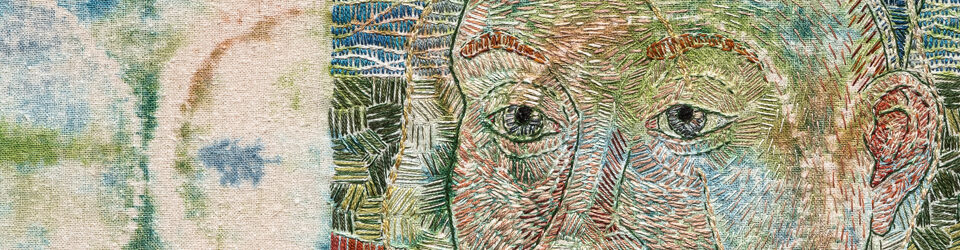
Not yet titled   ©2024 Elizabeth Fram, Watercolor and embroidery on paper, 9 x 8.5 in. 

When I first began this piece I was only planning to paint the eyes and to leave a lot of white space surrounded by monochromatic stitching. But as the work progressed it seemed to have its own ideas, one thing leading to another, until here we are. I’m still wrestling with the stitching on the face, but there’s something about it that won’t let me go. So I guess that’s just to say I have a lot to consider moving forward. I am learning from others’ responses that the house form is perhaps too subtle to be seen without prompting. That’s also something to think about for future pieces.

Meanwhile…

The Equivalents

I am so happy to have received this book from an Eye of the Needle reader. Not only was it a much appreciated gift in general terms, but also in light of one of the themes running through this post (reread my very first sentence). I had planned to put it aside for later in the summer, but once I began its introduction while eating lunch last week, I couldn’t put it down. It revolves around 5 artists/writers and their participation in the Radcliffe Institute for Independent Study. Were you aware of this fellowship opportunity for “intellectually displaced” women? It offered its fellows “a stipend, an office, access to Harvard’s libraries and professors and the gift of unfettered time”. That’s an opportunity we all might aspire toward; in the early 1960s it was unimaginable. Fascinating and highly recommended!

Don’t forget to use the coupon code  Life20  for your 20% discount in my web shop. These five pieces will remain on sale through 11:59pm July 17th. And don’t forget, free shipping within the continental US, with hanging slats included.

The next sale will begin with my July 25th blog post in two weeks.
Keep an eye on my web shop, as the next five pieces will be available to preview soon after this sale ends. You can find them under the category “Etudes”.

Leap of Faith

Mind Palace 1

I might have called this finished.


Mind Palace 2

But instead, I held my breath and lifted as much paint as I could outside a house shape that I had superimposed over the subject’s central features.


Mind Palace 3

It was my intention that by embroidering outside the house shape, the painted and stitched areas would stand apart from each other, yet still work together.


Mind Palace 4

The embroidery blurs details, such that texture becomes the overarching descriptor. It’s a quality I quite like – especially when paired with the untouched watercolor.


Mind Palace Finished

Mind Palace    ©2023 Elizabeth Fram, Watercolor, graphite and embroidery on paper, 5″H x 5″W

Despite the variation, the finished product still reads as a whole and I’m very pleased with the added dimension the stitching contributes. That’s not to say there aren’t a number of kinks still to work out. Taking this shot in artificial light emphasized the house shape to a degree that isn’t as easy to see in natural light. But that’s a puzzle for the next time around.
Regardless, the leap of faith was worth it.

It’s a new world out there – but check out the following and chalk one up for the little guy: artists fight back against AI.


A Respite and A Request

I’m taking a bit of a respite this week to recharge and reinvigorate. But first, an update.
The portrait that I shared briefly at the end of my last post is now in its last phase. The paint work is finished and the embroidery is well underway.

First pass

First pass

I’m loving the variety of processes involved in these works – first, because there’s a certain challenge to pulling everything together, and secondly, because it’s so satisfying to see the piece materialize as each stage builds upon the one before.

Detail

In many respects this whole process is parallel to my my previous stitched-then-dyed-then-stitched work, it’s just that the scales are tipped more toward drawing/painting with much less stitching. The up side is that since these latest pieces move along so much more quickly, I can learn from, and then move on to the next piece to respond to, my mistakes – and my successes – without the huge lag time inherent in the textile works.

Gold House

Happy accidents lead to fortuitous discoveries. Working on a dry run practice sheet for this section, I stumbled upon the fact that carelessly letting the paint extended outside the masked lines resulted in a flavor of batik. Hmmm, that opens the door to lots of possibilities. This is exactly the kind of discovery referred to above, which I can act on and explore more quickly because this piece is almost done.

And now my request:
I need of models for this series honoring the strength, wisdom and resilience of women of a certain age. If you (or someone you know) fit the bill, live in the central Vermont area and wouldn’t mind giving me 15-20 minutes of your time to take a quick series of head and shoulder photos of you to use as inspiration, please contact me.
ehwfram@gmail.com

Stitching

If you’re shy about having your picture taken, it may help to know that my painted results never turn out to be exact representations of my models – so it won’t be a portrait of you. Rather, your image would be a jumping off point. I’ve come to think of this process as something akin to literary historical fiction … based on fact, but with plenty of artistic license.
I would really like to continue with this series so thanks for considering, and I hope you’ll be in touch.

Oh – and be sure to come back next time for the full reveal of the finished piece!

A special thank you to India Tresselt for alerting me to Loreen Edwards Forkner @gardenercook after my post on painting the colors of my garden. I have color on the brain now and it’s seeping into my sketchbook. You might enjoy Forkner’s book Color In and Out of the Garden, based on intentional observation of color in tandem with nature’s palette.

Blue

I’m not sure I could ever quite do justice to the dramatic blue of the sky and circus tent stripes in Montreal a couple of weeks ago, but Winsor Newton’s Cobalt Blue Deep gave me a fighting chance.

Who’s Really In Charge?

I have to wonder sometimes, who’s in charge – the artist or the art?

When I began my latest portrait, I thought I had a pretty good handle on how it would progress. Having already stitched the white background pattern (shared with you in my last post) I fully expected to layer more paint and stitching both on top of that area and within the house shape surrounding the finished portrait.

Winter Garden Sketch

Preliminary sketches provide space to try out possibilities

Experimental practice sketches like the one above nudged me toward a rich stew of color and texture, brought to life by painting over the stitched white pattern, adding brushstrokes to mimic stitching, and finishing with another layer of colored thread embroidery.

Winter Garden 1

The next 5 photos follow the progression of this portrait at various stopping points.  I take these images because they give me a bit of distance after each session, allowing me to see where to go next. Plus, I’m usually so tied up in a piece during the making that it’s a treat to go back later to revisit its evolution.

It’s all well and good to have a plan, but you also have to be willing to let it go. This turned out to be a classic example of thinking I knew where the piece was headed, but ultimately the work itself had the final say.

Winter Garden 2

Once I had removed the masking from around the house shape, I had to acknowledge – despite all my plans – that the white-on-white stitching didn’t need my interference. It seemed to say everything I needed it to, just as it was. In fact, overlaying the background with more color and texture felt unnecessary and superfluous.

Winter Garden 3

Often, both the easiest and the hardest part of the process is to step away, trusting that sleeping on an issue will weed out any uncertainties and allow for deciding what will be the right call. After taking an overnight timeout I felt satisfied that my instincts were correct. Sometimes the best approach is to just get out of the way and listen to the work.

Winter Garden 4

All of this leads to two contradictory nuggets of wisdom that have proven, many times over, to be invaluable to me:

  • When you think a piece is finished, keep pushing deeper, and
  • Less is more

Of course the tricky part is figuring out which is called for, when.

Winter Garden

Winter Garden   ©2023 Elizabeth Fram, Watercolor, graphite and stitching on paper, 9.5″H x 12″W

One last word on the subject of portraits…I received the happy news this week that I received an Honorable Mention Award from Teravarna Art Gallery in their “6th Portrait” competition.

Substack is quickly becoming my new favorite reading spot.
In his “10 Things Worth Sharing” newsletter on Substack this week, Austin Kleon linked to an “Open Letter To The Next Generation Of Artists“, written by jazz greats Herbie Hancock and the recently deceased Wayne Shorter. Give it a read; it will give you a lift in return.

Sanctuary

The last week of the year is special.
All the hustle, bustle and added to-do’s that define December are now in the rear view, making way for pockets of time to sit back and think about what’s next.

Snow Moon & Firestorm

My final project of the year was a commission that a I’ve kept mum about until final approval. The directive was for it to be about a foot tall, a house nestled in branches and, similar to Snow Moon, covered with trees. Much like Firestorm, it was to be wrapped in a mantle of organza, this time embroidered with leaves. Prominent colors would be browns, oranges and greens. The aim was for the house to feel enveloped in nature and to represent, as my collector put it, “sanctuary from the crazy times we live in”.

Moon

Although not specifically asked for, this metallic copper-colored moon/sun seems to add just the right note of mystery

Working on such a relatively small scale carried a few unforeseen challenges, such as how to incorporate the organza cloak. But frankly, no piece would feel complete – or suitably satisfying – without a puzzle or two.

Organza with leaves

I dyed the organza to suggest the mottled colors of the tree canopy, and folded the fabric into a double layer to provide depth through color variation. The puzzle was figuring out how to embroider leaves so that the reverse, which would likely be visible, wasn’t a mess of knots and crossed threads. Sarah Homfray’s YouTube channel of embroidery tutorials is an amazing resource!

Now that it’s finished, it will soon be on its way to Texas. And in hindsight, I couldn’t have asked for a more positive note than the idea of “sanctuary” to close out 2022, or to prepare for the fresh page of 2023.

Sanctuary

Sanctuary    ©2022 Elizabeth Fram, Dyed silk with embroidery and foraged branches, 12.5″ x 10.5″ x 9″ Photo credit: Paul Rogers Photography

With that sentiment in mind, I wish you a peaceful new year – bright with the possibilities that lie in creativity. And I’ll look forward to reconnecting with you in a couple of weeks.
Happy New Year!

Following through on the idea of sanctuary – my final suggestion/recommendation for the year:

I’ve had my eye on Jethro Buck’s work for a while. The Albert Einstein quote on his website landing page pretty much says it all: “Look deep into nature, and then you will understand everything better”.

Step-By-Step

The snow is back!! — meaning both productive studio time and the bonus of excellent natural light.
As far as my latest post-Roe piece goes, all experiments have been set aside and I’m jumping in with both feet. Here’s a step-by-step guide to the process so far. There are still some ideas to pull together.

Stage 1

First, the figures and letters are laid out.

Stage 2

Next, a layer of masking fluid was added to protect some of the lettering from paint, while other letters are partially stitched.

Stage 3

Everyone is always curious about the back side. This shows areas that have been completed, along with pre-poked holes that are ready for stitches.

Stage 4

With the first layer of stitching complete, the individual portraits begin. The cotton thread that I’m using absorbs the paint but, as the brush flows over them, the raised stitches also tend to repel paint on the paper next to them. This adds an unexpected but welcome visual element to the textural effect.

Stage 5

With the 2nd portrait finished, things are beginning to materialize.

Stage 6

As I work on these I’ve begun to notice an interesting pattern. About halfway through each face, I reach a point where it seems as though the image is failing miserably. But I’m learning that it’s a lack of definition rather than a series of missteps. Not being shy about adding details and forceful darks gets things back on track.

I expect to finish the paintings in the next day or two, and then will tackle the 2nd layer of stitching. Stay tuned for my next post, or keep an eye on my Instagram account, to see how things pan out.

It’s that time of year.
Studio Place Arts in Barre has just opened its holiday show “Celebrate!” (follow this link for a sneak peek)  exhibiting the work of more than 70 member artists. I encourage you to come take a look and to get a leap on your artful holiday shopping. It’s a great way to support both local artists and a vibrant community art center.
I am exhibiting 3 wall pieces and 3 of my Sheltering-in-Place house sculptures.

SPA promo

Exhibit dates are November 9 – December 28, 2022
Maybe I’ll see you at the Art Social this weekend: Saturday, November 19 from 4:30 – 6pm! Many other artists will be there too, as well as a cello performance by Michael Close.
Masks are required.


My #1 Investment

First, my thanks to those of you who commented on my last post with your own reading recommendations. If you didn’t see those contributions, be sure to check them out. I have one more quick addendum of my own: the Strong Sense of Place podcast #65 centers on museums and includes an intriguing line-up of museum-related reading to dive into.

Kind Eyes

Kind Eyes    ©2022 Elizabeth Fram, Watercolor and graphite on paper, 8.5″H x 11″W

Meanwhile, I’m feeling pretty good about having taken care of a necessary chore by weeding through and reconfiguring the portfolio section of my website. Doing so is one of those time-consuming admin duties that accompanies uploading a chunk of new work. One change inevitably leads to another, so making these edits is always a bigger job than I anticipate – which is why I tend to drag my feet getting started. Spending days in a row at the computer feels like such a waste in the moment, but I have to admit the results are very satisfying once the job is done.

Daily Rhythms

As I began, I took a step back to try to see the big picture and it occurred to me that pretty much everything I make falls into one of two categories: “Daily Rhythms” or “Portraits”. So this time, rather than organizing my work chronologically, I’ve grouped all series under those two umbrellas. Ostensibly it may seem like just a menu change, but there’s a lot more behind the switch. The results feel crisp and concise. I invite you to explore the new drop-down menus to see what you think.

Portraits

Lastly, I’m doggedly plowing my way through the Stillman & Birn Beta sketchbook that I’ve devoted to portrait sketches this summer. With each new addition I learn a little more and feel more confident in the results. Practice makes for progress, and as I work ideas are beginning to hatch in anticipation of completing the last page and moving forward toward stand-alone pieces that incorporate stitch.

Confident Smile

Confident Smile    ©2022 Elizabeth Fram, Watercolor and graphite on paper, 8.5″H x 11″W

I’ve been concentrating on these two projects since mid-June and working on them has reminded me that the most important investment I can make in the studio is simply time. Time to practice, time to think things through and reevaluate, time to make mistakes and definitely time to experiment.
Overall, I think it’s starting to pay off.

Pensive Detail

Pensive, detail   ©2022 Elizabeth Fram, Watercolor and pencil on paper, full size 8.5″H x 11″W


Potluck

The past several weeks have been a bit of a smorgasbord of projects. Through them all, I can’t help but think I’ve been subconsciously influenced by our reawakened garden which, especially during this glorious month of June, has visually been like a rich shot of espresso after months of presenting as the equivalent of a weak cup of chamomile tea.

Lupine

Miss Rumphius’ Dream    ©2022 Elizabeth Fram, Watercolor and stitch on paper, 5 x 5 inches

Ice House

Ice House ©2022 Elizabeth Fram, Stitched-resist dye on silk with foraged branches, Private Collection

Fish

©2022 Elizabeth Fram, Stitched-resist dye on silk  A thank you gift for @gollyokate, whose Catch-and-Release Program contributed, via her art, to feeding hungry families, maintaining community safety nets and helping the planet.

Now that our show Tucked In: Resilience in Small Moments is closing at the Gruppe Gallery on the 19th (there’s still time to visit this weekend if you haven’t already!), I can move beyond the writing and back-end administrative duties associated with it to dip into a bit of artistic free-styling.

Neck Tattoo

Daily sketch practice   ©2022 Elizabeth Fram, Ink and watercolor, 8.5H x 8W.

Bird in progress

In process    ©2022 Elizabeth Fram, Stitched-resist dye and embroidery on silk  This avian fellow was originally meant to be a chickadee, but took a turn toward a more vivid imaginary specimen after reading The Feather Thief and as color returned to our yard.

Bird Detail

WIP Detail    ©2022 Elizabeth Fram

I look at our beloved perennials bursting back to life, each day’s view a bit different from the one before as they grow and bloom in a constant state of evolution, and I’m inspired. I think I’ll try to relax into that frame of mind in the studio for the next couple of months and see where it leads me.

Front Garden

Look Into the (Working) Mind of an Artist

First things first:
This week marks the opening of Transitions at Axel’s Gallery in Waterbury, VT. This show explores change – through both material and concept, as seen through the eyes and hands of members of the Vermont chapter of the Surface Design Association. It runs through the end of the month.

Ulysses' Wave

Ulysses’ Wave ©2014 Elizabeth Fram, Stitched-resist dye, paint and embroidery on silk, 19″H x 38″W x 2.25″D. My piece in the show is a meditation on how so often life mimics nature. How we see change coming from a distance, feel we are prepared, but are somehow shocked when it arrives. Strips of raw silk, hand-dyed to gradually transition from bright green to a subdued neutral, abruptly end in blue.  Over-dyed patterns, created via stitched-resist and further enhanced with embroidery and paint, reinforce a sense of continuity. They roil and swell, not unlike a massive wave that, despite seeing it coming, still takes your breath away as it crashes into you. Read more about the creation and concept behind this piece, in real time.

I’ll be at the Artist Reception Saturday, April 9th, 4-6pm. Please join us!

Transitions Post Card

Now for our regularly scheduled programming…
I owe a debt of gratitude to the friend who mentioned last month that she was reading Walter Isaacson’s biography of Leonardo da Vinci. When the book first came out in 2017, I made a mental note to add it to my TBR list in anticipation of the time when demand at the library would calm down. But of course I forgot. Thanks to her recent reminder, I finally followed through.

It was a fascinating read.
While no one would ever question Leonardo’s genius, Isaacson uncovers just how far-reaching and fascinating his mind truly was as he balanced art with science. One reviewer of the book alluded to how fans of traditional biographies might take issue with the heavy emphasis on art history, Renaissance Italy and Isaacson’s focus on painting and other artistic techniques over a dissection of Leonardo’s personal life. But that criticism never occurred to me; I think the author had the proportion of one to the other exactly right.

It’s true, this book concentrates more on Leonardo’s creativity and his work than on the finer details of his personality. But even so, Isaacson includes more than enough information about Leonardo as an individual to give one a healthy sense of him as a person, what was important to him and how his personality affected his outlook and, in turn, his work.

Leonardo's Notebook

A page from Leonardo’s notebooks, with illustrations and notations about the embryology of the human fetus.

In the final chapter, the reader is offered a compilation list of 20 “lessons” encapsulating Leonardo’s unparalleled creativity, with the suggestion that they are skills we too can access. I’m paraphrasing several below which struck me as particularly worth passing on.

  • Be relentlessly curious
  • Go down rabbit holes – drill down for the pure joy of geeking-out.
  • Procrastinate (gather facts and let them simmer) – creativity requires time for ideas to marinate and for intuitions to gel
  • Collaborate. Innovation is a team sport; creativity is a collaborative endeavor
  • Take notes on paper. Leonardo’s notebooks are still around to astonish us

It is a huge bonus that Isaacson’s biography contains plenty of accompanying illustrations of Leonardo’s drawings, paintings and pages from his notebooks — all of which provide a fuller glimpse into the way he kept track of and teased out ideas. With that in mind, if you’re able, please make a trip to the Highland Center for the Arts in Greensboro to catch their current exhibition: Frank Woods Minor Works.

Frank Woods' Self Portraits

Three self-portraits ©Frank Woods

The appellation of “minor” is somewhat misleading; there is nothing minor about Frank’s work. I was thrilled and inspired to see an exhibit of working drawings and sketches that, while perhaps initially created as a platform upon which larger work would be built, have much to say in their own right.  It’s always a privilege to get a feeling for an artist’s process and to have a bit of access into how s/he works through ideas. Having such a window into an artist’s mind – especially one whose work I respect as much as Frank’s – or Leonardo’s for that matter – is a gift indeed.

SnowMoon

This image of  developmental sketches, next to the final piece that evolved from them, shows my personal approach to working drawings. I, too, maintain a notebook/sketchbook to keep track of fleeting ideas as they occur to me and to record notes from all sorts of sources: meetings, reading, workshops, etc. It’s helpful to have everything in one place and I definitely prefer analog to digital. FYI: I’m a big fan of Dingbats Eco-Friendly Notebooks ; there are a variety of options available.  Snow Moon, ©2021 Elizabeth Fram, Stitched-resist dye and embroidery on silk with foraged branches, 18.5″H x 9″W x 7.5″D, Private Collection. Photo: Paul Rogers Photography

Last, but not least – apologies for the repeat blog delivery a week ago. I definitely don’t want to gum up your inbox. Without straying too far into TMI territory, let’s just say MailChimp automatic delivery has been something of a challenge lately.

As I write this, my fingers are crossed that the issue is now fixed. But I won’t know for sure until after this post’s scheduled delivery time (Friday @ 4:00am ET). Meanwhile, your patience is and has been greatly appreciated.