Category Archives: Textiles and Drawings

Two-fer

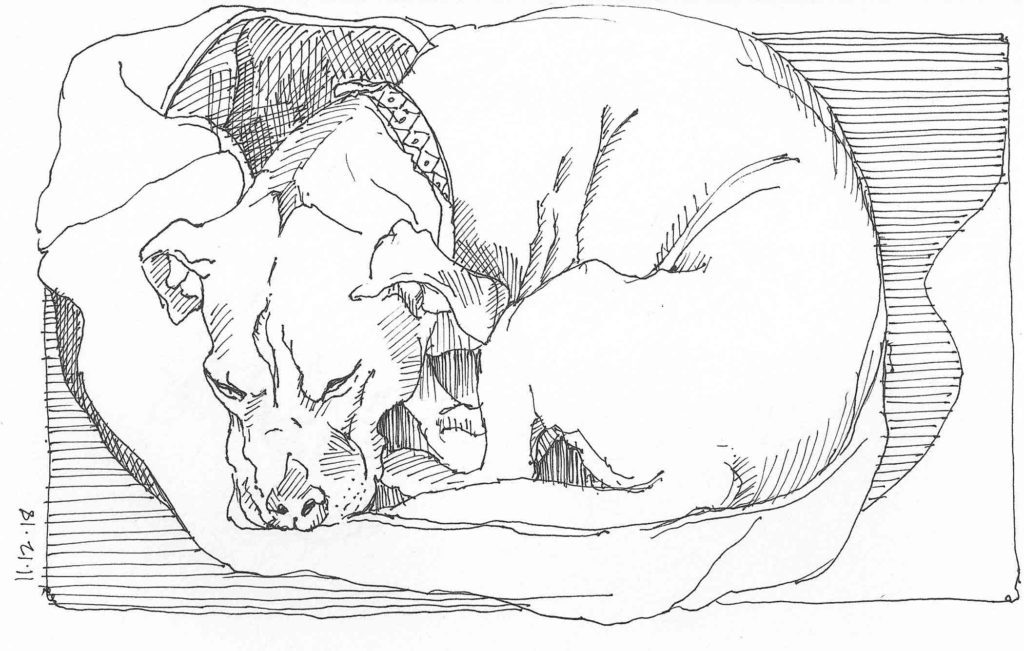
If you’ve been paying attention to my sketches and what I’ve written about them over the past several years, it won’t surprise you that I think a lot about composition. It’s the glue that holds all other elements together, as well as contributing an accessible pathway toward new discoveries.

Hiding

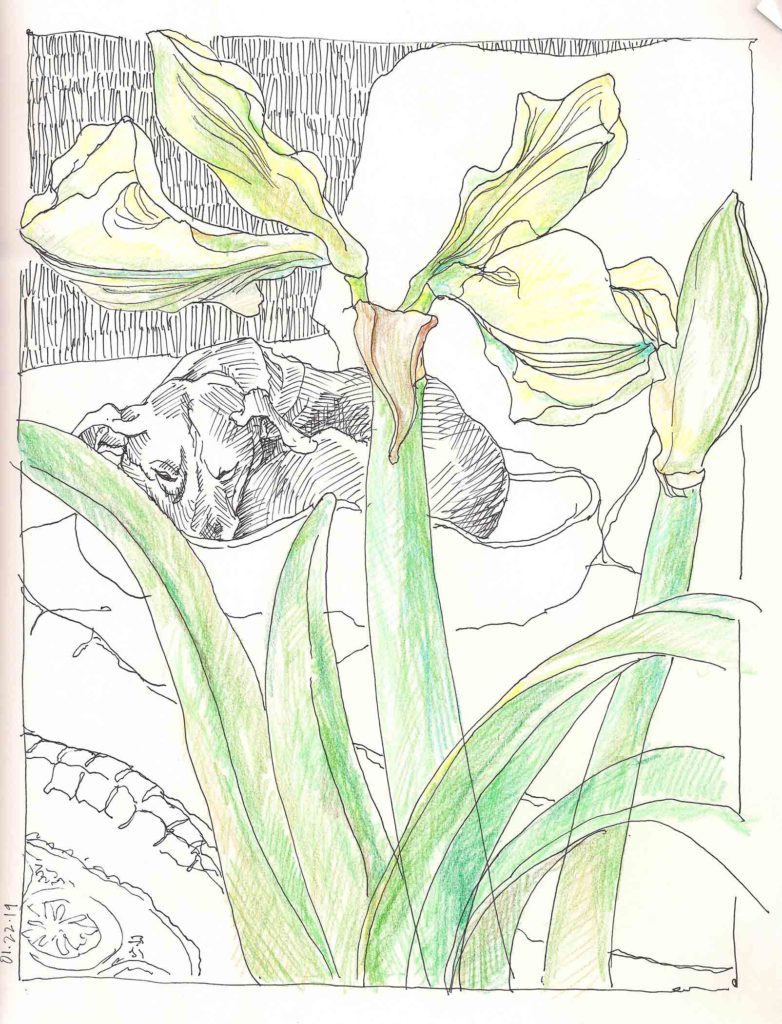
Hiding     ©2019 Elizabeth Fram, 11 x 8.5 inches, Ink and colored pencil on paper.   If you haven’t been following my sketches, you might not realize that lump in the background is Quinn, snuggled up in her bed at one end of the sofa.

Lately I’ve been playing around with the idea of including two focal points within a composition. My first stab at this approach was serendipitous, not intentional. Initially I just wanted to record a fading candy-striped amaryllis, but it soon became apparent that the flowers didn’t hold enough weight on their own for the drawing to feel complete. The decision to bring Quinn into the background not only added much-needed muscle, but by limiting color to within the amaryllis alone, an interesting tension arose between the foreground and the background.

Behind, Between

Behind, Between     ©2019 Elizabeth Fram, 11 x 8.5 inches, Ink and colored pencil on paper.

Thinking about that sketch afterward, and the way its various elements came together, made me realize there is something deeper to be mined in a drawing that balances two subjects. And, by including a bit of healthy competition between color (as an entity unto itself) and pattern (or marks), I think the overall effect has the potential to become even more compelling.

Frida Twins

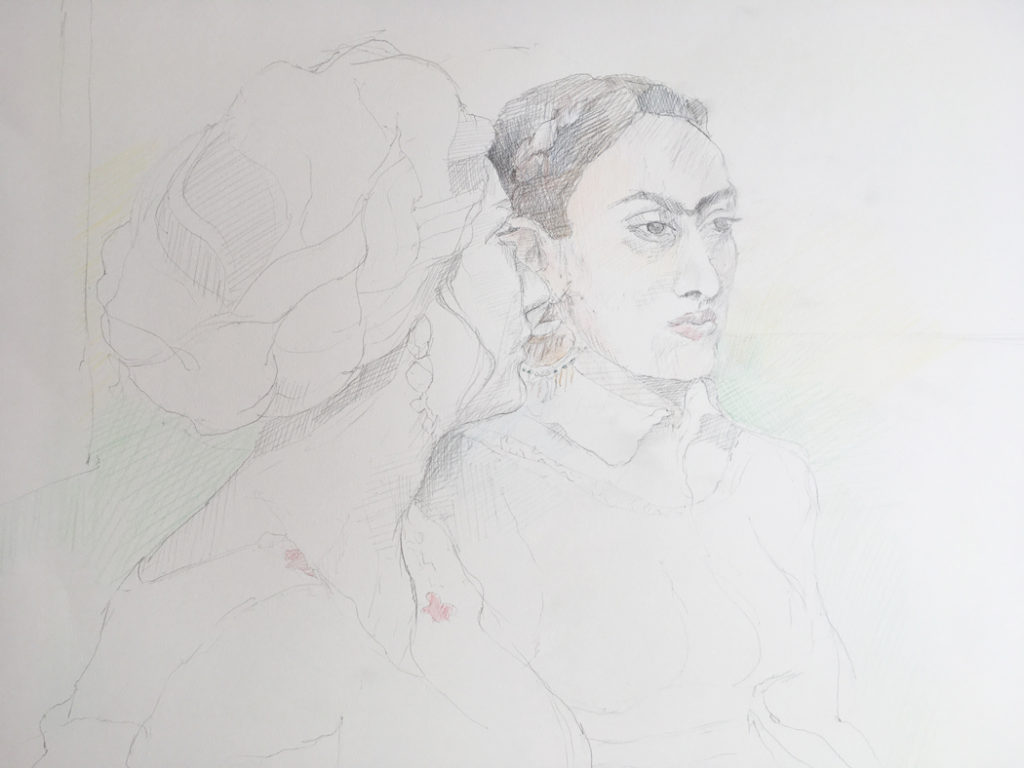
Frida Twins     ©2019 Elizabeth Fram, 18 x 24 inches, Graphite and colored pencil on paper.                    One of our regular models occasionally brings her twin sister to sit with her. This day they were both fully decked-out as Frida Kahlo, and drawing them from this angle became my “aha” moment.

It was pure luck that we had two models instead of just one at life drawing a couple of weeks ago. That session, on the heels of the first sketch with Quinn and the ones that followed it, cemented the idea that this is an approach I should investigate further.

Alexis Too

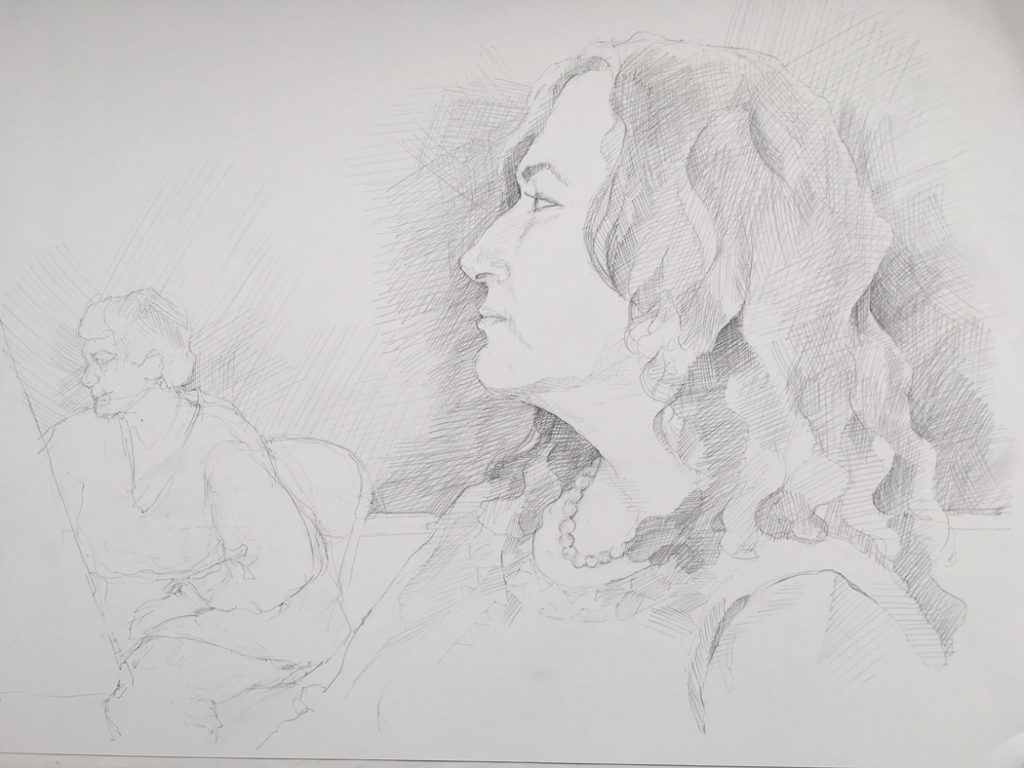
Alexis Too     ©2019 Elizabeth Fram, 18 x 24 inches, Graphite on paper                                                          This week, looking beyond our model, I experimented with including another member of our group. The fact that she was concentrating so deeply made it easier to capture her. The contrast between the more detailed figure and the sketchy one make for a more interesting drawing, I think.

I really enjoyed discovering Kate Park’s work and website this week. Maybe you will too.


Pleasure and Privilege

Making art is something of a ‘Get Out Of Jail Free’ card.

Yes, the stripped down beauty of a snowy landscape has a unique subtlety that many of us who choose to live where winter is serious business appreciate and even relish. But that doesn’t mean we don’t sometimes miss the full-blown colors of our gardens and of the local countryside that currently lie dormant under a blanket of snow.

Work in Process, Full

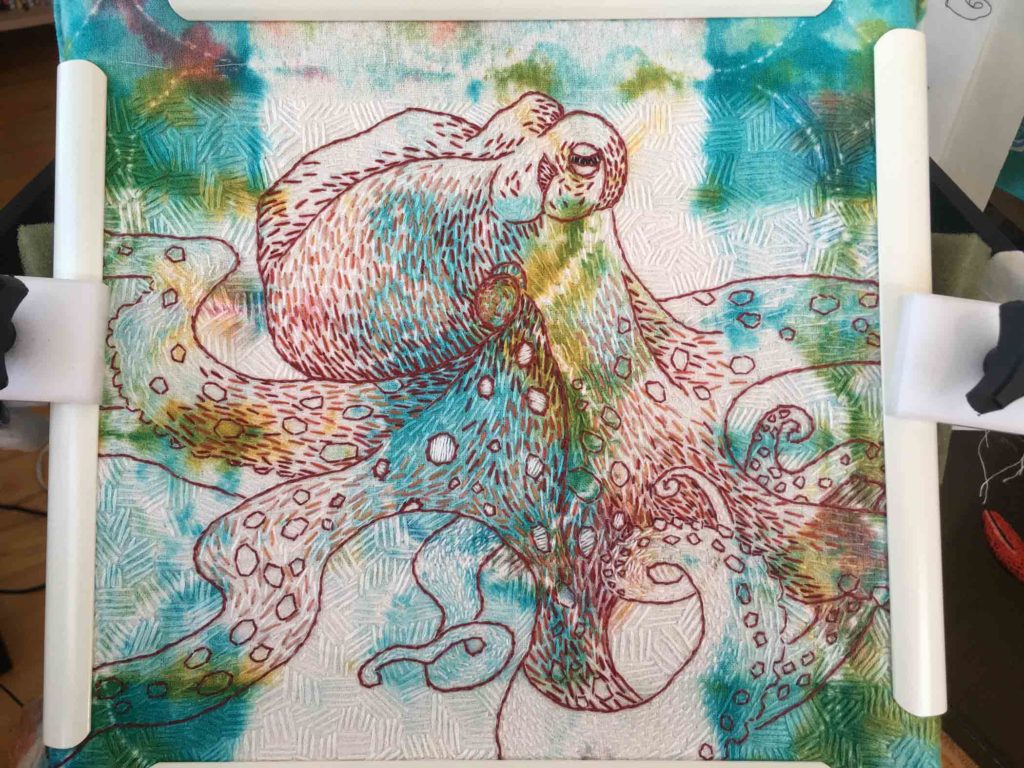
©Elizabeth Fram    Mid-process

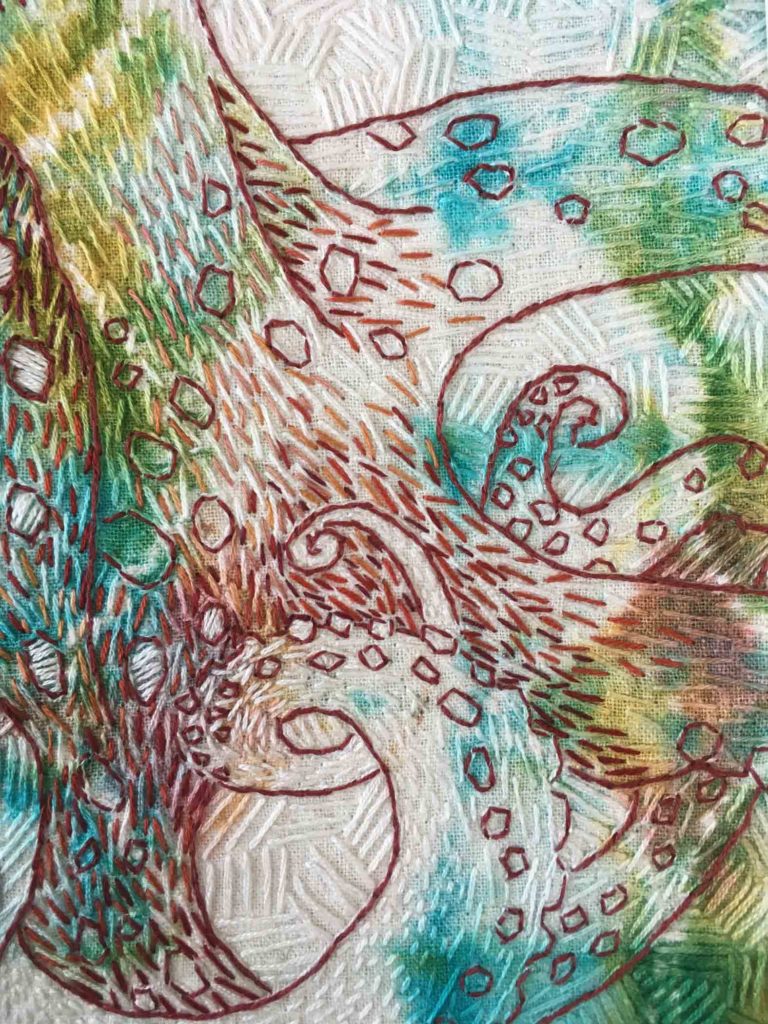
There is rich privilege in being immersed in color every day via drawing or stitching or dyeing. It’s an advantage I don’t take for granted. And perhaps for just this reason, I find the current phase of this piece – defining the octopus with color – the most enjoyable of all the various steps that have led up to it.

Do you remember the color theory exercises comparing two colors that seem completely different, but which are actually identical? The point being that their appearance is drastically affected by the color surrounding them. For an example of this phenomenon, check this out. That’s one of the key factors that brings so much pleasure to this current process of fleshing out the image. Each stitch is influenced by the color of its neighbors, as well as by the varying shades of the dyed silk ground it is sewn upon. That interaction creates a visual richness that at times seems almost melodic.

Work in progress, detail

©Elizabeth Fram, detail

It’s a fascinating process and somewhat addictive. I have to set a timer to remind myself to stop and get up to stretch because I get so lost in the rhythm of stitching and the desire to see how new interactions between colors will evolve. The wonderful bonus is that it’s also a great way to guard against any feelings of color deprivation that can often be mid-winter’s calling card.

How is a parterre like a patisserie?

I’ve begun watching Monty Don’s 3-part series Gardens of France. Drawing a parallel between the 17th century gardens of André Le Nôtre, creator of the gardens of Versailles, and rows of glistening pastries under glass, Don acknowledges a French cultural love of formality that lends a sense of order and harmony and balance, coupled with refinement. Admittedly, what I’m seeing in the gardens he is touring and in the display case of Carette at Place des Vosges, is a far cry from my relatively undisciplined flower beds and humble cookie creations, but the spirit of both are equally inspiring on a chilly winter day.

Back Garden in June

June in our back garden: azaleas, early phlox, and one of my favorites – American umbrellaleaf or Diphylleia cymosa, whose white flowers transform into blue/black berries on bright red stalks, and whose leaves become a beautiful mix of burgundy and gold toward the end of the summer.

Isn’t it wonderful how culture and even national sensibilities squeeze beyond the boundaries of a given discipline, surfacing in the arts and daily life?

Book Report

One of my aims this year is to read more about and by female artists. So far, I’m off to a decent start with 2019’s first two selections under my belt: Nell Painter’s Old in Art School: A Memoir of Starting Over and Devotion by Patti Smith. It was pure luck, but they read surprisingly well in tandem with each other.
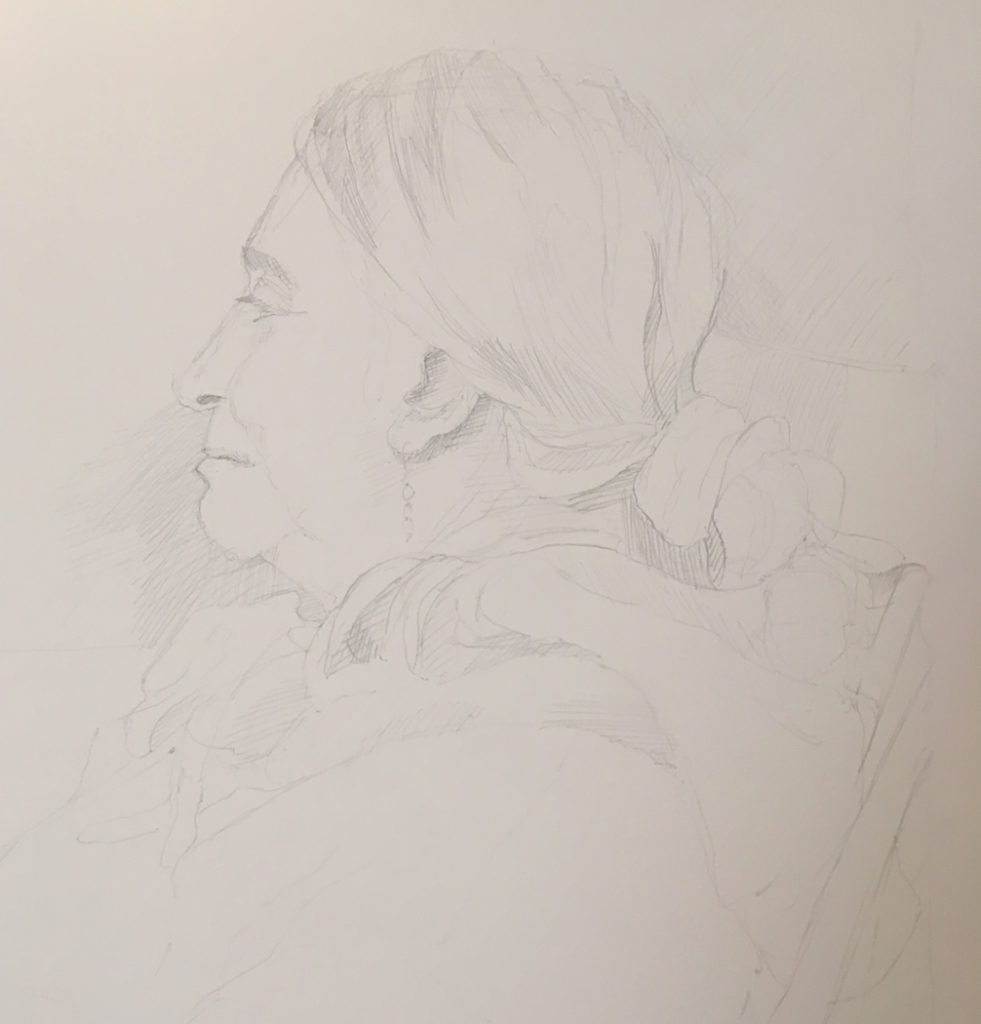
Nell Painter is a lauded historian with a remarkable list of accomplishments to her credit: Princeton professorship, honorary doctorates from the Ivy League and beyond, presidencies of professional organizations, and author of eight books. At the age of 64 she decided to retire from Princeton and to go to art school where she achieved a BFA from Mason Gross School of the Arts at Rutgers, followed by an MFA from RISD.

There are many levels to Painter’s book, too many to delve into in any depth here. But trust me, you will find it rewarding for its honesty as it cracks open the quandaries of art school, the ensuing struggles Painter encountered, and finally, the enriching wisdom and satisfaction she discovered.
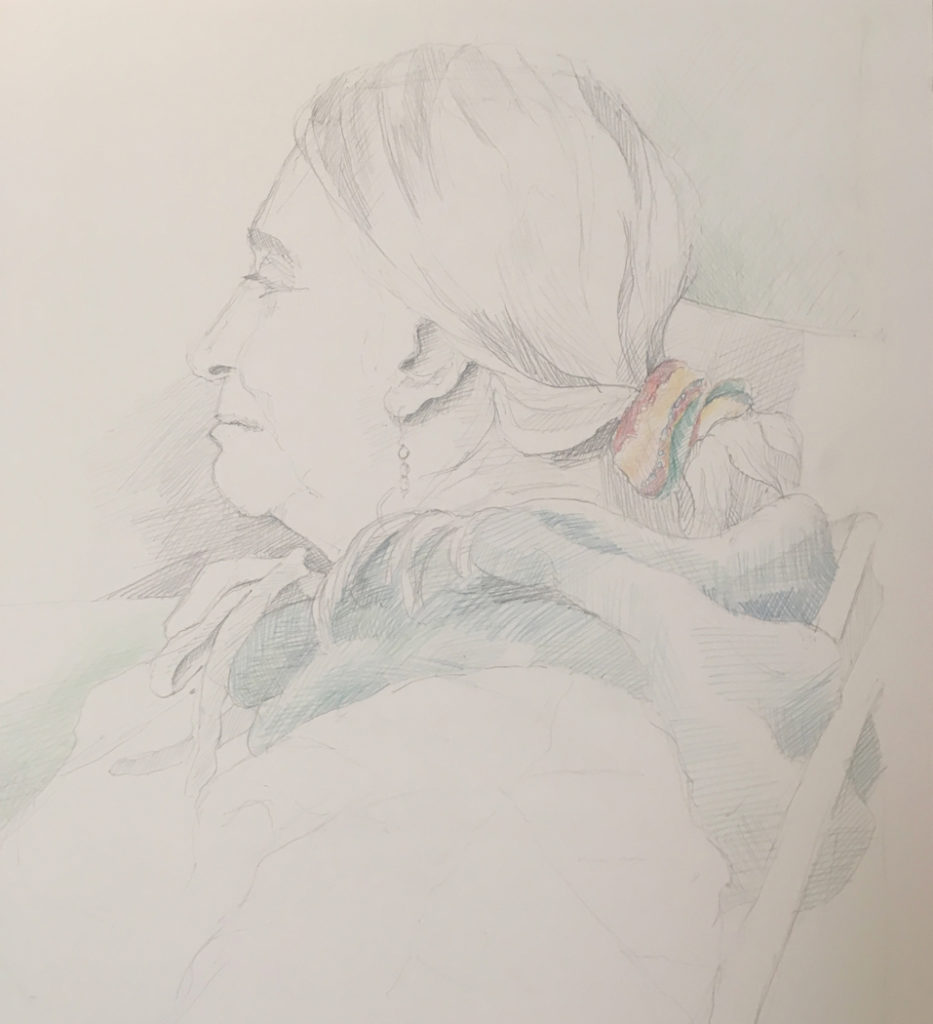
Painter was used to navigating the world as a woman and as a black person, yet adding the element of being seen – and at times not seen – because of her age, caught her by surprise. In many ways that issue was the defining fact of her experience, begetting this book.

Her discussion of coming to terms with viewing and making art with “20th-century eyes”, in a program where her fellow students and her teachers were looking through 21st-century eyes, was very enlightening for me. I too struggle to appreciate and understand cutting-edge work and methods, finding comfort and familiarity in formalism. I am all the more convinced in reading Painter’s memoir of the need for artists and curators to write and talk coherently about changes in philosophy, making new thinking accessible to all, assuring we stay in the loop as ideas evolve.
Katharine 5

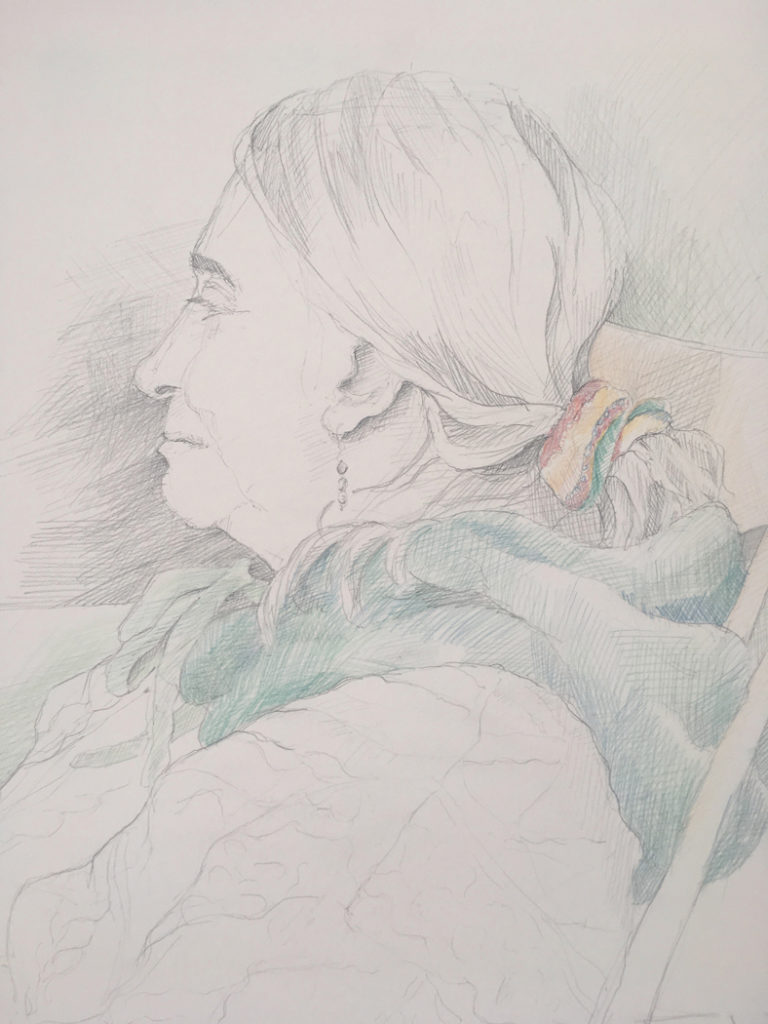
Katharine     ©2019 Elizabeth Fram, 24 x 18 inches, Graphite and Verithin pencil on paper                           I am playing with adding color sparingly, hoping for a spark of life without interfering with the sense of line I’ve established. Verithin pencils are very hard and, unlike most colored pencils, allow me to carry this idea forward with crisp, discernible marks.

A subject that struck a chord for me was Painter’s in-depth acknowledgement of the soul-crushing difference, understood by her professors and all in her graduate class, between being an artist (small letters) and An Artist (proper noun). It was a distinction she hadn’t known existed before matriculating, but one which strongly impacted the level of respect afforded her and her work, as well as the opportunities (or more accurately, lack of opportunities) that came her way. “An Artist” is one who willingly sacrifices everything for her art, unable to let anyone or anything step between her and her vision/work. This was a commitment Painter was, and is, unwilling to make.

She muses on the subject:

“Serious artist? Yes. I make and show my work regularly.
Professional artist? Yes, I get paid for my work.
An Artist artist? Probably not, probably never, because I still do other things.”

I am sharply reminded of the easy dismissal and lack of guidance I experienced from my college art advisor (at a liberal arts school, for heavens sake!) who felt that my ongoing interests in other subjects disqualified me from meriting his full tutelage. From my now much older vantage point, grateful for the experiences I didn’t miss, I still find it ridiculous that finely-tuned and perhaps artificial definitions dictate structures that can have such long-reaching and detrimental sway.
With that in mind, Patti Smith’s short and sweet Devotion also addresses the subject of being An Artist. Similar to her 2015 book M Train, Devotion opens a door into her process, allowing us to walk silently with her as she straddles the unseen line between a humbly “regular” creative life and the extraordinary advantages afforded her by virtue of her astoundingly wide knowledge, coupled with her fame. Sandwiched between her creative reflections is a jewel of a short story that articulates an intriguing definition of “An Artist”.

How fortuitous to have read these two books in succession!
Siouxsie2

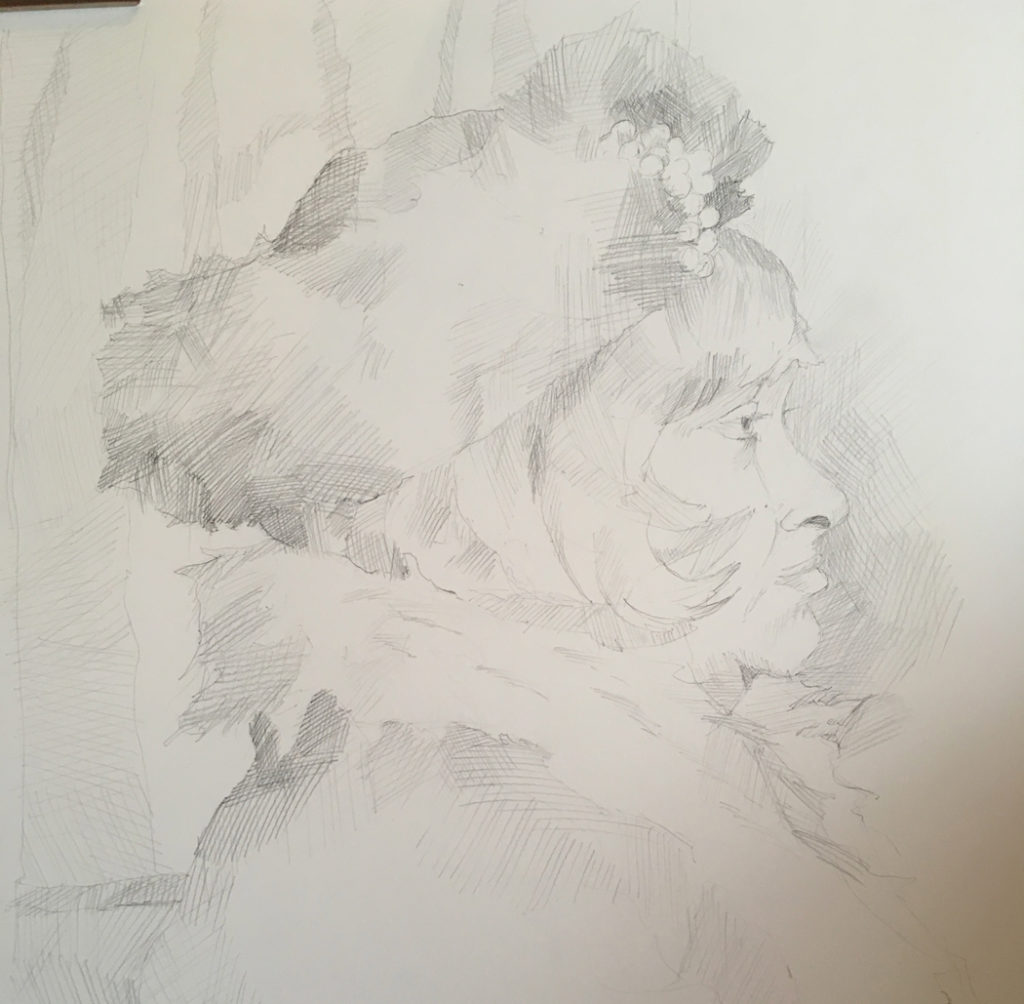
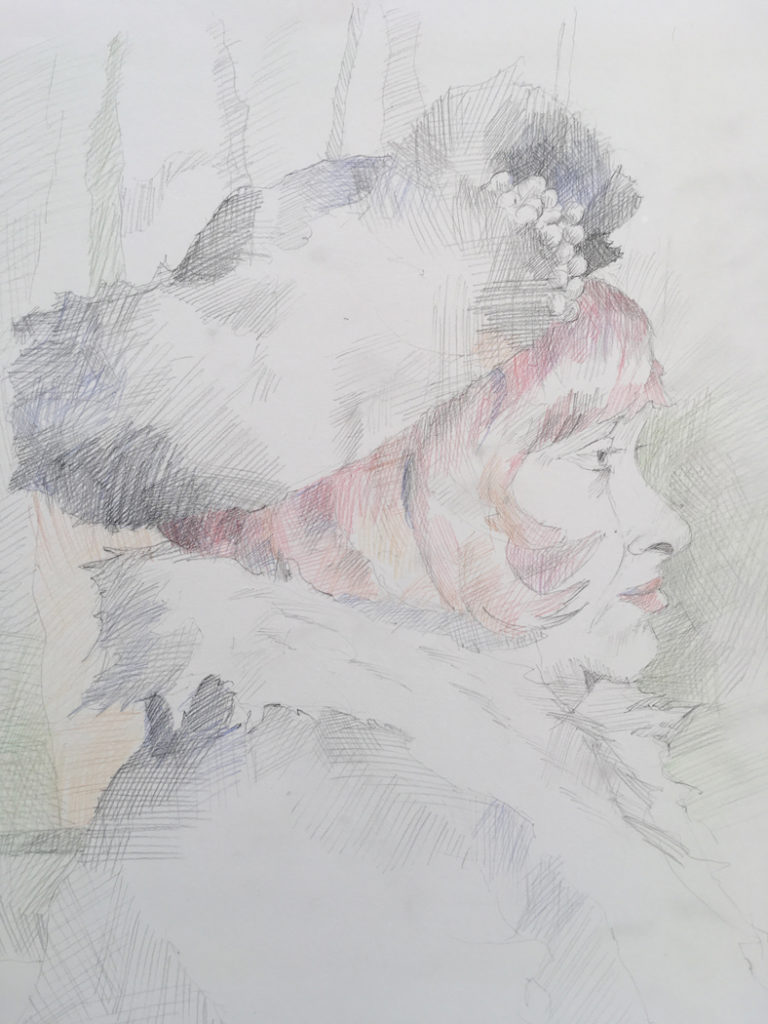
Siouxsie     ©2019 Elizabeth Fram, 24 x 18 inches, Graphite and Verithin pencil on paper

In the beginning of her book Painter asks “Why would I want to go to art school?”
Answer: “The pursuit of pleasure. Concentrating on what I could see gave me intense pleasure, and seeing what I could make with my own hand and according to my own eye was even more satisfying. Mark making and mixing and applying color contented me deeply, just the very process of putting line on paper, brush on canvas. Art stopped time. Art exiled hunger. Art held off fatigue for what would have been hours as though hours hadn’t really passed. Pleasure. Satisfactions. Contentment.

Isn’t that exactly it, in a nutshell?

The PBS Newshour did a short segment on Nell Painter and her book last year. As they often do, the segment finished with a quote: “Research shows that people creating art are 73% less likely to develop memory loss or dementia.” And, along the same lines, this recent New York Times article discusses how drawing offers a better way to remember things. Very encouraging on both counts!
Back to Normal

Things are starting to feel like normal again, now that all the holiday trimmings are packed away, the thank-you notes are written, and the extra cookies are safely frozen — out of sight and mind.

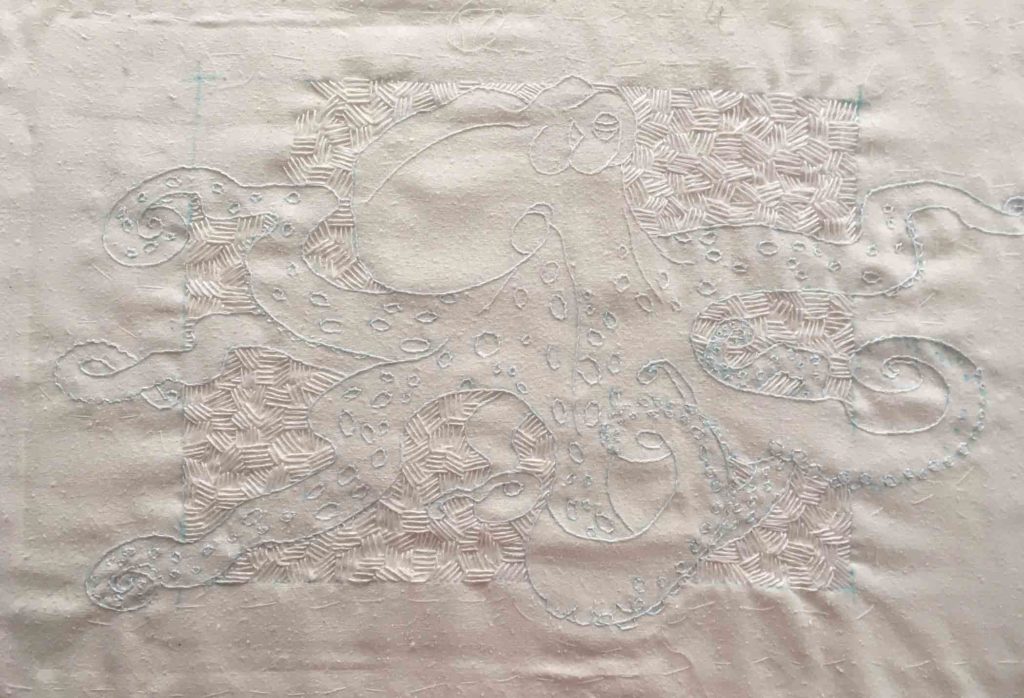
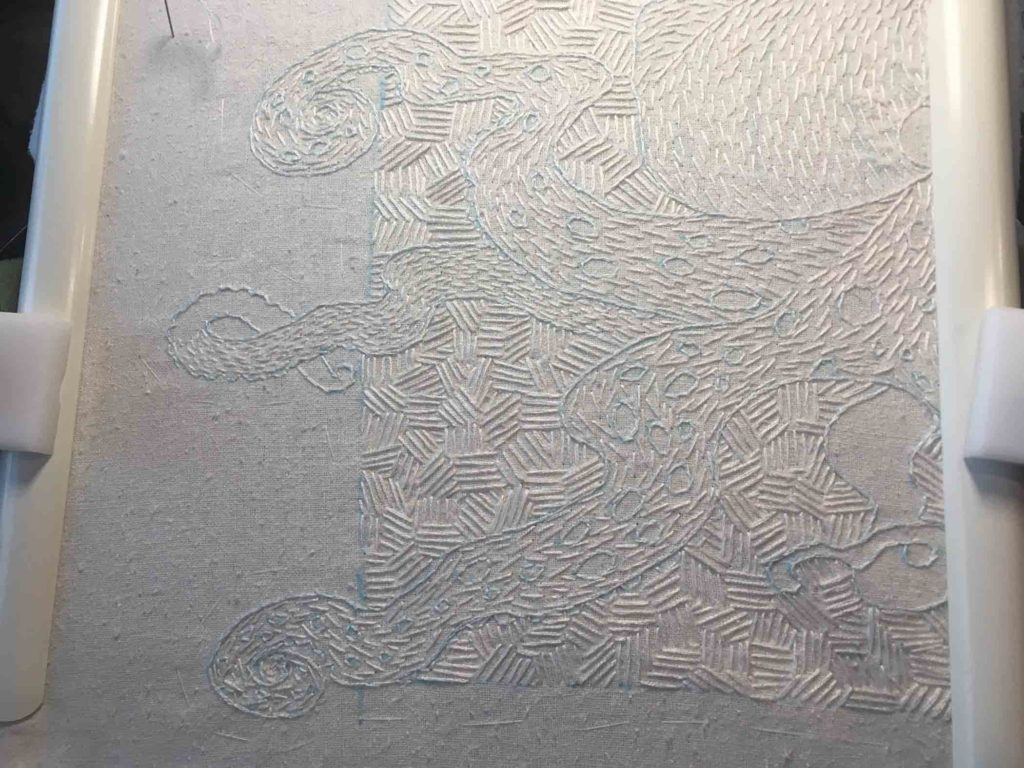
Octopus 1

©2019 Elizabeth Fram        It’s a big milestone passed once the general outline of the image is stitched in. Eventually this piece will be 18 x 24 inches; the rectangular area is 9 x 12 inches. (Not sure why there is a reddish tint to this photo – it’s a trick of the eye, not part of the work).

As I sit down to stitch this week, it feels like forever since I last had my needle in hand. This octopus piece, that was begun in early December, got sidelined when I ran out of silk thread and my local supplier was closed for an indeterminate amount of time. It wasn’t as easy as I thought it would be to replace my depleted stock, but in case you’re ever in a similar predicament 123Stitch.com in Utah turns out to be a speedy and reliable vendor. Not exactly local, but great in a pinch. And, I certainly learned a valuable lesson about keeping one step ahead of my materials.

Octopus 2

©2019 Elizabeth Fram     This time around I’m making a concerted effort not to lay the stitches in too tightly, knowing that I will likely be restitching the whole thing once it’s been dyed in order to pull the image out from the dye.

Meanwhile, as December got fully underway, I began to realize that there are only so many balls one can have in the air at once. So this piece took a back seat while I gave in to holiday preparations. I still kept my head in the game though by reading The Soul of an Octopus by Sy Montgomery. It’s a fascinating book that has given me plenty to think about regarding these amazing creatures.

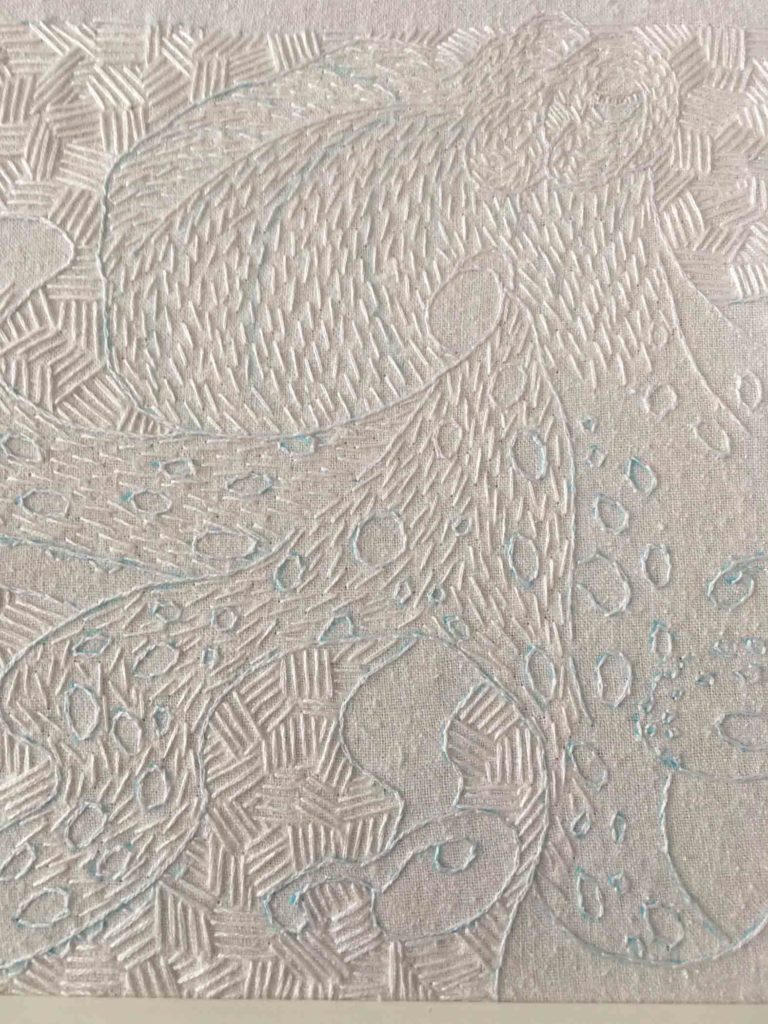
Octopus 3

©2019 Elizabeth Fram    I definitely have a romance with the patterns that develop and the way they work together.

And once again, I’m grateful for my sketchbook because, despite all the other stuff going on, I could manage to squeeze time for drawing in around the corners of everything else. So December turned out to be a relatively productive month art-wise after all and, in hindsight, the change of pace was probably a good thing.

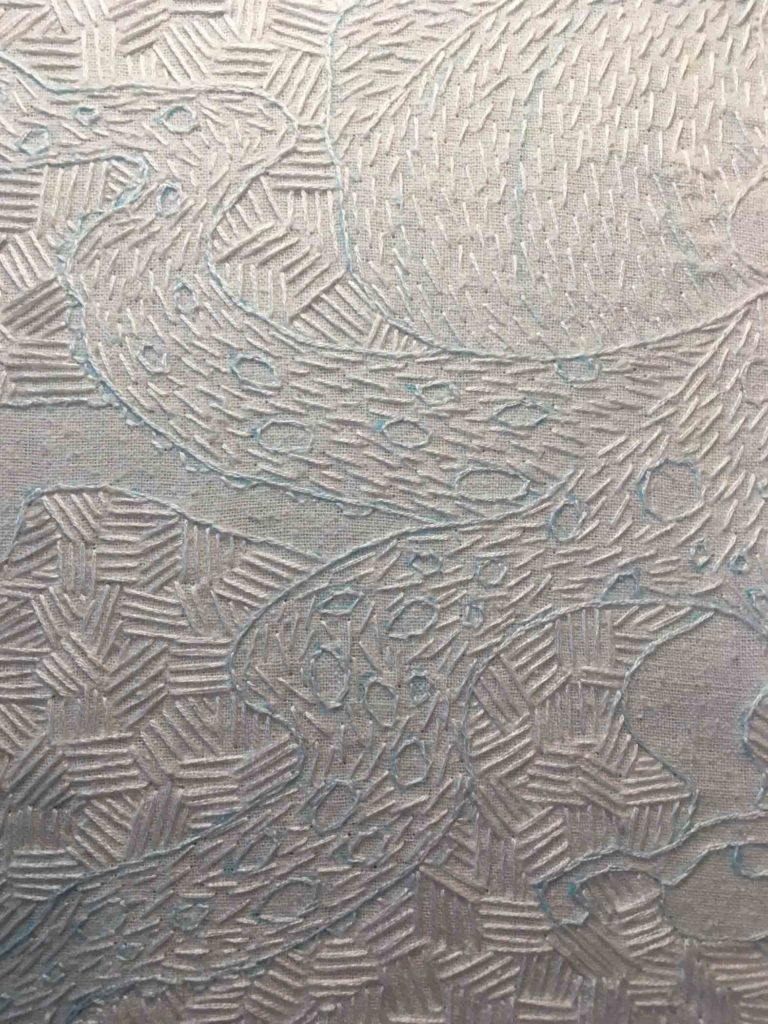
Octopus 4

©2019 Elizabeth Fram     There’s only so much that can be done at this stage. The real work will begin once the piece is dyed and it’s time to bring this guy to life.

But now, in these expansive weeks of January, it feels great to be back to a normal routine and to start to see this fellow take form.

On A Different Note______________________________________________________________________________

I am honored that my piece “Crescendo” was featured in Alyson Stanfield’s Art Biz Success blog post on writing artist newsletters this week. I hope you will check out the post, not just to see my piece, but because, as usual, Alyson offers terrific ideas and tips. Over the years Alyson has been one of my best resources for learning about the business side of art. Aside from her blog, her book I’d Rather Be In The Studio is a must-read for any artist.

Reminder for subscribers: Despite best intentions, sometimes technical glitches occur. Last week was another of those times. FYI, I always publish my blog on Thursdays, and if all goes as planned, it is delivered at 4am the following day into subscriber inboxes. If, for whatever reason that automatic delivery hasn’t happened on a given Friday, I will send out another email with a link to the current post. Yet you can also always head directly to the site (https://elizabethfram.com/Blog) on your own. Thanks so much for your continued interest!


Green Mountain Generosity

Hard to believe, but 2019 marks 10 years since our nest emptied and my husband and I moved north. Relocating to Vermont was one of the best decisions we ever made.

It may be small and sparsely populated compared with most other states, but the people here are fiercely engaged — globally, nationally, and locally. That attribute has proven true – and then some – for the art community as well. It is a strong and vibrant force that, by the way, is fully supported by our congressional delegation who have continually gone to bat to maintain NEA funding, recognizing the importance of the arts to our economy and our well-being.

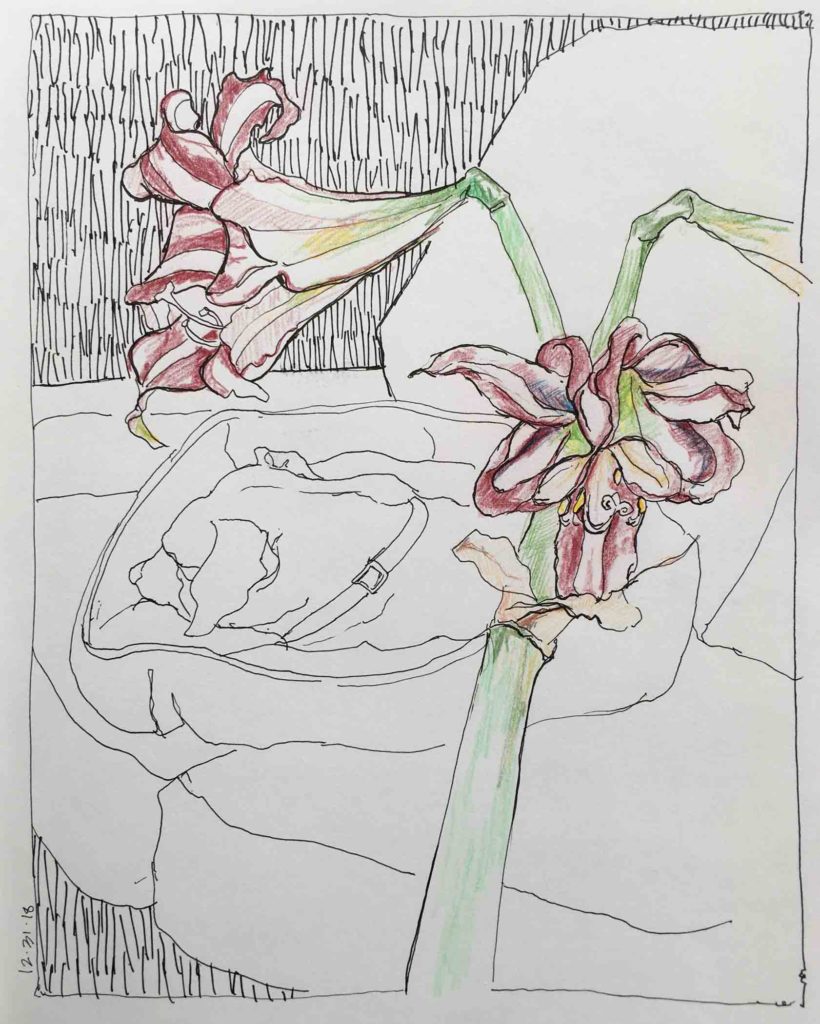
Amaryllis

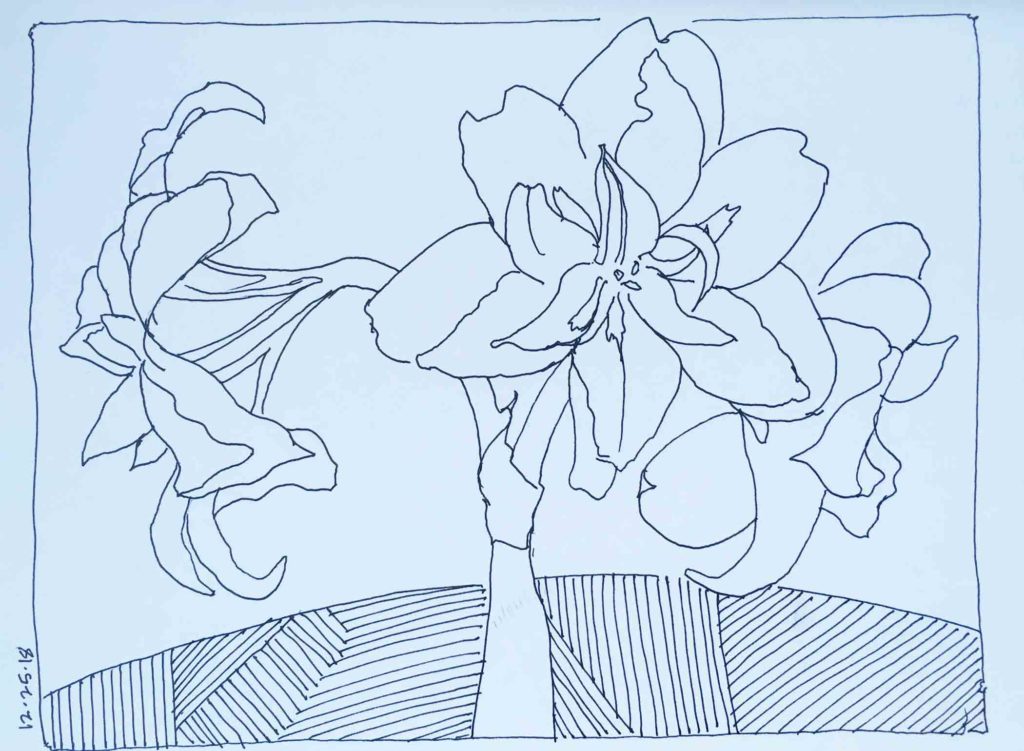
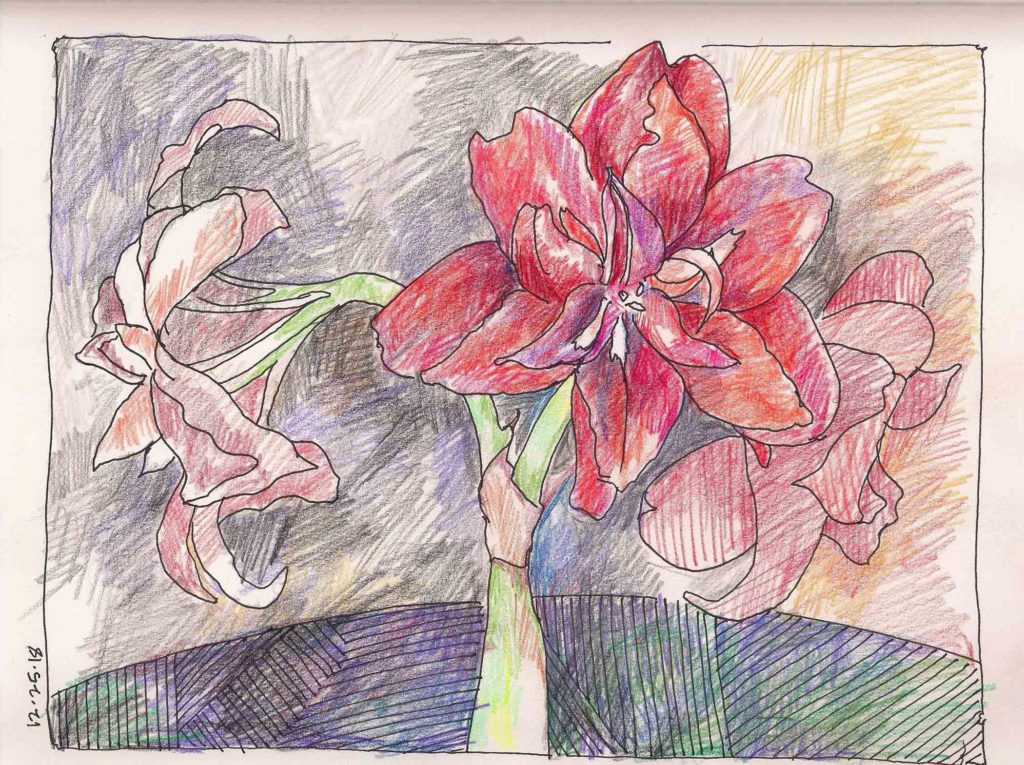
Amaryllis     ©2018 Elizabeth Fram, 11 x 8.5 inches, Ink and colored pencil on paper    One of my goals this year is to incorporate color into my sketches / drawings. Bear with me as I start to figure this out.

But above and beyond that, the generosity of many of the artists I have met here sets a tone I haven’t experienced in the other places we have lived, and that humbles and inspires me. In the decade that we’ve lived here, I’ve gotten to know some remarkable people whose commitment, not just to their own work, but to those of their fellow artists, is quite remarkable. There are numerous (too many for me to outline here) Vermont artists who, in my mind, lead the way by forging connections between their work, and/or the artwork of others, with the community beyond the art world, for the betterment of all.

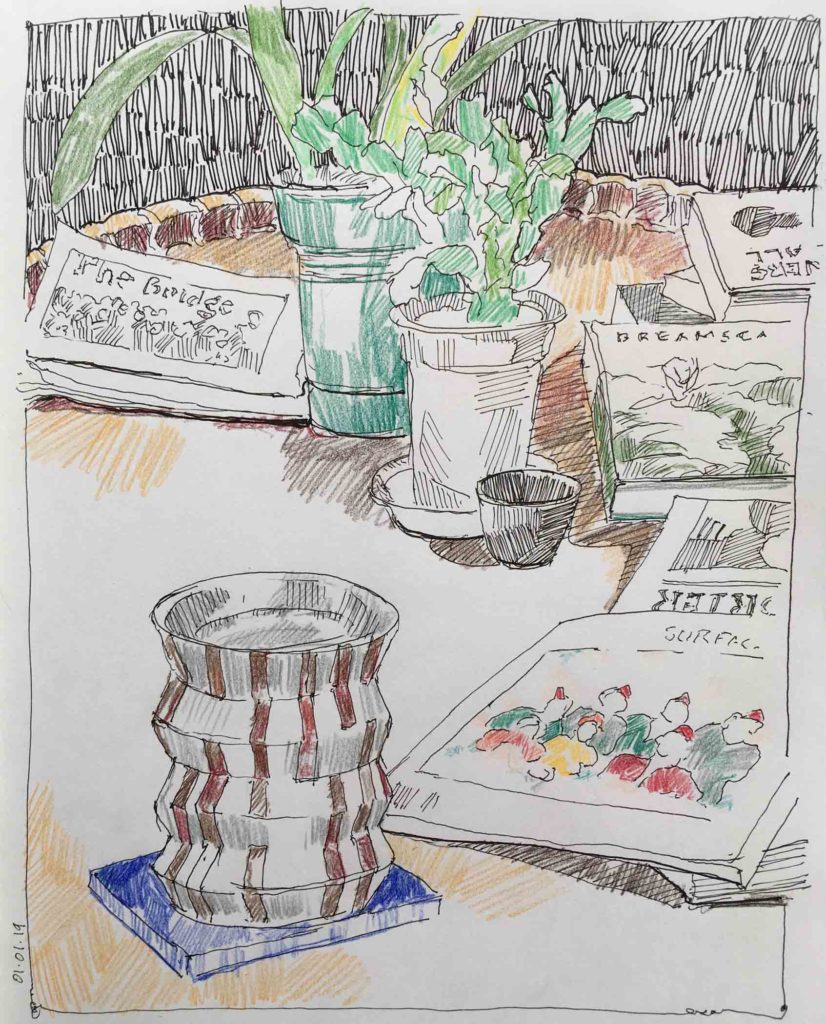
The Bridge

The Bridge     ©2019 Elizabeth Fram, 11 x 8.5 inches, Ink and colored pencil on paper

All that said, I was particularly moved by the most recent newsletter from Barre painter Patricia Leahey Meriam. It underlines her devotion to her art beyond commerce as she fosters the indescribable connection we all seek between our work and those who view it — and hopefully want to live with it.

In addition to the many other hats she wears, Patty Meriam makes work that promotes environmental activism. Among other honors, it’s worth noting that last year she was inducted into the National Association of Women Artists. But beyond those distinctions, Patty has committed to donating 5% from the purchase price of her work to a cause of the buyer’s choice from a list of organizations that she also supports. Pretty remarkable!

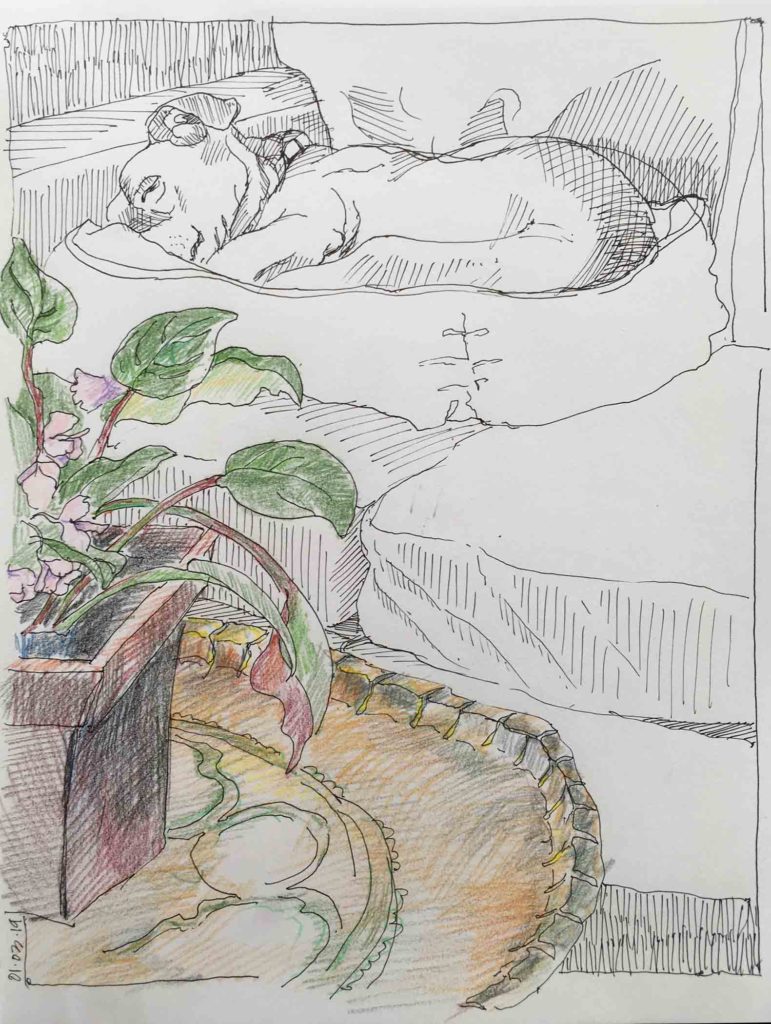
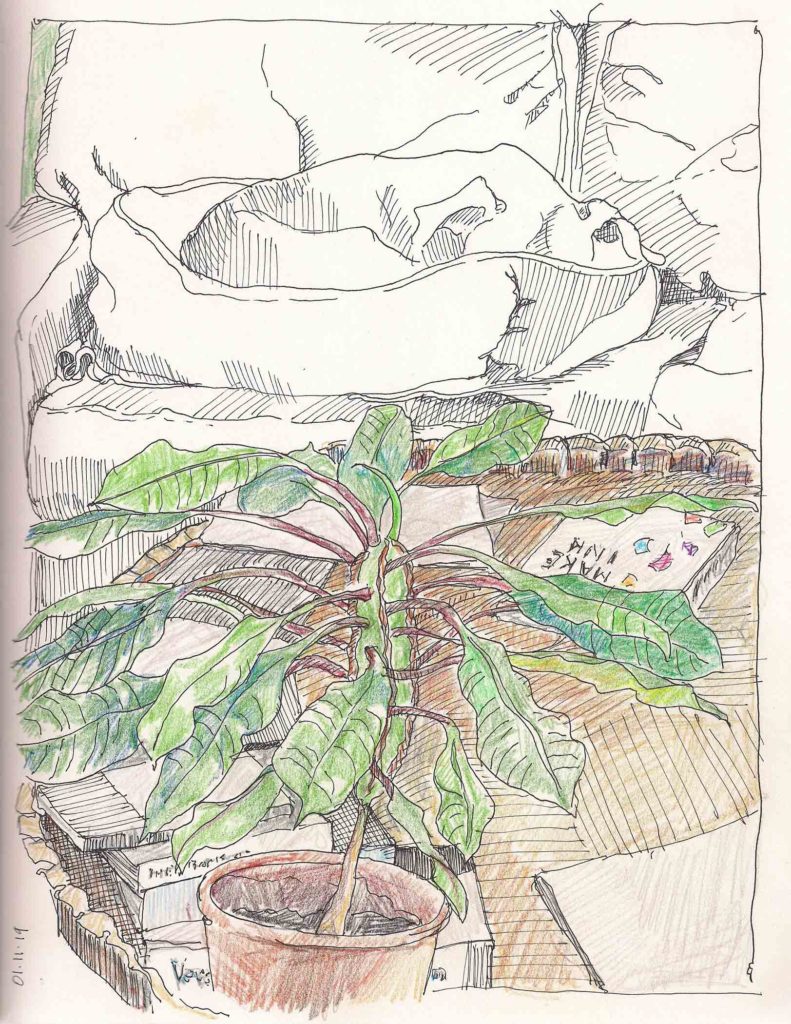
African Violet

African Violet     ©2019 Elizabeth Fram, 11 x 8.5 inches, Ink and colored pencil on paper

But to get back to my main point, please read her newsletter The Joy of Giving, which goes one step further. It details how she set out to give away one work of art to someone who loved it but who felt it was beyond their fiscal reach, and ended up giving away six pieces. When you read the quotes from the request letters she received, you too will be moved by the power of art to truly affect lives and I think, like me, you will marvel at and find cheer in Patty’s benevolence.

On a different note:_______________________________________________________________________________

One of the final highlights of 2018 for me was learning that my work has been selected for the 2019 Textile Biennial at the Museum Rijswijk  in Rijswijk, Holland. To give you a feel for what is in store, you can view 2017’s Biennial Exhibition here. Note that their website allows for translation into English.


10 Best Finds From 2018

This year I have finally surrendered to the fact that December is a period of limited hands-on studio work. There are just too many holiday details and business-related organizational tasks that need to get done so, rather than beating myself up over lack of production, I’m going to embrace that approach and actually write it into my plan for 2019.

For one who straddles left brain/right brain thinking rather than falling solidly into either camp, I’m actively working to accept the reality of December in a positive way — not least for the comfortable element of rhythm it contributes to the year’s end. Among many other things, this final week of the year caps off thirty-one days of reflection about the past eleven months – what worked and what didn’t, and of course plenty of excitement as I look ahead.

Amaryllis Black and White

Amaryllis     ©2018 Elizabeth Fram, 8.5 x 11 inches, Ink on paper

Mulling over 2018, here are the “10 Best” that I either found or was introduced to this year:

  • Stonehenge paper  – This reasonably-priced workhorse is acid-free, 100% cotton, and comes in sheets or pads. It accepts a variety of media, wet and dry. I like its smooth surface and solid weight.
  • Saral Transfer paper – As I wrote in my March 8th post, I learned about this product from Michelle Kingdom’s interview on textileartist.org. It’s a great option for transferring an image to fabric. Because it’s available in both light and dark colors, it is possible to use with either dark or light fabrics. The only con is that it is extremely fugitive (a good thing in the long run), so you have to handle the transferred image very gingerly so as not to rub it off too early.
  • I learned about jazz musician Tommy Flanagan from one of my life drawing mates. Find him on Pandora or Spotify for hours of fabulous background music for drawing, writing, or just plain thinking!
  • What would I do without podcasts to listen to throughout long stretches of stitching? Here are three that have become my new “go-to’s”:
    • But That’s Another Story with Will Schwalbe.  Asking the question ‘can one story change the course of your life?’ these one-on-one discussions cover the moments and the books that most affected each creative interviewee (mostly writers).
    • Just The Right Book! with Roxanne Coady. As a bookseller with an online book subscription service by the same name, Coady caters to individual tastes. Her podcast is a series of in-depth discussions with authors that are much more than a mere recap of their writings. Try this fascinating episode with author/historian Joseph Ellis: What the Founding Fathers Would Say About America Today
    • Revisionist History with Malcolm Gladwell. If you’ve read any of Gladwell’s books you will appreciate his penchant for above-and-beyond research. This series reinterprets something from the past: a person, event or idea…something, as Gladwell puts it, overlooked or misunderstood.
  • My Modern Met – A feast of art and design
  • Sun Star Delde Slide Pen Pouch – This little number is compact, yet I can fit 36 colored pencils in it — and then some. It has a water-resistant lining with a pocket, and the best feature is it doubles as a mobile stand-up holder.
  • HAND/EYE Magazine – Yes, I’m biased because they recently published my article Paying Attention, but I hadn’t heard of HAND/EYE before the editor contacted me, so I had no idea what I was missing. Because of the brevity of the articles, it’s perfect for dipping into for a quick read and it’s a tremendous resource for learning about the wide scope of though-provoking  work currently being made.
  • The Faraway Nearby by Rebecca Solnit – This was the first book I read in 2018 and, aside from art books, it is the only one of the many that followed it that I expect to return to in 2019. It is beautiful literary non-fiction that balances feeling both personal and universally resonate in the connections it draws between us all. I plan to reread it slowly and considerately.
Amaryllis Finished

Amaryllis     ©2018 Elizabeth Fram, 8.5 x 11 inches, Ink and colored pencil on paper

As a parting shot, should you need a boost as you deliberate how to manifest your creative aspirations next year, read Vermont painter Susan Abbott’s inspiring post ‘Choices’.

Best wishes for your creative and productive 2019!


Just the Facts

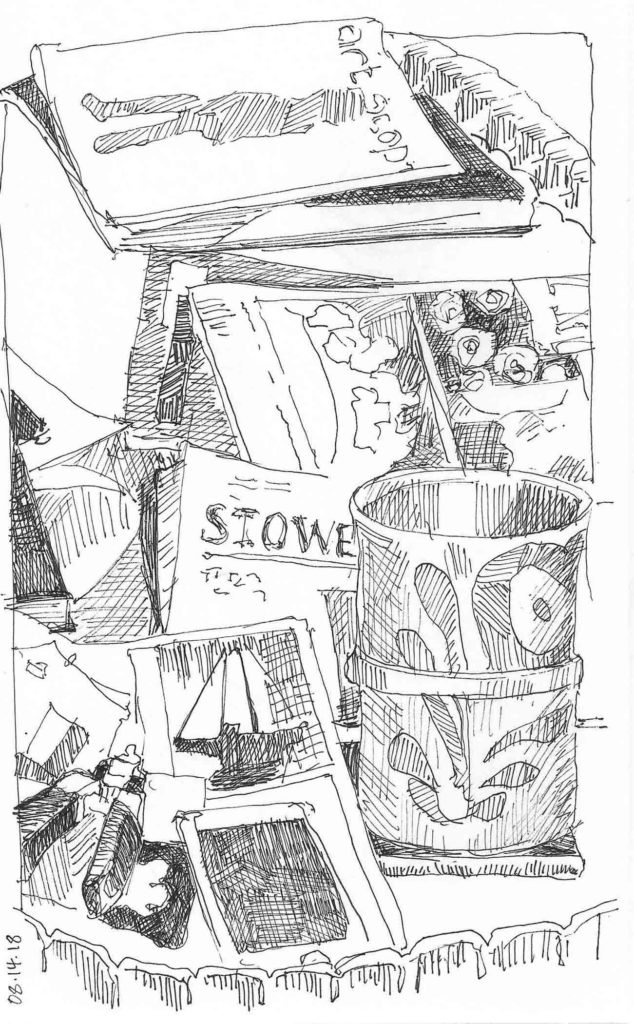
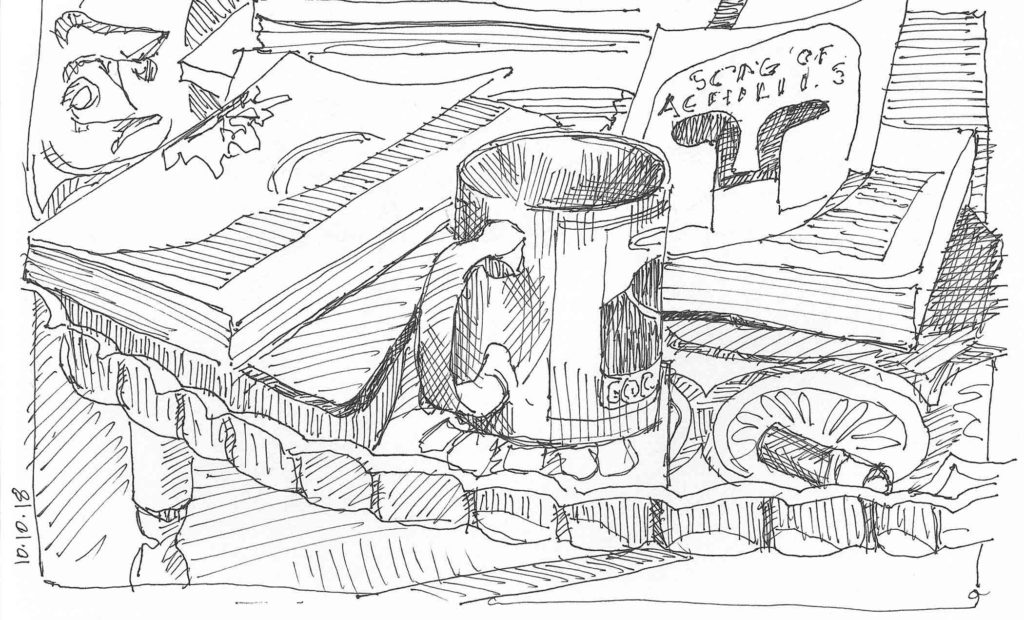
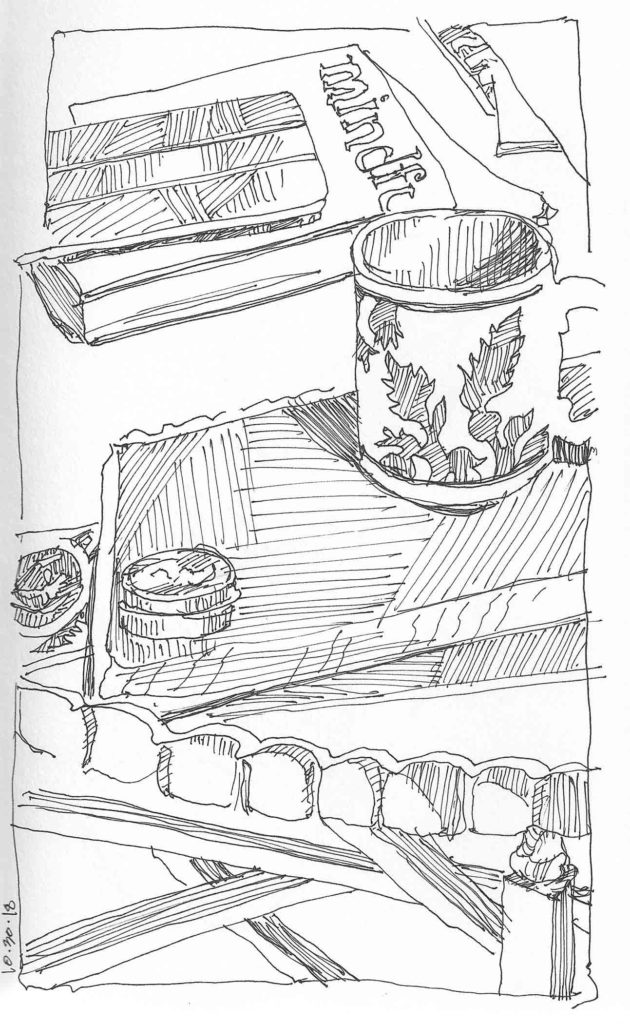
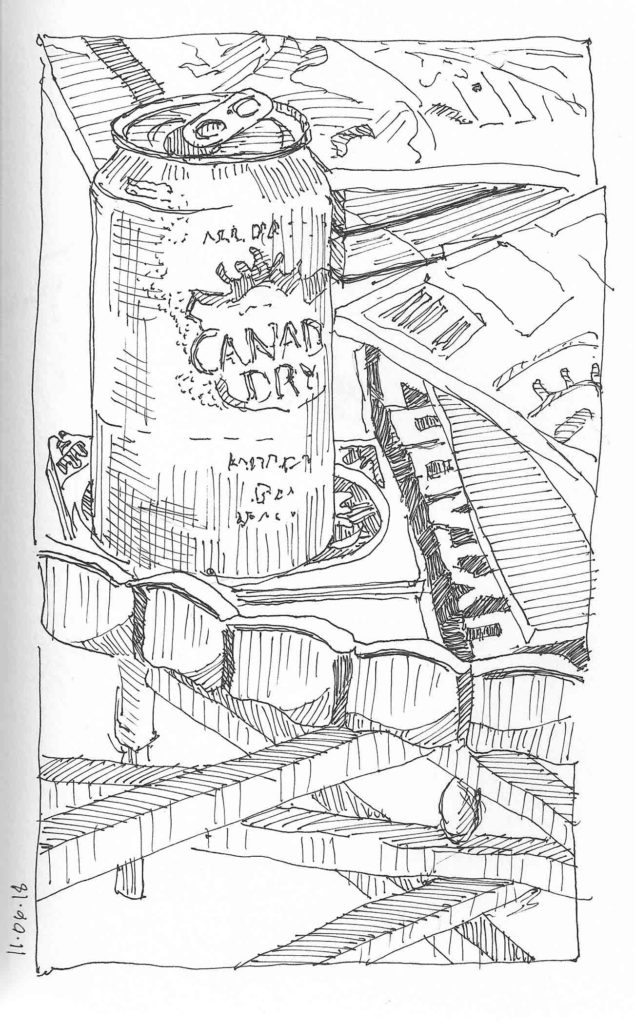
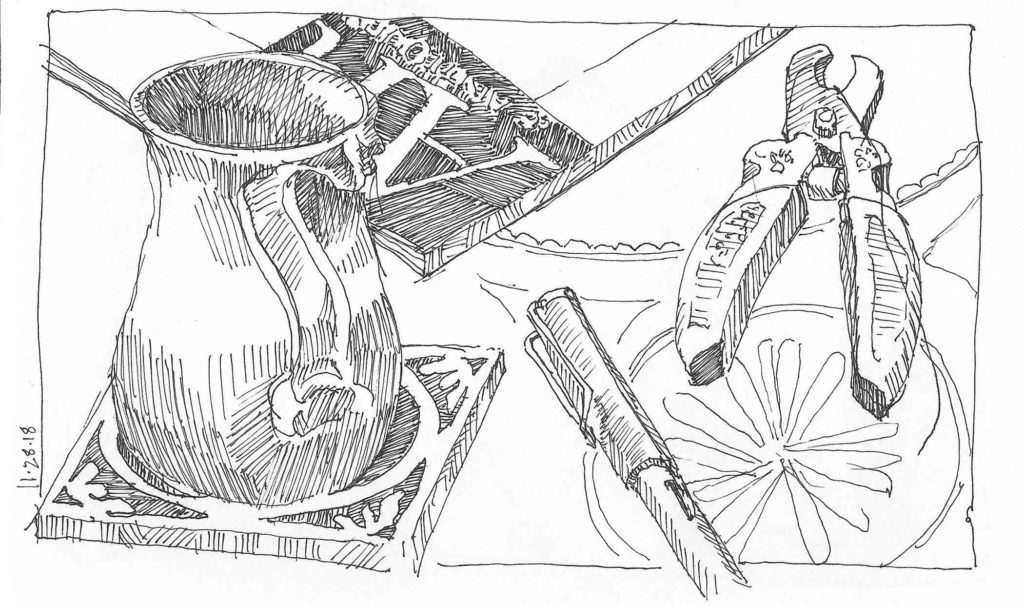
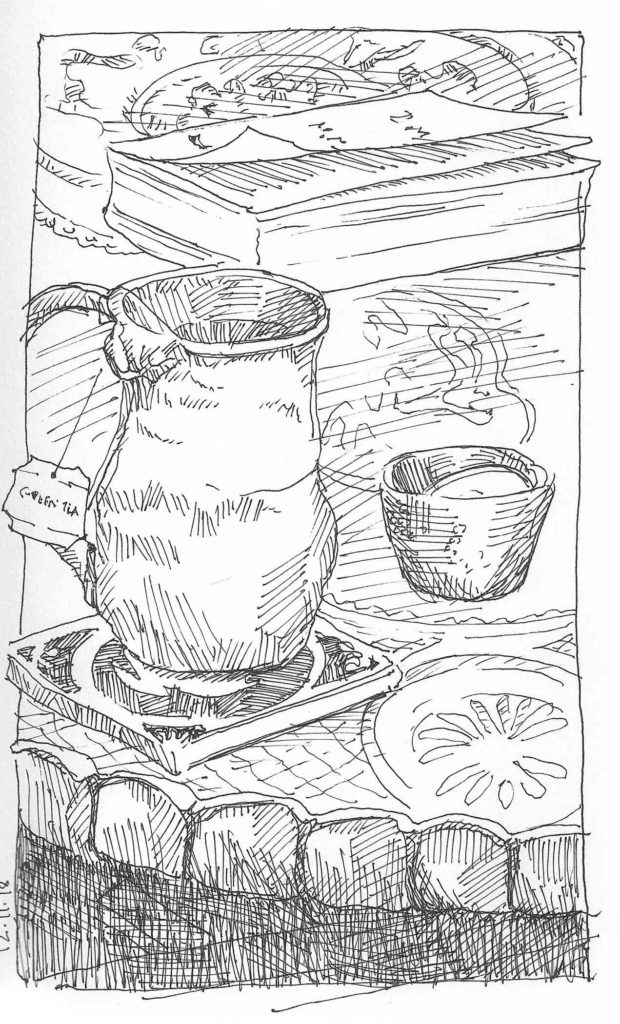
At the end of a long day one of my favorite ways to recharge is to sit on the sofa with my sketchbook, the pooch snoring beside me, and to zone out drawing whatever is right in my line of sight on the coffee table.

Art Scope

©2018 Elizabeth Fram

There is no pre-arranging or readjusting of the clutter and, unlike most of my drawings, I don’t plan around composition (although once underway I do allow myself some selective edits). In other words, there’s no sugar coating or prettying-up of these images — they are just the facts.

Song of Achilles

©2018 Elizabeth Fram

The subject is pretty much always the same – a mug of tea, cup of water, or can of seltzer that I was too lazy to pour into a glass, plus whatever jumble of books and magazines happen to be sprawled out across the surface. As I’m winding down for the day, this is a relaxing chance to practice without any concern for outcome.

Mindful

©2018 Elizabeth Fram

I inherited our coffee table from my grandmother and it has graced our many living rooms for over thirty years. Of Middle Eastern origin, it’s basically a large brass tray with “pie-crust” edges and beautiful designs and characters incised onto the surface.  I can’t begin to do justice interpreting those designs but, provided they aren’t completely covered with whatever we were last reading, sometimes I try to include a bit of them, finding they can potentially add another level of  interest and perspective to a drawing.

Canada Dry

©2018 Elizabeth Fram

The table top sits on interlocking legs that often appear at the bottom of these sketches, an element that may seem confusing if you aren’t aware of what they are. I especially like the way they create diagonals that echo the edges of the scattered books and magazines above.

Nail Clippers

©2018 Elizabeth Fram

Side note: This table carries emotional history as well as being pretty and practical. When our kids were learning to walk, they would grab onto the pie-crust edges and side-step their way around the perimeter. It’s a big oval with no corners, so I never had to worry about head bumps then — or once they were fully on the move. Funny how things change. I surely had no idea at that busy time of life that it would morph into a representation of relaxation!

One last and heartening note about the practice of drawing: I was really taken with Terry Gross’ Fresh Air interview with author/artist Jonathan Santlofer a couple of weeks ago. Did you hear it? The episode surrounds Santlofer’s newly published memoir The Widower’s Notebook, and the way that drawing helped him begin to cope with the sudden and completely unexpected death of his wife. His story about drawing during that time is quite moving and, for anyone who draws regularly, I think you’ll agree it rings quite true.
I’m looking forward to getting my hands on a copy.

Green Tea

©2018 Elizabeth Fram

Gearing Up for Next Year

Now that December is underway, it’s time to take stock of the past year, reevaluate goals, and make a game plan for 2019.

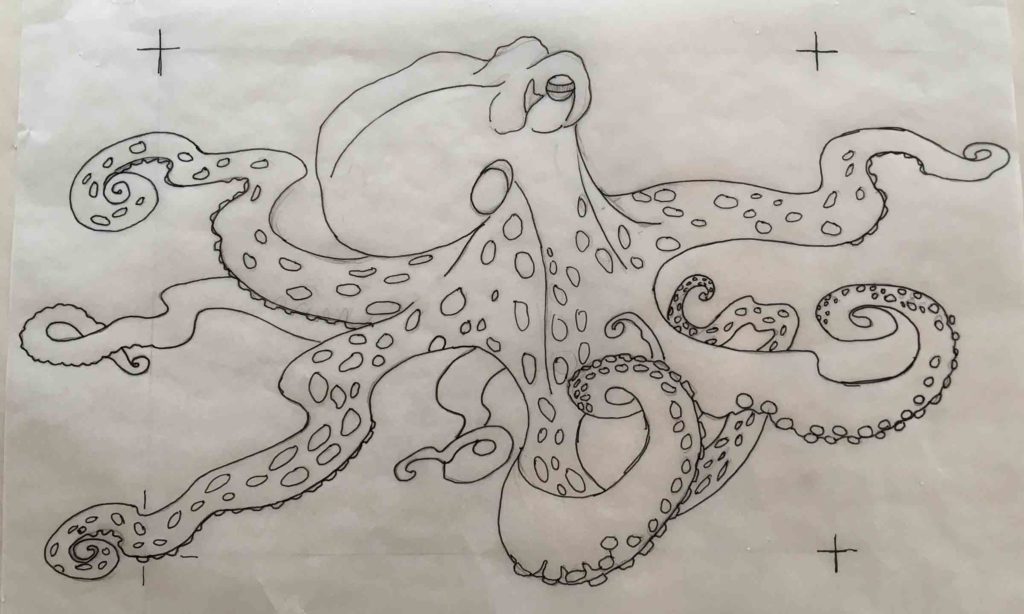
Octopus drawing

This next piece is going to be a bit larger than the past several.  The area within the crosses is 9 x 12 inches. While I was working on my last piece, I kept thinking about octopi and their interesting camouflage. This fellow should be a worthy candidate / subject to hide in a field of shibori pattern, don’t you think?

Last week I attended a webinar for creatives offered by Cory Huff of The Abundant Artist and productivity coach Charlie Gilkey. They packed a lot of helpful info into 90 minutes and I’m already feeling the impact of their suggestions, especially as the holiday season and its accompanying extra to-do’s begin to take hold.
Granted, there was so much to absorb that I’m still sifting through my notes, but I’d like to share two take-aways that I think are particularly noteworthy.

First, stick to a 5-project rule at any given time. Realistically, one just can’t juggle any more than five projects at once, and it is probably more achievable to concentrate on only three.

Secondly, separate your workdays into time blocks:

  • Focus blocks: 90-120 minutes for deep, creative work (keeping in mind that sometimes that includes staring out the window, taking a walk, or looking at work in progress as you figure out your next move). It was reassuring to hear them say that most of us can only expect to put in 4-6 hours of such focused work a day. I am mentally exhausted at the end of 4 or more hours of active drawing and/or stitching.
  • Social / Service blocks: 90-120 minutes for meetings, volunteer activities, visiting galleries, etc.
  • Administrative blocks: 30-60 minutes for attending to email, computer work, phone calls and other “backstage” chores (Facebook, Instagram, & Twitter don’t count).
  • Finally, and very importantly, Recovery blocks: for recharging — exercise, meals, reading, time with family and friends — whatever it is that fills you back up and staves off burnout.

The beauty of this approach is, depending on your objectives and commitments at any given time,  you have total flexibility in how you divide your days and week into said blocks . The key is that structure facilitates momentum and in turn, achievement.

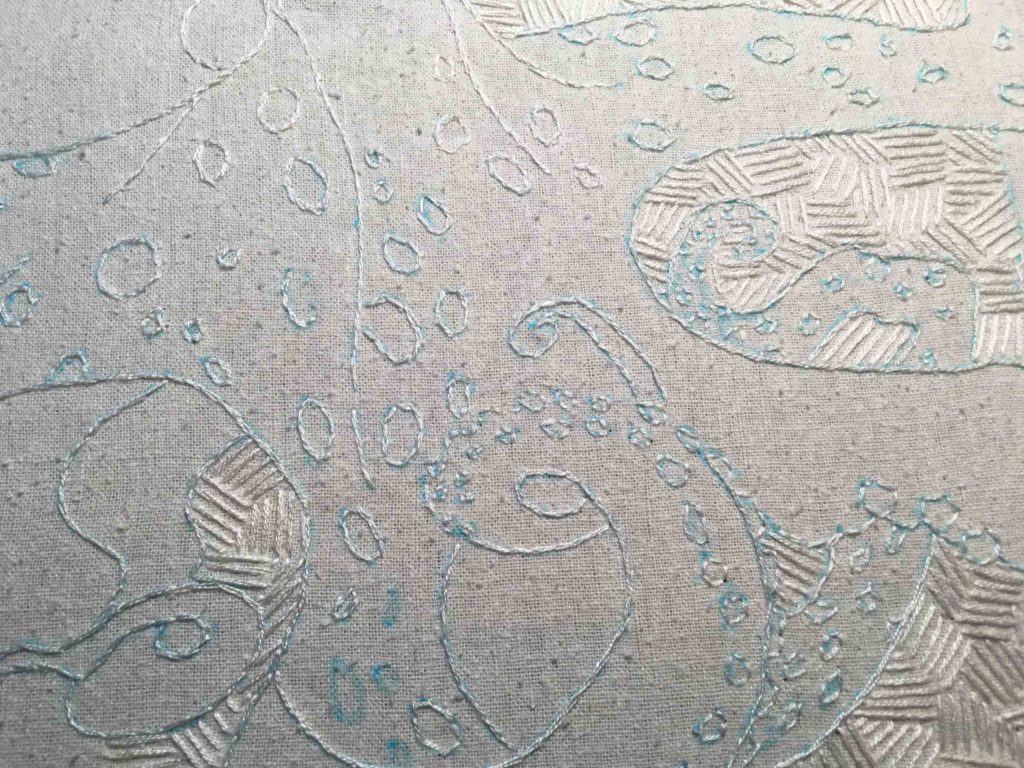
Octopus stitching

The pre-dye white work is time-consuming, especially considering all the little circles to embroider. I am going to be figuring this one out as I go along, but am trying to resist laying the stitch-work in too heavily before dyeing, knowing now that a lot of stitching will be necessary afterwards to bring out and define the image from the shibori pattern.

I’ll admit that I’m something of a productivity geek, so I love this stuff. Huff’s and Gilkey’s ideas were just the boost I needed to get started on the rollover from 2018’s goals to those I’ll concentrate on in 2019.

And speaking of goals, one of mine for 2018 was to pursue a source that would accept/publish a self-written article about my work and practice. Every now and then fate goes to bat for you.
Last week I received an email from the editor of HAND/EYE Magazine, asking if I would give her 500 words and 8-10 images for this week’s online publication. You bet I said yes! … and it was well-worth the focus blocks it took to get everything in order on such short notice. As a result, I didn’t get as far as I’d hoped with this current stitched piece, but that’s a trade-off I was more than willing to make . I hope you’ll read the article.

One last thing that may be of interest: Slow Fiber Studios of Berkeley, CA is having a 10%-off holiday sale through December 31st. They carry books, videos, fiber, tools and natural dyes. Who knows what you might find!
Use the promo code: HOLIDAY.

Secret Weapon

If ever I needed a good reminder of why it’s important to have drawing materials with me at all times, it happened last week.

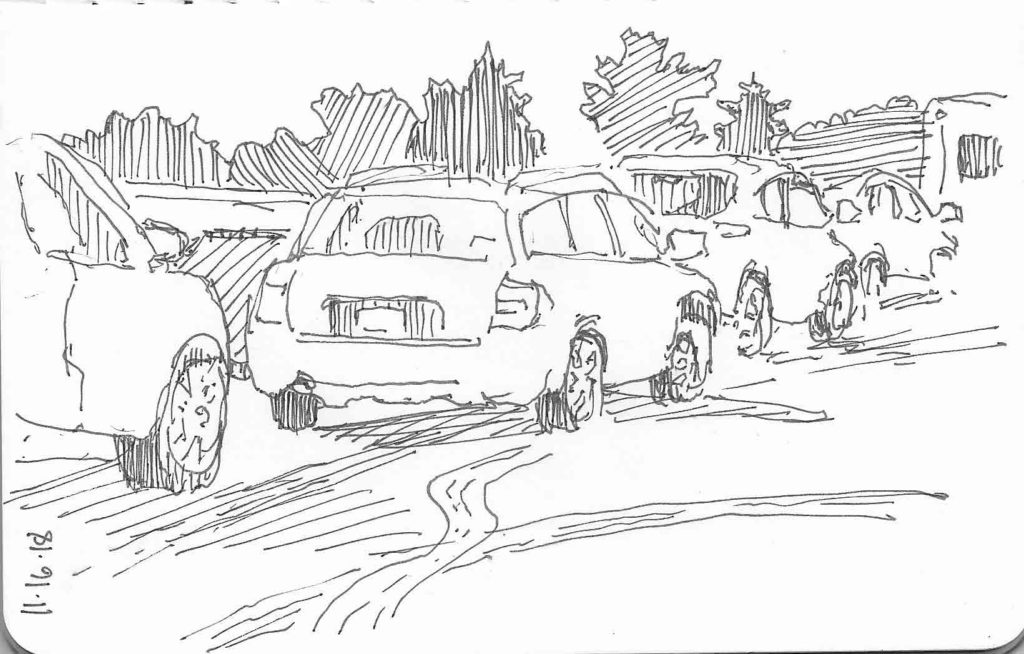
189 Jam

Rte.189 Pile-up     ©2018 Elizabeth Fram, 3.5 x 5.5 inches, Ink on paper

For years, a sketchbook has been a very trusty companion while I’ve waited…in school and store parking lots, in airports and train stations, and even for cookies to be done in the kitchen. In many instances you never know just how long you will be left hanging. But the beauty of a sketch is it can be done very quickly or, the longer you sit, stretched out into minute detail.

planes

heads

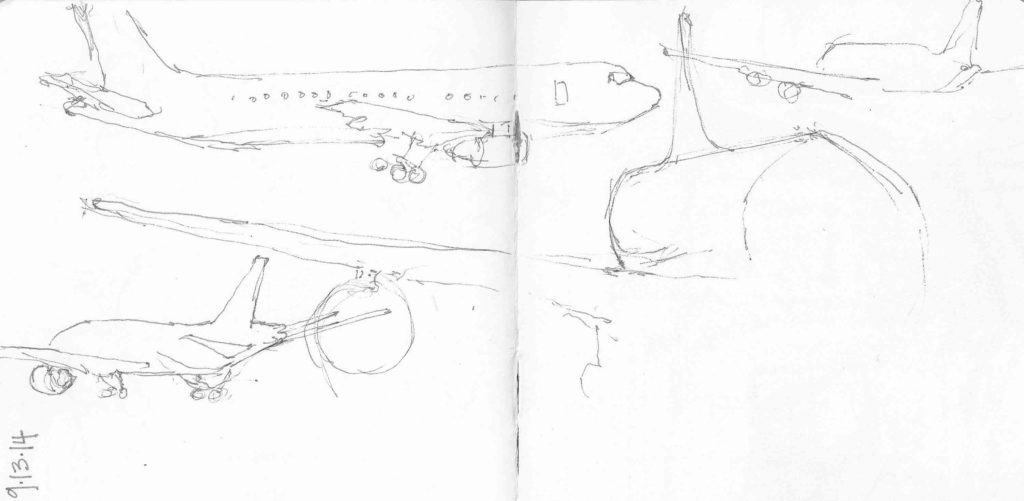
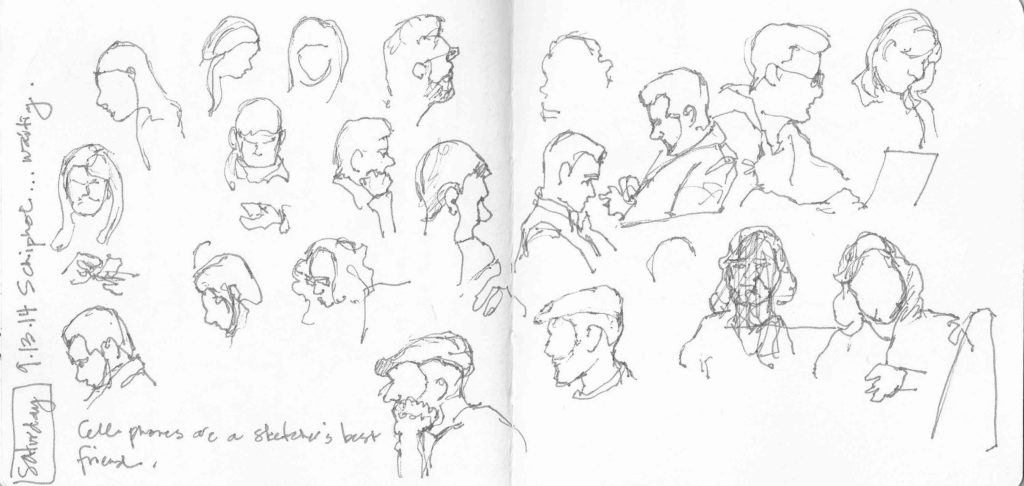
Schiphol Airport   ©2014 Elizabeth Fram      The word “waiting” shows up a lot in my travel sketches. Airports are great places to try to explore the fluid shape of a plane from different angles.  And ubiquitous cell phones & laptops make it easy to practice quick captures of fellow travelers.

Due to an accident on snowy roads last Friday, I sat boxed-in at the top of an off-ramp for the better part of an hour. Not wanting to turn off my engine because it was only 19º F. outside, at least I had the radio for company. But it doesn’t take long to feel pretty antsy when no one is moving and there’s no way to know what is happening or how long the snarl is going to last.

Bruce Road

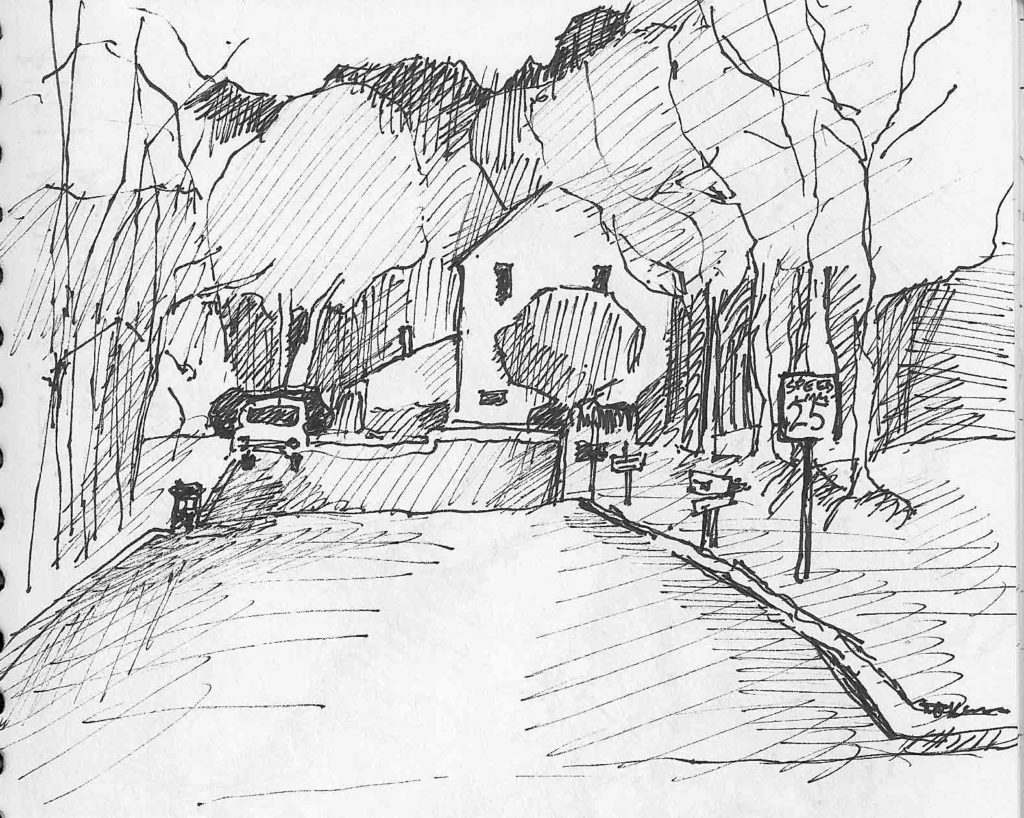
Bruce Road      ©2009 Elizabeth Fram, 4.24 x 5.25 inches, Ink on paper          When our house was on the market before moving to VT, appointments for house showings would invariably be set up for around dinnertime…most inconvenient when you have a ravenous teenager with a boat-load of homework to get through. We would would pile homework, food, and drawing supplies into the car and park up the street to wait where we could watch to see when they’d left.

Luckily, even though I only had a small 3.3 x 5.5 Moleskine Cahier with me, that was all I needed to get my mind off the frustration of being late for my appointment while finding myself stuck for who knew how long. There’s a lot to be said for getting lost in the world of shape and line — it’s far more interesting and productive than sitting and stewing. And to tell you the truth, it made the situation rather pleasant.

CR vs Bensalem

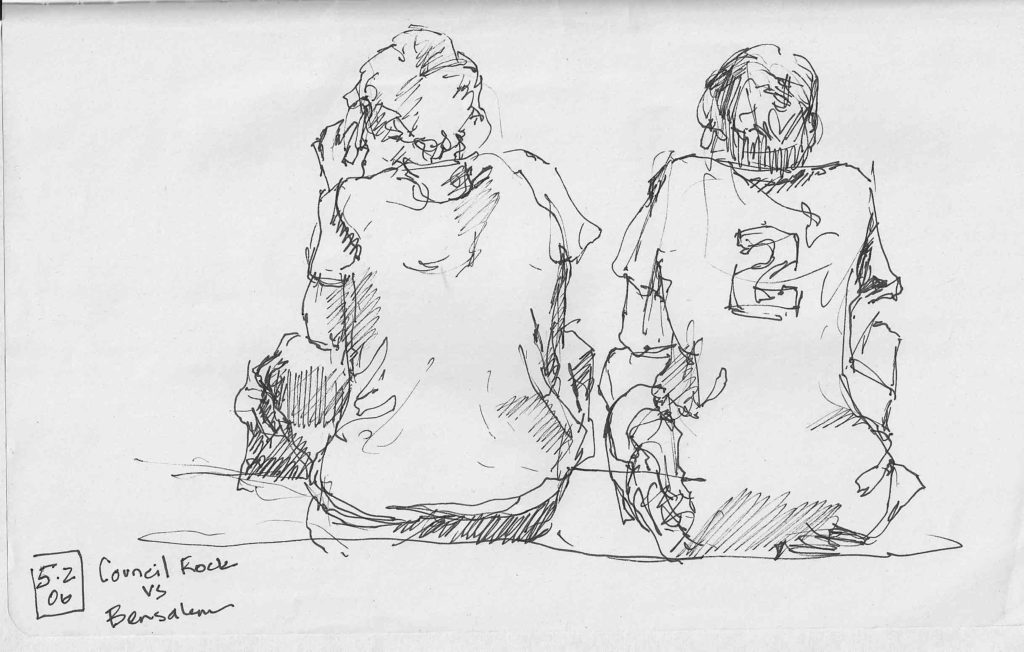
Council Rock vs Bensalem     ©2006 Elizabeth Fram, 5 x 8.25 inches, Pen on paper.    Over the years I spent as much time as any parent waiting for games and track meets to begin, and happily so. Occasionally lacking someone to chat with, there was usually something interesting to draw.

After about 40 minutes with no police presence to take charge, a resourceful UPS driver (thank you again, whoever you were) got us backed up and turned around, one-by-one like a sliding tile puzzle. And just like that, I was on my way.

Shaws Parking Lot

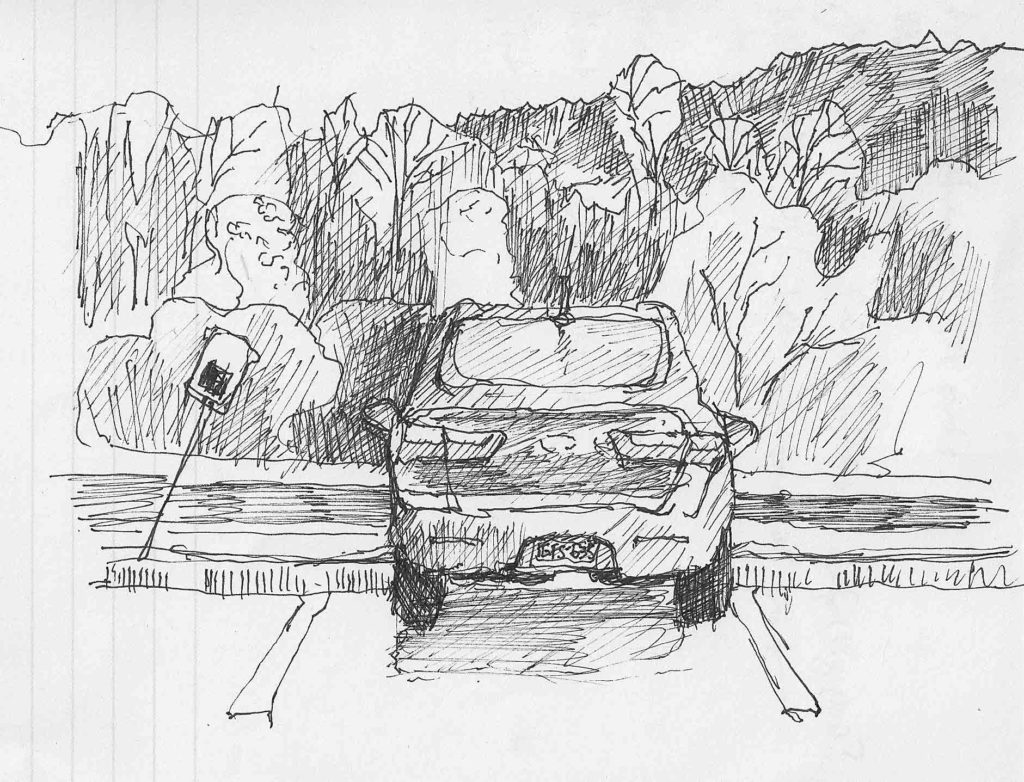
Fall View from Shaws     ©2014 Elizabeth Fram, 5.25 x 6 inches, Pen on paper.        The parking lot of our local grocery store looks across to lovely tree-covered hills. It’s a good spot to gauge subtle seasonal changes.

In hindsight, I keep thinking about how that little sketchbook made it possible for me to leave the situation happily lost in thought about John Muir Laws’ principles, rather than dwelling fruitlessly on the frustration caused by the unexpected delay.
$3.00 very well spent, wouldn’t you say?

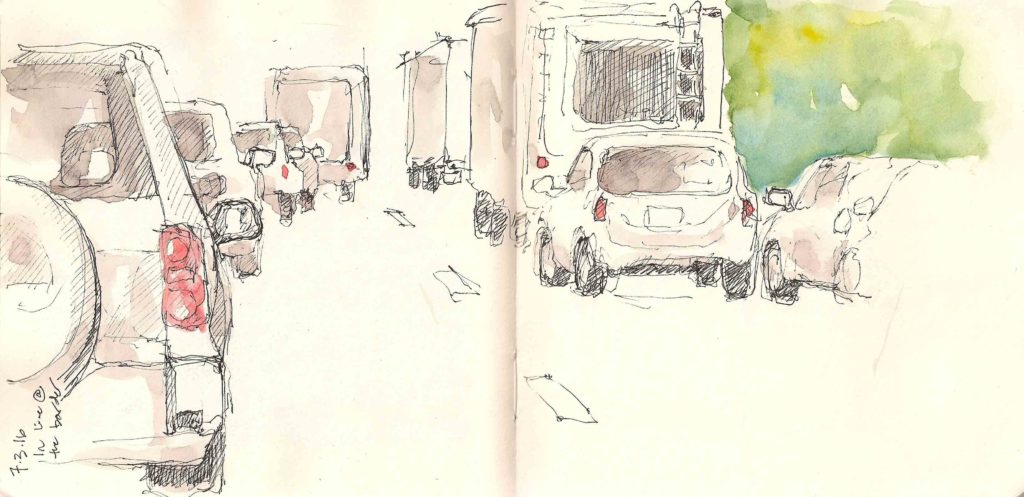
Customs     ©2016 Elizabeth Fram 5.5 x 11 inches, Ink and watercolor on paper.      Getting across the border to Canada on a holiday weekend can be another sort of waiting game.

Enjoy your Thanksgiving leftovers!