Author Archives: ehwfram

About ehwfram

I am an artist living in Vermont, inspired by the day-to-day details of life.

Organized Chaos

Self-Portrait

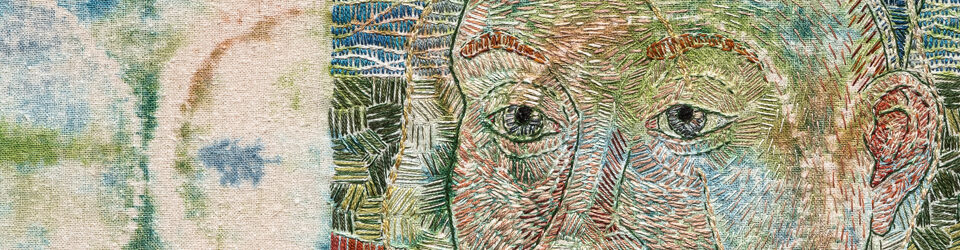
Self-Portrait ©2026 Elizabeth Fram, Gouache & Embroidery on paper, 6 x 8 inches   This represents a couple of firsts: my first time painting a face using gouache and a first self-portrait. While I think the stitched pattern works well in this case, what I’m ultimately aiming for is to find a way to more fully integrate pattern, stitching and paint with each other.

I have an uncle who wrote a regular newspaper column for years. During family get-togethers, including major holidays, he would inevitably sequester himself from the family group for a bit so he could meet his deadline. I was just a kid, but still peripherally aware that his challenge included what to write about week after week; it never occurred to me then how personal that memory might become.

Bowl and Cup

Bowl and Cup, in process ©2026 Elizabeth Fram  This piece shows my most exciting discovery to date. I absolutely LOVE the almost batik-like effect of the pattern which lies underneath this image. Gouache’s inherent nature to reactivate with water has worked to my advantage here. That said, it’s also a very tricky operation. I haven’t had a chance to add stitching to this piece, but I have ideas…

There are weeks when I really struggle with what to post here. It’s not that I lack things to share, but rather the challenge can be figuring out how to weave together my behind-the-scenes loose ends in a presentable and, hopefully, interesting way. It’s one thing to make the work, another altogether to write about it coherently, especially when it’s in a place of transition.

Underlay

Establishing an under-layer of pattern with paint as a first step.

Anyway, that’s the spot I find myself in this week – trying to articulate organized chaos. I’ve been plenty busy, but other than just showing you my progress, I lack a cohesive way to explain where I’m headed, especially since I’m not exactly sure yet where that might be. I’m puzzling my way through unknown territory and thus finding comfort in that discomfort.

Head-on Stare

In progress ©2026 Elizabeth Fram, Gouache on paper Look closely and you’ll see that I painted this portrait on top of the above under-layer. I learned a couple of important lessons to carry forward. Still planning to stitch on this one, but again, haven’t yet had time.

The one thing I know from experience is that the secrets I’m hoping to uncover will only float to the surface through doing the work. One has to venture down a lot of dead-ends before finding the road through.
I’ll have to ask my uncle if that’s how it worked for him too.

3 Vessels

3 Vessels ©2026 Elizabeth Fram, Gouache & Embroidery on paper, 8 x 4.5 inches  This one feels one step closer to where I want to go.

A colorful reminder that Spring is on its way.


Out and About

Now that February has arrived, it’s been a lovely change to emerge from January’s hibernation to spend time catching up with friends and getting out and about to see art beyond my studio walls.

Elizabeth Fram, Fiddler, Watercolor

Susan, detail    ©2026 Elizabeth Fram, Watercolor and Graphite on paper, 16.5″ x 18″   Drawing alongside like-minded souls is such a pleasure. Last week our model brought her fiddle and played while we drew/painted her. It was the essence of community.

Last week, three of us went to AVA Gallery in Lebanon, NH where we caught a terrific “two-fer”.
First was Eva Sturm-Gross’s exhibition “Beasts of Eden”.

Eva Sturm-Gross The Watchers

The Watchers,   Eva Sturm-Gross, Carved basswood

Representing a fragmented symbolic world, her sculptural and printed pieces refer to Biblical narratives expressed through the animals that dwell near her childhood home in the Upper Valley of New Hampshire and Vermont.

Eva Sturm-Gross The Thief

The Thief,   Eva Sturm-Gross, Carved basswood, Relief print, Gold leaf and beeswax on paper

She often merges reality with myth.

Eva Sturm-Gross Behold

Behold,   Eva Sturm-Gross, Carved basswood, Relief print and beeswax on paper

According to the gallery notes, animal-headed figures are a common motif in medieval Jewish aesthetic culture. Sturm-Gross uses that device to convey a sense of the sacred found within the local landscape.

Eva Sturm-Gross

What Does the Lover Want From Love,   Eva Sturm-Gross, Carved basswood, Relief print and beeswax on paper

This quality in her work speaks directly and convincingly to those of us who also find ourselves living in daily pace with the land and the creatures who surround us.

Juni Van Dyke These Beautiful Hands

Juni Van Dyke,   These Beautiful Hands: A Tribute to Our Elders

Next, I felt a huge sense of connection with Juni Van Dyke’s installation “These Beautiful Hands: A Tribute to Our Elders”. Similar to my Full Bloom series of stitched portraits, her pieces directly challenge this country’s sadly all-too common attitude that value and beauty are diminished with age.

Juni Van Dyke These Beautiful Hands

Juni Van Dyke, Plaster cast hands and hand-made paper: “Handholding. You do a lot of that when you raise children. When my daughter was eight and in the hospital with appendicitis, she held my hand and begged me not to leave. ‘When are you coming back?’ she pleaded. Now, somedays here (in the nursing home) I sit by my window and I know exactly how she felt.”

This series of cast-plaster hands, in conjunction with brief anecdotes gleaned in conversation during the casting process, represent, in Van Dyke’s words, a soul and a life well-lived.

Juni Van Dyke These Beautiful Hands

Juni Van Dyke, Plaster cast hands and hand-made paper: “Heaven and Hell. I don’t care if there is or there isn’t. I’ve been through hell. Heaven is where I am right now. My doctor says ‘Keep doing whatever you’re doing’. I drink vinegar and pickle juice every day. I’m old and I feel great!”

Accompanying her installation of hands and quotes are a series of small oil paintings that Van Dyke created as a gesture of gratitude to the elderly — made for and about people she has known and loved, and for those who participated in her Beautiful Hands project.

Juni Van Dyke Paintings

Juni Van Dyke,   The Gratitude Series, oil on board

Both exhibits are only open through February 14th, so you’d better hurry if you want to go.

Finally, I have a must-see documentary recommendation.
Porcelain War, which can be streamed on PBS (expiring on March 1), is an incredibly moving portrayal of three artists who have chosen to remain in Ukraine “armed with their art, their cameras, and for the first time in their lives, their guns. A stunning tribute to the resilience of the human spirit, embodying the enduring hope and passion of ordinary people living through extraordinary circumstances.” 

Porcelain War Poster

Here’s a link to the trailer.
I can’t use enough superlatives about this stunning piece. It is gorgeously filmed, absolutely heart-rending, yet simultaneously uplifting. Don’t miss it!


Start to Finish

I use mid-process photos as an invaluable tool to help me work my way through most new pieces. Photos give me a chance to evaluate what I’ve already done and, also, looking back over my progress at any given point generates ideas for next steps. It’s a means toward perspective via distance.

Fram Sketch

Making such a detailed initial sketch is not how I usually work.
But I’m currently in the midst of feeling my way toward something new and this kind of notation serves as a potential roadmap as I get my sea legs. A sketch is a means of working through possibilities (look closely to see plenty of erasures) and of recording specific ideas to keep in mind for later. In this instance, I was thinking especially in terms of value.

,Resist

Laying out the major elements with outlines of gouache sets my bearings. Next, I painted resist in specific areas (seen as barely visible yellowish lines around the leaf shapes and as hash marks surrounding the tube of paint in the lower right). My aim with this step is to create visual texture by preserving the white of the paper in a way that would be hard to do with paint alone.

Palette

Learning about color is never-ending. Choosing a limited palette simplifies and unifies.

First Layers

Beginning layers of paint get things underway. Gouache’s opacity gives me elbow room to tweak colors and change my mind in a way that isn’t possible with watercolor. It’s quite liberating.

Value

Value is such an integral part of color. Using my phone’s black & white mono filter helps me stay on track in terms of value.

First Stitches

Once the painting is done and the resist is removed, the stitching begins. This photo highlights that the work itself, together with intuition, dictates my direction far more strongly than any initial sketch. Rather than merely filling in the whole area on the left with needle weaving, as originally intended, I realized mid-way that the varying thread colors really made the pink ground pop – so why cover it? Plus, by not filling the area completely with stitches, that pause of pink serves as a bridge which highlights the “conversation” between the stitched area and the white marks on the red ground.

Holding Substance

Holding Substance ©2026 Elizabeth Fram, Gouache and Stitch on paper, 8.5 x 6.5 inches

A stitched border extends the ideas found within the imagery, yet stands on its own. I’m attracted to the idea of wrapping common objects in pattern, texture and color to give them a sense of significance beyond their unassuming simplicity.

This Hyperallergic article by Damien Davis is worth considering if you regularly pay application fees when submitting your work to exhibitions. If nothing else, it’s food for thought.

Take Advantage of this Resource

If you aren’t already aware of the PBS series Craft in America, check it out. All episodes are free and available to stream.

I am rewatching them one by one while I work out in the morning, grateful not just for the inspiring jumpstart to my day, but for the introduction to artists I was previously unfamiliar with — along with becoming better acquainted with the practices of some I already know. Wisdom, technique, process — it’s all there. Beautifully filmed and layered with contextual information; it’s an amazing resource.

Each episode is centered on a specific concept, delving into the practices of several artists, their ideas and stories.  Many segments shine a spotlight on the treasure that is embodied in cultural diversity, knowledge and history, eloquently expressed through the lens of these artists’ work and words while focusing attention on legacies we should – no need – to be mindful of nurturing and protecting — especially considering our current political climate. In the words of master weaver and dyer J. Isaac Vásquez García in the espisode “Borders”, “Art is universal, there are no borders”.

Craft in America

J. Isaac Vásquez García

If I had to single out any specific episode to start you off, should you choose not to go chronologically, I’d say “Visionaries”. It’s a touchstone with the value of the groundbreakers who have paved our paths and will surely inspire you to explore other chapters in the series.

With all this in mind, I’ve seen a number of fascinating exhibitions over the past 3 months by artists whose cultural vantage points, however different from a potential viewer’s, offer the sense of connection we all crave and which art can deliver.

At the Art Institute of Chicago:

Raquib Shaw’s   Paradise Lost
This monumental wall installation (more than 100′ wide) is an allegorical and autobiographical telling of Shaw’s journey through life. Dense with supernatural symbolism, it alludes to Milton’s poem of the same name and is a reflection of the many paradises lost across a lifetime. Shaw notes, “This is not just my story. It is the story of each of us, and the story of our times”.

Raquib Shaw Paradise Lost

Paradise Lost, Raquib Shaw, 2009-25, as installed in the Art Institute’s galleries. Photo from the website of the Art Institute of Chicago.

South African artist Jane Alexander’s  Infantry with beast
Situated within a dark and cavernous room, adorned only with the red carpet they march upon, an army of life-size fiberglass, lockstep “humanimals” are foreboding and unsettling.

Infantry with beast Jane Alexander

Infantry with beast, Jane Alexander, 2012

Many of the drawings, prints and sculptures of revolutionary artist Elizabeth Catlett (1915-2012), in an eponymously named retrospective at the Art Institute, centered on the lives of black women in the American South. Her powerful work was an ongoing challenge to social injustices.

Elizabeth Cartlett, Tired

Tired, Elizabeth Catlett, 1946, terracotta, 13 1/2 x 6 x 7 inches

And at our local Fleming Museum:

Fuji and Woodland in Fog, Itchiku Kubota

Fuji and Woodland Covered in Fog, Itchiku Kubota, 1994, Tie-dye, ink painting, and embroidery on chirimen, silk crepe with gold wefts

The now-closed exhibition “Kimono” was a grand display of shimmering 20th and 21st century pieces, including a spectacular hand-dyed kimono by the Shibori master Itchiku Kubota. More contemporary works, such as the one below by Na Omi Shintani, were inspired by the form of kimono as well as its historical and cultural significance.

Na Omi Shintani

Deconstructed Kimono 7, Na Omi Shintani, 2024, Silk kimono, alter of ceramic vessel and wood, bamboo

The Reward of January

Happy New Year!

I’ve been getting my ducks lined up for the new year ahead – what about you?
What’s on your creative agenda for 2026?

Tom Leonard after Alex Main

With no chores hanging over me, I loved having time to sketch at our Airbnb every morning over Christmas week. This is Tom Leonard, Scottish Poet, painted from a photo I took at the National Portrait Gallery of Scotland, of a bronze bust by Alex Main (love what Main has to say in this short YouTube video)

Now that December’s festivities and accompanying chores are in the rearview, I’m pretty excited to get back into the studio. Sketchbook time and logging ideas/notes in my studio journal is a given, but otherwise last month’s change of scene (Christmas in Berkeley) and a holiday project for our new grand baby, were a good reset. Taking a breather – whether chosen or imposed – can be a very productive way to keep the creative juices flowing. Or maybe it’s just that absence from the studio makes the heart long to get back to it…or something like that.

Seated Man

The best way to learn about values is to minimize them

And suddenly it’s January — a month that I find tends to be relatively spacious and under-scheduled compared to the other eleven — or does it just seem that way because December is always overflowing? Either way, the weeks of January give us a chance to act on the new year’s sense of possibility. And that in itself is a gift.

Island

A section of our yard, in greener days

My guidepost for the next month (and hopefully beyond) will be one of James Clear’s ideas from his most recent 3-2-1 Thursday Newletter:

“To learn, wander. To achieve, focus.”

I’m planning to put both approaches into action. I am following Peggy Kroll Roberts on Patreon and just enrolled in Lena Rivo’s course “Color Mastery”, which will give me a chance to dive deeply into gouache, as well as, I hope, new ways to think about incorporating stitching.

College Ave

It was rainy and gray almost every day we were away which, frankly, I don’t mind. It helps other colors sing

Time to get to work!
And best of luck to you as you jump into 2026.

In and Out of the Studio

I have been having the best time lately, in and out of the studio.

Airport People

Airport people

I never go anywhere without bringing some sort of art supplies, even if just a colored pencil and a tiny sketchbook. On our trip to CA earlier this month, I learned just how easy it would be to bring along my gouache and accompanying materials.

Travel Kit

The center flap of this case flips over and has 6 pen straps on the other side which holds all my brushes. The numerous zippered & elasticized pockets assure I have plenty of room for everything.

I bought an inexpensive travel palette that has a silicone cover which keeps the paints moist and leakproof. It nestles within a generously sized collapsible water container which, along with all the rest of my gear, fits neatly into my 4″x9″ pencil case. Together with a lightweight Holbein 7.5″ x 6″ watercolor/multi-media sketchbook, I have a very compact but complete travel kit.

Makeshift Studio

Note the palette with its silicone cover in place.

That said, makeshift studio space while traveling can be a bit of a crapshoot. Luckily, our Berkeley Airbnb not only had terrific natural light, but a lovely little desk looking out on the garden.

Berkeley Garden

You may laugh, but with no IKEAs in VT, wandering through the maze of the Emeryville store was more than a planned activity – it was an inspirational treat.

IKEA pattern

This boldly patterned duvet cover was a real eye-catcher. The calm of recreating it later with paint was equal to, if not better than, any meditation app.

Painted pattern

This little exercise was a great way to use up leftover paint that I didn’t want to waste.

A subsequent field trip to the Ruth Bancroft Garden in Walnut Creek was just as fruitful in the inspiration department.

Cacti

You have no idea how hard it was to choose just 2 photos among the many I took, to show here

This dry garden has been on my to-see list for a long time and it was worth the wait. So many wonderful layers of color, pattern, and texture.

Succulents

The bottom line is, pretty much anything can serve as input to brew in the back of one’s mind and eventually lead to new ideas. This trip got me thinking about ways to incorporate pattern within my worktable still lives — sometimes as a last layer, but also at the beginning of a sketch.

Under Layer

I used some Neocolor I’s for the under-layer of this experiment. Unlike Neocolor II’s, they aren’t water soluble, so didn’t bleed when I washed a thin layer of gouache over everything, followed by the contours of objects, again with gouache.

It’ll be interesting to see how pattern might affect a push and pull between the fore and backgrounds. Because of its opacity, gouache gives me the freedom to try this in a way that isn’t possible with watercolor. And that is a game-changer!

Over Layer

2025 Elizabeth Fram, Gouache on paper, 9″H x 5.75″W     As I go along, bits of the original pattern poke through, which I can obliterate or enhance with subsequent layers of paint

Before I go, you may remember that last year I took the month of December off from posting to Eye of the Needle. It was such a successful way to recharge my batteries that I promised myself I would do it again this year. With that in mind, my next post will be on January 1, 2026 — which will be here before we know it.

Dots and Dashes

Dots & Dashes ©2025 Elizabeth Fram, Gouache on paper, 9″H x 11.5″W

Till then, wishing you and yours the happiest of holidays ahead!

PS: I want to give you a heads-up that there are changes on the horizon for Mailchimp (the platform I use to send out blog notifications to all you lovely subscribers). Looking into other options is one of my December chores, so there is the very likely possibility that I may send you a test in December and that my notification emails may have a new look when I return for real in January. Thanks for your patience.

Risk, Discovery, Momentum

With Art at the Kent now in the rearview, I’ve just finished another broken vase and shadow piece and have a fresh sheet of paper stretched on my board, ready to begin a new one.  I still need to get these pieces out of my system before I can move on.

Broken Shadows

Broken Shadows ©2025 Elizabeth Fram, Watercolor, gold pigment, knotless netting & stitching on paper, 9″H x 7″W

Even so, I’ve spent the majority of my studio time pushing forward with gouache. It’s a dance of two steps forward, one step back, yet feels ever so liberating. With each sketch – and at this point they are definitely just sketches – I’m becoming more aware of what a deep and, at times, mysterious pond I’ve jumped into.

Maine Mug

Maine Mug ©2025 Elizabeth Fram, Gouache on paper, 8″H x 11″W

Stlll, there are plenty of folks to lead the way. Aside from masters such as Paul Klee, Lois Dodd, and Fairfield Porter, contemporary painters like Lena Rivo, Maru Godas, and Mike Hernandez give me plenty to think about and to study.

Three Tubes

Three Tubes ©2025 Elizabeth Fram, Gouache on paper, 9″H x 11.5″W

In a timely bit of kismet, I was listening to an “I Like Your Work” podcast by Erika b Hess in which she touched on the commonality, and even the bravery, of delving into the fresh territory of a new medium. Her characterization of such explorations as a period of “risk, discovery, and momentum” nails the feeling. What better time than now, after a couple of big exhibitions, to thwart complacency by breathing some fresh air into my practice?

Orange and Purple Bowl

Orange and Purple Bowl ©2025 Elizabeth Fram, Gouache on paper, 9″H x 11.5″W

Please note: I’ll be back in four weeks (Nov. 20th). We have a date to meet our first grandbaby!

Something New

Perhaps the biggest gift of an ending is the beginning that follows.

Truex Cup Painting

©2025 Elizabeth Fram, Gouache on paper, 12″ x 18″

This past summer has left me with a lot to digest.
Marked most significantly by the loss of my father, I can’t ignore that that sadness was bookended by two events which have brought me tremendous joy. Both “Full Bloom” in June and “Holding – Mementos Kept, Memories Kindled” (which wraps up at the Kent Museum this Sunday, 10/12) have grounded me over the past several months while being an ongoing reminder of the irrefutable fact that life is inherently a mixture of bitter and sweet.

Vase and Ink Gouache

©2025 Elizabeth Fram, Gouache on paper, 12″ x 18″

Maybe it’s the confluence of these three recent endings that has led me to seek out something new this fall. Without departing too terribly far from the familiar, I treated myself recently to a basic palette of gouache and a few new brushes. With no particular endpoint in mind, I have been having a wonderful time this week, just seeing what happens.

4 quadrants of color

If you look closely, you will see this was the first pass for the painting below.

Following the examples of Sandi Hester and Peggi Kroll Roberts, I divided a sketchbook spread into quadrants of color as a starting point, then ad-libbed a composition of items from my work table — letting those initial four colors be something of a guide without being too restrictive. The point for now is to keep things simple, concentrate on learning to handle the paint, and to make discoveries about color. I’ve ended up happily lost in the process.

3 Tubes of Paint, Gouache

©2025 Elizabeth Fram, Gouache on paper, 9: x 12″

Up to this point, my only painting experience is with transparent watercolor, so the opaque quality of gouache is a revelation. It has triggered a whole different way of thinking and is SO MUCH FUN! I can’t help but consider a million possibilities, not to mention how great it will be to incorporate stitch once I get my sea legs and figure out where I may be headed.

Scotch Tape, Gouache

©2025 Elizabeth Fram, Gouache on paper, 9″ x 12″

Not able to make it to Calais for “Holding” at Art at the Kent?  Get a taste of its unique flavor with this episode of  Across The Fence.   If you keep your eyes peeled, you’ll see a few of my pieces along the way.

In case you didn’t already see it, please enjoy this gifted-to-you New York Times article by Sam Thielman and Gabriel Gianordoli about Emil Ferris“The Comics Artist Who Sees Monsters in Museums, and in the Mirror”. Her drawings are spectacular.

Things to Smile About

Cued by the trees, which seem to be changing color by the hour, I’ve been taking time to just soak in and enjoy the sights around me this season. Below are a few of the things that have caught my eye in the past couple of weeks.

Art at the Kent – “Holding”

There are so many wonderful artworks in this show! These shots barely skim the surface of the 22 artists exhibiting, or their work. I will be back again (and again) in an effort to capture more before the exhibit closes on October 12. I hope you can make it at least once.

Olaf Saaf

Soapstone Guy with Bristles ©2021 Olaf Saab, Soapstone, paintbrush bristles

Usually I am careful to document the labels which fully identify works that I am photographing. I was so excited moving through the exhibit that I forgot myself and, other than the piece above, can only provide the name of each artist for the works below. This show is that good. However, I’ve linked to each artist’s web presence, if available.

James Patterson

James Patterson

The preserved patina of ancient paint, wallpaper and exposed lath within the Kent Museum building all work in concert with the art on display. Below are a few examples of my pieces in the show. It makes my heart sing to see the thoughtful way they are presented in conversation with their surroundings and others’ work.

Fram, Taking Pause

Taking Pause, ©2014 Elizabeth Fram, Paint, stitched-resist dye and embroidery on silk, 21″H x 33″W

Fram, Pick Me Up

Pick Me Up © 2017 Elizabeth Fram, Stitched-resist dye and embroidery on silk, 12″H x 16″W    The curation of “Holding” is exquisite. For instance, consider the exchange between my stitched cup and Stephen Proctor’s clay vessel outside.

Fram, Dawn Patrol

Dawn Patrol ©2012 Elizabeth Fram, Paint, stitched-resist dye and embroidery on silk, 34″H x 15″W   The colors of this piece echo the landscape through the window.

Fram, Ulysses' Wave

Ulysses’ Wave ©2014 Elizabeth Fram, Stitched-resist dye, paint and embroidery on silk, 19″H x 38″W   This piece, a visual narrative of the gradual, then sudden changes I saw in my mother as she struggled with the beginnings of dementia, reflects both the exuberance and the memento mori quality of the lush floral arrangement sitting to its right.

Québec City

The following on-the-fly shots in Québec weren’t necessarily inspirational and have no particular redeeming quality other than they made me smile. I think we could all use a bit more levity these days, don’t you?

Trois Garçons


Harvest Cannon

The last in a lineup of cannons that are part of the Fortifications of Québec and which highlight this area’s  past military function as a defensive battery, the irony of this vase tipped on its side with hands offering flowers and wheat from its opening is delightful. Zoom in to see that the treads of the tires are leaving tracks of roses. Having neglected to find any info near this sculpture, I searched the internet but came up empty regarding the artist. However, I did discover that In 1617, the first French family to settle in the colony — Louis Hébert, his wife Marie Rollet, and their three children established their farm on this site atop Cap Diamant which is today Montmorency Park. They grew cereal crops, vegetables and different medicinal plants.

Cat weaving


Slatted Window


Exciting Macarons


Creature

One more thing that’s making me happy: I’m rereading Stephen King’s On Writing: A Memoir of the Craft. Per his suggestion, I edited out any adverbs that had snuck into this post 😊. Ha! I haven’t gotten to the part where he’s horrified by emojis.
Regardless of what your creative practice may be – or if you even have one – you will enjoy this book. Not to worry – it isn’t remotely scary.

Diverse, Thought-provoking & Inspirational

Check out these amazing Vermont artists:

Julia Zanes    Cindy Blakeslee     Rona Lee Cohen    Valerie Hird    Susan Jane Walp

The unifying thread between them is that I first encountered their work at the Kent Museum in Calais, VT. Along with apples, glorious foliage and good sleeping temperatures, fall in Vermont means it’s time again for Art at the Kent.

Passages, 1

Passages 1    ©2006 Elizabeth Fram, Hand-dyed, hand & machine stitching on silk and cotton, 32″H x 33″W   I will have 20 or so pieces in the show this year. In many ways, those selected represent a survey of my work. While they are all connected via the idea of memory, the lure of color and texture manifested through stitched, drawn and painted marks remains constant. The pieces shown here are a teaser. As many of you know, in the early days, art quilts were my main means of expression. It was a medium that allowed for the interruptions and inconsistent work hours that go hand in hand with raising a family.

For me, it’s always been a treat to see the work of friends, as well as artists I have followed from afar, appear on the Kent’s walls and on its surrounding grounds. But just as exciting is knowing that each show will introduce me to artists I was completely unaware of previously. This is the beauty of an exhibit that highlights only Vermont artists and, until this year, has never repeated any of them.

Taking Pause

Taking Pause   ©2014 Elizabeth Fram, Paint, stitched-resist dye & embroidery on silk, 21″H x 33″W  This is one in a series of dog-walk shadow pieces that  marked a time of upheaval and transition. Walking the pooch in the early morning hours was one piece of our routine that remained regular during those months.

A quick swing through the exhibit archives is a testament to Vermont’s incredibly rich creative sector. I’ve had to pinch myself over the past months, knowing how privileged I am to soon be among them.

Disparate Pair

Disparate Pair    ©2014 Elizabeth Fram, Verithin pencil on mylar, 10″H x 8″W  Also one in a series, these pieces tell a story through the shadows and seemingly distinct personalities of decades-old chairs on a cottage porch.

There will be 22 of us exhibiting this year. I’m intrigued to see how all the work will interact with each other and with the historic building which houses the exhibit. I have every confidence the experience will be as remarkable and unique as it has been every other year, thanks to the vision of curators Allyson Evans, Nel Emlen, and David Schutz.

Mussel Memory

Letters from Home: Mussel Memory    ©2022 Elizabeth Fram, Stitched-resist dye & embroidery on silk, 12″H x 16″W  As we were emerging from the pandemic, I wasn’t ready to give up on the house shape after spending months making my 3-D “Covid Houses”. One day I had the epiphany that the shape of an open envelope is the same as that of a house. With that, I began a number of “Letters from Home” pieces, most of them carrying memories of Maine.

In fact, one can’t help but wonder how they manage to pull together a show that hits it out of the park, year after year. As always, this year’s exhibit “Holding – Mementos Kept, Memories Kindled” will most certainly contain viewpoints that are diverse, thought-provoking, inspirational and, not least, a celebration of the act of making itself. What more could one ask?

Fleeting Recollections

Fleeting Reflections ©2025 Elizabeth Fram, Watercolor & knotless netting on paper, 6″H x 8″W  On the heels of my Full Bloom series, I have become interested in knotless netting, incorporating it within paintings. As you can see from each of the pieces above, as new work develops, one element  will invariably carry through from one series to the next  – be it shadows, stitching, or portraits.

Have I piqued your interest? I hope so. Please come between September 12 and October 12 to see for yourself. I’ll be at the opening on Saturday; see you then?


Holding Poster


And to further entice you, there are numerous accompanying events scheduled throughout the exhibition month, including:

Words Out Loud