Category Archives: Process

Drawing Things Out

I always look forward to Thursdays – especially on blog publishing weeks. I get an extra lift of accomplishment from clicking the “publish” button, knowing it’s another opportunity to connect with all of you, and also that the week ahead will be less about writing and more about making.

Breakfast dishes

Breakfast   ©2020 Elizabeth Fram, Ink on paper, 11 x 8.5 inches   Drawing continues to be a place of respite in the midst of everything else, both art-wise and from the big world around us.

I have a system in place that allows me to get these biweekly posts out, making room for the time that blogging requires while still juggling the dyeing, drawing, and stitching that make up the practice I write about.

Snoozer

Snoozer    ©2020 Elizabeth Fram, Ink on paper, 8.5 x 5 inches

In a nutshell, I let ideas for writing simmer until the end of the day on the Monday of publishing week, write a draft on Tuesday, polish the draft on Wednesday, and finally make last-minute adjustments before going live sometime during the day on Thursday. Dividing all these components into small chunks allows me to also keep up with whatever else may be in the pipeline, practice-wise.  Having such a set schedule may seem restrictive, but it’s become my tried-and-true method for achieving this task, without fail, for almost 6 years.

Lemons

Lemon Juice    ©2020 Elizabeth Fram, Ink on paper, 11 x 8.5 inches

To underline this approach of manageable, consistent bites, James Clear’s Thursday 3-2-1 Newsletter last week drilled down on the concept.  His title says it all: Scaling Down Your Habits, Obstacles, and Finding Time to Do What Matters.  And while I have to continually remind myself to keep up with it, time and again I have seen the wisdom of adhering to this theory. Below is one of the key take-aways he offers:

“Go smaller.
Can’t learn an exercise? Reduce the range of motion.
Struggling to grasp a new concept? Break it down.
Failing to stick with a habit? Make it easy.
Master stage one, then advance.”

Jen

Jen    ©2020 Elizabeth Fram, Graphite, ink and colored pencil on paper, 11 x 8.5 inches.

With all this in mind, I have a new house that is almost complete. There have been lots of unexpected decisions and mid-stream changes that have cropped up along the way. Chipping away at it in small bites has made for steady progress. Come back next time when I will share the process and the results with you.

Little Houses

For the time being, continuing to make these little houses inspired by the Sheltering in Place project seems right and appropriate. There is something reassuring about making work that directly relates to this unusual time and that has the power to add a positive spin.

COA Pieces Laid Out

The in-process piece I showed you two posts ago is now finished. Here all the sides are laid out and ready to assemble. I planned the imagery so that it would wrap continuously around the corners.

Fern Detail

The ferns in detail

Shadow

It has been exciting to discover needle-weaving as a concise (although slow) means of creating richly textured images. It also serves to make the most of the color variations found in variegated threads.

Dog and Shadow Corner

The corner images of this shot and the next illustrate a fuller idea of the piece as a whole

Fern Corner

As the ferns turn the corner, the dogwood branches add to the sense of woodland.

In speaking with a friend who is a plant expert, I was bemoaning the fragility of the branches I’d collected in our woods to make “Cocooned”. I wanted to find something more flexible to use going forward.

Cocooned

Cocooned   ©2020 Elizabeth Fram, 20″H x 11″W x 14″D overall, house dimensions 9″H x 6″W x 4.5″D, Wrapped-resist dye on silk with foraged branches.   I barely dare to take this out of the studio because the branches are so brittle.

I told her I had hoped to be able to use plant material from our property, but figured I was out of luck because we don’t have any willow trees. She suggested I try our red-twig dogwood. It was a great idea. The dogwood branches have made a world of a difference, resiliently bending and springing back as I manhandle the piece while stitching it together. Their lovely red color and the fact that my dogwood needed a good pruning was an added bonus.

Dog and Shadow Full

Cultivating an Oasis  ©2020 Elizabeth Fram, 27’H x 15″W x 16″D overall, house dimensions 9″H x 6″W x 4.5″D, Wrapped-resist dye and embroidery on silk with foraged branches.

Titles are often the last big hurdle to finishing a piece. I try to come up with something brief that conveys the spirit of the work while offering a window into what was going through my mind in the making.  “Cultivating An Oasis” is meant to communicate how valuable it’s been to have a garden to tend in isolation.

Due to the overall repetition, and my struggle to come up with pithy titles, it made sense to choose a series name and then to number each piece within it. If that method was good enough for Richard Diebenkorn, it surely works for me.

After much thought, I decided to go with “Retreat” as an umbrella title for these latest little houses. After all, a retreat can be seen from two opposing angles: as a withdrawal from danger or as a quiet and secluded place of comfort.
And doesn’t that dichotomy speak exactly to our experiences at home these past months?

Retreat Nos. 1 & 2

Retreat #1 (left) & #2 (right) ©2020 Elizabeth Fram, Wrapped-resist dye on silk with foraged branches

It’s occurred to me that of the ten COVID selfie images I’ve completed so far, eight are those of artists. I feel very lucky to have found such a vibrant tribe of creative souls since moving to Vermont!

Michelle

Michelle ©2020 Elizabeth Fram, 11 x 8.5 inches, Ink and colored pencil on paper

I’ve written about Michelle’s work before, ironically almost exactly a year ago. She is continually pushing herself and her process. I encourage you to check out her website and her Instagram account.

And for those of you who may have missed this, I hope you enjoy it as much as I did.

Making It Work

There has been so much to write about in the past weeks that I’m just now realizing it was all the way back on September 19th that I last made any reference to the piece that is currently in the works. Time to  bring you up to speed.

ChessKing1

Progressing from bottom to top

The various issues that were dogging me in the beginning have since ironed themselves out, so I’m at the point now where it’s more a matter of putting in the time to get the piece done. I will undoubtably be circling back to polish up this first side, but for now I’m roughly halfway to the finish line and hope that the piece as a whole will progress more quickly. But that said, hand-stitching is not speedy work.

ChessKing2

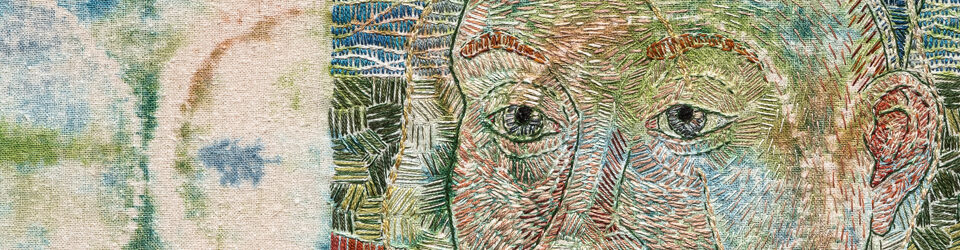
I’ve used this stitch a fair amount. I like the way it fills a space without letting it become too static. For another example, look at my banner photo above.

As is often the case, fortuitous discoveries tend to develop out of necessity, and this piece is no exception. As I was methodically stitching the main figure of the chess king, it didn’t take long to realize that I wouldn’t have enough of the colors I’d chosen to complete the checkerboard pattern within it. Whenever my work is going smoothly and I’m on a roll, I really hate interrupting the process to go out for more supplies. Therefore, I’m much more likely to search for (in the words of Project Runway’s Tim Gunn) a “make it work” solution that will allow me to keep going.

ChessKing3

Now that I’ve told you my secret about the color variety in this central figure, don’t be surprised if you see me using the same device again.

So what you’re seeing above are the results of that hiccup. Rather than just the two thread colors originally planned, I’ve used a variety of six. And frankly, I think doing so has brought life into the figure that would have been missing otherwise.

ChessKing 4

Onward and upward — the queen will soon be appearing within the blue arch.

You can’t arrange for these kinds of issues / solutions ahead of time, but they do seem to regularly present themselves. Invariably that’s a good thing. To a large extent that explains why I try not to plan a piece too far in advance or to be too married to a particular outcome. Kismet is often much smarter than I am.

Words to live by:
I just started reading Carol Marine’s  Daily Painting. Although I haven’t gotten very far into it, I like it very much so far. In Chapter One she talks about writing a letter to portrait artist Michael Shane Neal for advice. He wrote her back with a lot of helpful information, but finished the letter with what Marine characterizes as the best advice she’d ever receive.

“The best way to improve your skills is to do some kind of art every single day.”

The Missing Ingredient

It’s been a frustrating week with this latest piece. In my effort to get it off the ground, the easiest (and most fun) part — aside from initially making the stitched-resist arches — was going to my favorite thread store to choose colors.* But doing that was a bit like having dessert first, and everything beyond that step has been an ongoing struggle.

Thread Choices

My first problem has been size. The chess pawns that will appear in the background are so small that it took me until Wednesday to figure out how best to stitch them so that they didn’t just look like amorphous blobs, completely losing their definition once one stepped back from the piece.

The second issue has been color. It should be a no-brainer to stick with light-valued thread so that the image has contrast and definition against a background of red and black squares. But the pawns on this side of the piece are going to be black, and I quickly discovered that simply using black thread not only zapped all the life out of them, but they soon became lost in their equally dark background.

Pawn 1

I had hoped to keep things simple with just a running stitch outline. But it was too simple, and though I don’t have a picture, once I stitched in black behind this pawn, it became completely lost.

It took me a while to figure it out, but compromise was the missing ingredient. All week I’ve been trying different stitch patterns and different colors, wondering how in the world I was going to get these pieces to sit confidently in their red and black background while conveying that they are the darker half of the chess set.

Pawn2

Another failed attempt – but I’m getting closer by branching out to other colors.

The answer is twofold: artistic license and letting go.
Using a deep blue, which has more richness than mere black, has been both an escape hatch and my saving grace. Pairing it with a variety of other colors has allowed me to make a stab at fine-tuning the definition of a pawn, breathing some life into this tricky part of the image while still conveying the impression that these are the darker pieces of the chess set. The other solution is to let the red dye stand in for the red squares and only stitch the darker squares. Why bother to restate the obvious?

Pawn 3

Here is my solution after countless stitched and re-stitched attempts.

I’ve only just begun, but it feels like I’m finally on my way. Time to leave this hurdle behind me in order to get ready for the next one.

*The Wooden Needle in Stowe, VT has a vast selection and variety of beautiful threads. It is really worth a trip if you’re in our area.


Safety Net

I’ve been sifting through my Evernote files in order to do a bit of digital housecleaning. As tasks go, revisiting the diverse array of items collected there can be both enjoyable and interesting because it often results in new and unexpected ideas.

Midway

Work in progress   © Elizabeth Fram

Tools like Evernote and Pocket make it easy to file all sorts of data and images without the burden of storing paper. I never know when something I’ve saved — inspiration, business tools, specifics about art supplies, notes from my reading, calls for entry, etc. — will be useful, but sooner or later a need invariably crops up. That said, every so often it’s fruitful to review the whole lot, culling the bulk for what still resonates.

Skimming through a series of quotes saved from various readings, I found one to be particularly apropos to the new piece I’ve begun this week. At this early stage I don’t have much more than a sketchy idea of the endpoint I’m aiming for, so I know there will be plenty of trial and error ahead on the horizon. But leaning on previous lessons-learned will help me get the stitching off the ground, and I can consider the exercise a fresh opportunity to deliberately practice older methods while hopefully discovering new ways to mesh ideas with process.

Mid-Point

Work in progress   ©Elizabeth Fram

In discussing the idea of “deliberate practice”, Joshua Foer writes in his book Moonwalking with Einstein,

Deliberate practice, by its nature, must be hard.
When you want to get good at something, how you spend your time practicing is far more important than the amount of time you spend. In fact, in every domain of expertise that’s been rigorously examined, from chess to violin to basketball, studies have found that the number of years one has been doing something correlates only weakly with level of performance. Regular practice simply isn’t enough. To improve, we must watch ourselves fail, and learn from our mistakes.

What a perfect testament to the desire we all have to keep trying. Some pieces make me feel a bit like I’m at the foot of a mountain that I haven’t yet figured out how to scale. The wisdom and encouragement of the above quote is reassuring, like a climbing harness or a safety net, lending support as I wrestle with the possibilities of where I want to take this piece and, perhaps more importantly, where it will eventually lead me.

Slant

Work in progress   © Elizabeth Fram      The stitched-resist dye in this new piece is the perfect example of deliberate practice. At this point I’ve stitched and dyed this pattern many, many times, but this time my goal was to separate the two sides of one length of cloth with opposing colors while still having the piece read as a whole. It’s a first shot at a seemingly simple idea, but tricky to accomplish, and one that will benefit from further practice.

Giving shape to a nebulous idea doesn’t come easily. I appreciate Foer articulating the importance of mindfully failing in order to succeed — an attitude that lightens the overall process.

If you’re interested in what Foer has to say about how important memory is to creativity, link back to this post.

Full

Work in progress   ©Elizabeth Fram, Stitched-resist dye on silk, approx. 18 x 24 inches

The Wisdom of Orchids and Octopuses

I had so hoped that this guy would be finished in time for this week’s post, but it’s been too short a week in the studio and I’m just not quite there yet. You will see the reason for this next week, but in the meantime, I’m reassured by some unexpected wisdom, surprisingly learned from my five orchids.

Left Tentacles

In process   © Elizabeth Fram

It wasn’t until we moved to Vermont that I could even keep an orchid alive. I’m sure a good part of that new-found luck is due to the wonderful light we have in this house. Because they seem to be happy in this environment, I’ve been able to watch my orchids pass through several cycles of their various stages of growth.

Lower Right Tentacles

In process   © Elizabeth Fram

I guess you can find a parallel for anything if you take the time to notice. As I was watering said beauties on Sunday, fretting about how little time I would have in the following days to finish up this piece, it occurred to me while looking at the tiny buds that will gradually develop into a spray of beautiful, long-lasting blooms, that there is much to be valued in things that evolve slowly.

Full View

In process   © Elizabeth Fram

Too often we’re in a rush to get “there” — for the art to be finished, for the flower to bloom — rather than savoring measured growth by relaxing into the various layers of process along the way. But there’s no hurrying with an orchid; it isn’t in a hurry to arrive, and it isn’t in a hurry to leave, which is another characteristic that makes it so special.

Hindsight is teaching me that unless there is a looming deadline, it is often best in the long run when circumstances are such that I can’t charge ahead full-speed. Forced “intermissions” provide time for reflection and the distance necessary to see aspects of a piece I might otherwise have missed.

Orchid

So with that in mind, I’m easing up on any negative sense that I am lagging behind on this piece and instead am learning to embrace the deliberate advantages to be found when things unfold more slowly.

I’ve been so happy to see that Susan Abbott is posting to her Painting Notes blog weekly. Her posts are a wonderful combination of art history, art theory, personal studio experiences and gorgeous art — her own and that of a multitude of masters. Susan’s teaching skills (which I happily benefitted from in a sketchbook workshop last fall) shine through in her writing. Without being didactic, she shares her wide knowledge while humbly managing to sprinkle in plenty about the challenges she regularly faces as she works. It’s a great reminder that we’re all in the same boat. I guarantee you’ll not only be inspired, but you’ll walk away feeling all the richer for what you have learned.

Out of the Deep

White on White Octopus

The base stitching is finished. From this distance, it’s hard to make out the image in the midst all the pattern, but if you zoom in you will see it.

Every new piece brings its own discoveries. When it was time to dye this one, I decided to work with high key colors rather than the deeper tones one might associate with an octopus’ habitat. The next days will be spent figuring out how to merge the two (background and figure) so that neither overpowers the other, or gets lost.

Stitched-resist Dye

Folded, with resist stitching in place, the dyed piece looks darker when it is still wet.

Embroidery

This is the exciting part: seeing how the dye and pattern are absorbed into the embroidery.

These photos are a log of this past week’s progress. I can’t stress enough how many decisions take place as I go along. There are constant questions and challenges to each choice (is the outline too dark? How can I keep the stitched rectangle background obvious without overdoing it? How much of the shibori pattern can, or should, remain within the figure of the octopus?)

Red Outline

I am planning to use red tones to define this guy, but it will also have to include some of these other colors so as to play on the camouflage effect.

Ready for color

Now that the piece has been completely outlined, the real fun of blending and playing with color can begin.

Every hurdle presents a puzzle and the potential for new revelations to add to my “toolkit”.  The fact that the road ahead is uneven is a big part of what brings joy to this work.

Who, besides yourself, are you trying to please with your work? Once again, Danny Gregory lights the way in his recent blog post How Not to Give A Damn.

Back to Normal

Things are starting to feel like normal again, now that all the holiday trimmings are packed away, the thank-you notes are written, and the extra cookies are safely frozen — out of sight and mind.

Octopus 1

©2019 Elizabeth Fram        It’s a big milestone passed once the general outline of the image is stitched in. Eventually this piece will be 18 x 24 inches; the rectangular area is 9 x 12 inches. (Not sure why there is a reddish tint to this photo – it’s a trick of the eye, not part of the work).

As I sit down to stitch this week, it feels like forever since I last had my needle in hand. This octopus piece, that was begun in early December, got sidelined when I ran out of silk thread and my local supplier was closed for an indeterminate amount of time. It wasn’t as easy as I thought it would be to replace my depleted stock, but in case you’re ever in a similar predicament 123Stitch.com in Utah turns out to be a speedy and reliable vendor. Not exactly local, but great in a pinch. And, I certainly learned a valuable lesson about keeping one step ahead of my materials.

Octopus 2

©2019 Elizabeth Fram     This time around I’m making a concerted effort not to lay the stitches in too tightly, knowing that I will likely be restitching the whole thing once it’s been dyed in order to pull the image out from the dye.

Meanwhile, as December got fully underway, I began to realize that there are only so many balls one can have in the air at once. So this piece took a back seat while I gave in to holiday preparations. I still kept my head in the game though by reading The Soul of an Octopus by Sy Montgomery. It’s a fascinating book that has given me plenty to think about regarding these amazing creatures.

Octopus 3

©2019 Elizabeth Fram    I definitely have a romance with the patterns that develop and the way they work together.

And once again, I’m grateful for my sketchbook because, despite all the other stuff going on, I could manage to squeeze time for drawing in around the corners of everything else. So December turned out to be a relatively productive month art-wise after all and, in hindsight, the change of pace was probably a good thing.

Octopus 4

©2019 Elizabeth Fram     There’s only so much that can be done at this stage. The real work will begin once the piece is dyed and it’s time to bring this guy to life.

But now, in these expansive weeks of January, it feels great to be back to a normal routine and to start to see this fellow take form.

On A Different Note______________________________________________________________________________

I am honored that my piece “Crescendo” was featured in Alyson Stanfield’s Art Biz Success blog post on writing artist newsletters this week. I hope you will check out the post, not just to see my piece, but because, as usual, Alyson offers terrific ideas and tips. Over the years Alyson has been one of my best resources for learning about the business side of art. Aside from her blog, her book I’d Rather Be In The Studio is a must-read for any artist.

Reminder for subscribers: Despite best intentions, sometimes technical glitches occur. Last week was another of those times. FYI, I always publish my blog on Thursdays, and if all goes as planned, it is delivered at 4am the following day into subscriber inboxes. If, for whatever reason that automatic delivery hasn’t happened on a given Friday, I will send out another email with a link to the current post. Yet you can also always head directly to the site (https://elizabethfram.com/Blog) on your own. Thanks so much for your continued interest!


Pushing Forward

When I left you last week, I had no idea how I was going to proceed with the piece that I’d just finished dyeing. The pre-stitched imagery was completely overpowered by the dye and I didn’t have a clue how to pull it back into control.

Stage one

As you may remember, this is where we left off last week – you have to really strain to see even a hint of the stitched image.

As with many things, the only way out is forward. And as we’ve frequently discussed in one of my art groups, the most fruitful option is often to just dive in and make a move, see how the piece responds, then make another move, and so on. Slowly and surely the elements (hopefully) begin to fall in place.
And the definite advantage to stitching is that it can always be undone.

Stage two

Adding strong darks and experimenting with color help to bring the image out from the dye. Note the dark lines in the back corner behind the bowl and pitcher, they serve to push the flat surface away, introducing depth.

There’s a lot to be said for this type of problem-solving and discovery. I often think best while working; a myriad of ideas tend to pop to the surface in the midst of stitching, probably because the work itself is slow and methodical.

I also find it very helpful to take a break overnight before progressing too far. When I come back with fresh eyes the next morning the verdict can easily go either way. Often what I thought was brilliant the day before is decidedly not so — and vice versa, but the time away helps to make that judgment clearer, regardless of which way the needle points.

Stage three

Drawing out and amplifying the minimal reds from the dye in the foreground (see previous picture) not only brings it forward, but ties it to the nectarines so they don’t appear isolated.

With each new piece in this series, I uncover more avenues I’d like to explore with this process. I’m learning a lot along the way, but don’t feel I’m quite “there” yet. In the meantime, despite the moments of hair pulling, I can think of no other place I’d rather be than on this particular path to discovery.

Nectarines, Detail

Sweet Bowl of Summer, detail  ©2018 Elizabeth Fram             What was sorely needed was contrast. Intensifying the amount of stitching overall, including complementary sunset-tones to offset the blues, and adding highlights and darks to specific areas, pulls everything together. Remarkably, even though I had virtually no control over where the dye would land within the pre-stitched image, with mindful after- stitching the dye often works to my advantage (i.e. the color on the left side of the bowl and within the pitcher heighten the illusion that they are receding in space).

Nectarines, mid-range

As the camera pulls farther away, the image holds its own. The stitching, texturally and visually, adds the necessary heft that keeps the surrounding pattern from overwhelming the piece as a whole.

Nectarines, full

Sweet Bowl of Summer    ©2018 Elizabeth Fram, Stitched-resist dye and embroidery on silk, approx. 18 x 24 inches.

On a different note_____________________________________________________________________________________

Get your weekend off to a great start with these images by Portuguese artist Luisa Azevedo. Pure delight!

Enjoying the Ride

Last  July I started experimenting with a new approach to my dyed and stitched pieces.
Flipping the coin from the way I’d been working, I started embroidering the imagery with white silk thread first, and then dyed the cloth afterward using a new stitched-resist method that I had begun experimenting with at the Vermont Studio Center in April.

Espresso and Peanut Butter 1

Espresso and Peanut Butter  ©2018 Elizabeth Fram,  In process, Stage 1

My hope was that the silk thread would absorb the color and pattern of the dye process, leaving the image to some degree camouflaged while still maintaining its visual strength. I wanted the viewer to be drawn in by the pattern and to discover the imagery upon closer inspection.  Unfortunately, the results were decidedly unsatisfactory because the image became almost completely lost. It shows more clearly below because the angle of the photo catches the light to its advantage.
To jog your memory, check back to my post “Committing to a Process of Search” to read about my initial stab at this new process.

Espresso and Peanut Butter 2

Espresso and Peanut Butter     ©2018 Elizabeth Fram,  In process, Stage 2

After working my way through the more recent lobster piece (my second attempt at this idea), I returned to the original this week with new thoughts on ways to salvage it from its ghost-like appearance.

Espresso and Peanut Butter 3

Espresso and Peanut Butter     ©2018 Elizabeth Fram,  In process, Stage 3

While there are elements of the process I’d like to tweak, I am definitely making progress toward my initial objective. And more importantly, as I work back and forth between the stitches and the pattern they sit upon, I’m really enjoying the ride.  For lack of a better way of describing it, there’s a satisfying rhythm to considering both image and surface, puzzling out a way to bounce between the two so that they can simultaneously work together and independently, with neither being overwhelmed by the other.

Espresso and Peanut Butter 4

Espresso and Peanut Butter     ©2018 Elizabeth Fram,  In process, Stage 4

Meanwhile, serendipity happened in the form of Neil Gaiman’s 2012 University of the Arts commencement address “Make Good Art”.
The thing about a good graduation speech is that it’s just as inspiring to everyone else in the audience as it is to the graduates…maybe even more so because being older provides the benefit of life experience as a measuring stick. Gaiman’s advice resonates loudly and clearly in its encouragement to make mistakes and to keep trying.

Espresso and Peanut Butter Detail

Espresso and Peanut Butter, detail     ©2018 Elizabeth Fram, Stitched-resist and Embroidery on Silk

If you too are attempting to gain some traction in your current work, give it a listen and see if it doesn’t give you a boost.

Espresso and Peanut Butter, full

Espresso and Peanut Butter     ©2018 Elizabeth Fram, 20 x 16 inches unframed, Stitched-resist and Embroidery on Silk