Category Archives: Discussion

Small Things Adding Up To Big Things

There isn’t much in my process that quite matches the excitement of undoing the resist stitching or wrapping that was painstakingly put in place before a dye bath. Wonderful surprises are always revealed.

Dye1

Sure, there are things one can do to nudge the process along; with time one learns about the various ways colors will mix and how multiple layers will absorb (or not absorb) the dye. But there are also rich rewards in the tiny unexpected passages that appear through pure kismet.

Dye 3

As with any venture, outcomes always vary in success. But without fail, there is at least one area of wonder to be found in each piece, even if only a couple of square inches within a whole yard of fabric.

Dye6

Working on my little houses, especially the ones without embroidery, has given me an opportunity to appreciate and highlight some of the more beautiful passages of pattern and color that might get overlooked in a bigger field. Spotlighting those sections within the small parameters of a wall or a roof is somewhat akin to opening the curtains in a dark room, allowing light and color from outside to burst through the window frame into the space, emphasizing individual elements that might not be noticed if you were sitting outdoors with the full scope of your vision in front of you.

Dye2

Along this vein of paying attention to small areas for their particular visual interest (sorry for the semi-awkward segue here), in addition to the fact of bigger matters surrounding the post office, I am worried about what I think of as one of the best (and smallest) elements the USPS has to offer: the postage stamp. Aside from being a way to dress up the mail by adding a little art to the pedestrian, stamps are one of the most public and cost effective ways that we honor our artists in this country.

Dye4

My father taught me to appreciate stamps years ago, so I am always on the lookout for something beyond the generic American flag to elevate my personal snail-mail. Most recipients probably never notice, but my choice is the final bit of care that finishes any hand-written note.

Asawa Stamps

What a pleasure it was to walk into my local PO branch last week and to buy a 20-stamp sheet of 10 different miniature images of the lyrical work of Ruth Asawa.

Since our son moved to the Bay Area in 2015, I’ve crossed paths with numerous Asawa works. Perhaps the most memorable being a permanent installation of 15 of her pieces in the Education Tower of The de Young Museum in Golden Gate Park.

De Young Installation

Asawa installation in the Nancy B. and Jake L. Hamon Education Tower of The de Young Museum, San Francisco   Photo credit: ruthasawa.com

There has been a lot written about Asawa concurrent with the issuing of these stamps. This recent article by Thessaly La Force in the NY Times is quite comprehensive. Asawa is yet another female artist who created consistently throughout her long life, forging ahead despite little recognition, and in tandem with the consuming business of raising a family of six children, becoming an educator, and being an activist. Imprisoned as a teenager in Japanese internment camps, she endured prejudice and racism but never saw herself as a victim. She just kept moving forward. Her recognition as an American Master is long overdue.

Asawa Detail

Ruth Asawa, detail

Below are several Asawa quotes that are particularly resonant for me. They hold a lot of wisdom. Hopefully you will find something in them that rings true for you as well.

It’s important to learn how to use your small bits of time. All those begin to count up. It’s not the long amounts of time you have that are important. You should learn how to use your snatches of time when they are given to you.

Sculpture is like farming. If you just keep at it, you can get quite a lot done.

I am able to take a wire line and go into the air and define the air without stealing from anyone. A line can enclose and define space while letting the air remain air.

An artist is not special. An artist is an ordinary person who can take ordinary things and make them special.

This weekend marks the 28th South End Art Hop in Burlington, with curated exhibitions to follow for the next 1-3 months. As with so many happenings right now, this year’s Art Hop will primarily be a digital event with as many in-person portions as possible. Visit the link above to learn more and for the full program guide and schedule.

I have two pieces in the affiliated 2020 SEABA Art Hop Juried Show:

Relative Distance (front)

“Relative Distance” ©2020 Elizabeth Fram

and


Cultivating An Oasis

“Cultivating An Oasis” ©2020 Elizabeth Fram

You can see them and preview the show now. Please return to vote for the People’s Choice Award, which will go live on that link Friday 09/11 at noon through Sunday 09/13 at 7pm.

You Win Some, You Lose Some

Ai, yai, yai!

This week is as close as I’ve come to crying “uncle” during the selfie project. No matter what I do, I just can’t seem to capture my dear friend Dianne in a satisfactory way. Sometimes only the eyes and nose pass muster, sometimes it’s the mouth that is okay. And every single time I’ve struggled with the overall shape of her face, partially because in the photo her mouth is open, making her chin look unusually elongated.
This is the inherent danger of drawing people I know. I so desperately want to get it right.

Dianne 1

I can’t even tell you how much courage it’s taking for me to post these images, especially since I know many of you who read this blog know Dianne personally and will immediately see my missteps. However, I think it’s important to highlight that rough patches are a given. They test our resilience and are also the secret sauce that moves our work forward.

The picture she sent was not meant as a selfie submission, but rather to share the beautiful hat her granddaughter had made for her for Mother’s Day. She looked so tickled and proud that I asked if it would be okay to use the image for this project and she graciously said yes.

Dianne 2

The result is I have felt doubly responsible to both Dianne and her granddaughter, so my shortcomings and inability to do them justice cuts deeply. Four unsuccessful iterations later, each new version cringe-worthy in its own way (I’m not even going to share the 3rd attempt with you), the process has left me feeling more than a bit beaten up.

Dianne 4

To say I’ve been frustrated doesn’t come close. The next best (and only) step was to just shake it off and to start completely from scratch, this time using a bamboo reed pen and a bottle of ink. No expectations, just the joy of line and the buttery feel of the pen as it glides across the paper.

Red Ink

This latest may not be successful in a formal way, but it’s not a total loss because I can finally see the slightest glimmer of my friend Dianne as I know her peeking through. Even more importantly, I am going to celebrate the fact that this little drawing represents a fight survived. Not one that was won, or even one that was escaped without a few mental scrapes and bruises. Rather, it marks a battle that honors persistence and stands as a reminder that the real reward is in the process, not the result. That realization in itself is more than enough for today.

Note: Austin Kleon’s latest book Keep Going: 10 Ways to Stay Creative in Good Times and Bad is a welcome shot of inspiration for navigating minor rough patches like the one outlined above, or for finding ways to keep your creativity intact through bigger challenges, such as the uncharted territory of a pandemic.

On the flip side, there was also a bit of a win last week.
I’m quite happy with this new little house – an offshoot inspired by the Shelter in Place project. It’s an expression of the dichotomy of feeling both hemmed in and safe at home – one I know  we’re all experiencing these days.

Cocoon

Cocooned    ©2020 Elizabeth Fram, 20 x 11 x 14 inches, Wrapped-resist dye on silk with foraged branches

Lesson 13

Sometimes the smallest thing will spark an idea which begins (or reignites) a line of thinking that ultimately impacts what happens in the studio.

A couple of weeks ago, while thinning out the overly abundant Lady’s Mantle in our back garden, I was struck by the way it develops. Unlike most plants which sprout baby leaves that are a miniature version of their full-grown selves, the new growth of this perennial is something of an engineering wonder. Each tiny leaf emerges intricately compressed in a series of accordion-style folds, perfectly designed to open into the wide, dew-catching, platter-like leaves that characterize the plant. I couldn’t help but think of this as a prime example of nature-made origami.

Lady's Mantle

Lady’s Mantle leaves in three different stages

That reminded me of when we first met Quinn at the dog shelter and they allowed us to take her for a quick walk around the block before deciding to adopt her. I was walking behind her and noticed that as her ears jauntily bopped up and down with every stride, they exquisitely folded in upon themselves. Smitten by this wonderful quirk, I thought of them then, and still do, as “origami ears”.

Origami Ears


A quick search online about the origins of origami makes it pretty clear that it’s an art that has been around for so long that pinning down a comprehensive history is nearly impossible. But I’d be willing to bet it was originally inspired by nature.
With all of the above in mind, it’s not a huge leap to wonder how I too might adapt origami-type folds into my work.

Origami Dye 3


A couple of years ago I began experimenting with basic folds as a way to enhance dye patterns. At the time I was using a wrapped resist (Arashi Shibori) technique with interesting results. But I never quite figured out how to take my test samples to the next level. I’m thinking that this summer might be a good time to revisit and push the idea to see where it might lead.

Origami Dye

Coincidentally, and in that same light, last week I listened to the art critic Jerry Saltz on The Upgrade  (How to be Creative Right Now) as he talked about “his secrets to finding inspiration in these isolating times, as well as how he imagines the art world will emerge from this global pandemic”. It’s an interesting interview, but even more importantly, it alerted me to his newly-published book How to Be an Artist. Take a look at the list he has compiled — I’m sure you’ll be able to relate to much of what he outlines.

origami dye 2


Saltz’s Lesson 13 makes me feel like I’m on the right track.


Eve

Eve    ©2020 Elizabeth Fram, Ink and colored pencil on paper, 11 x 8.5 inches  When I emailed Eve her scan of this drawing, I told her that I’m finding this project simultaneously very fruitful and extremely humbling. The question that’s always in the back of my mind is: am I doing this person justice? And while that’s not something you have to spend too much time worrying about when drawing an anonymous model, I think it’s something to strive for nonetheless. With someone I know, I’m happy if I can get into the mere neighborhood of a likeness. The bigger lessons lie in the nuts and bolts of pushing my understanding of color and how to best use my materials. I think I need to do about 100 more of these to make any true progress, but it’s very motivating to work with the images of folks who inspire me. Eve is currently meshing her previous career as an election law attorney with her current path as a full-time artist by spear-heading Knit Democracy Together – a project connecting people with ideas and each other through art and knitting.

I am grieving a bit over having to miss a planned trip to Maine last week due to the virus. In an effort to get a remote fix, I’ve been paying special attention to Maine galleries and museums on Instagram and then following up online. Discovering Carrie Moyer’s and Sheila Pepe’s fabulously titled exhibit Tabernacles for Trying Times at the Portland Museum of Art has offered some thought-provoking inspiration, despite the distance. Don’t miss their short video on the Museum’s website.


A Little Bit Of Everything

Such a sobering week.
I have spent most of it trying to grasp the horror of what we’ve all witnessed, while doing my best to learn from those who are far more in touch than I as they respond to George Floyd’s murder. The voices that have most moved me are those of people on the street, in the midst of peaceful protest, articulating their direct experience of life in this country as African Americans. Many of them, interviewed in the moment, demonstrate more grace and eloquence, measured strength and wisdom than one might think possible in the face of this latest devastating event.

George Floyd

George Floyd     ©2020 Elizabeth Fram, 11 x 8.5 inches, Graphite, ink, and colored pencil on paper

How could one’s heart be anything but heavy at the way our communities of color have long been, and continue to be treated? Words are woefully inadequate.

I am a privileged white woman who has never for a moment worried that my actions might be observed and misconstrued as threatening. And even more tellingly, I have never ever worried that my children might be profiled or be mistakenly, dangerously detained because their race made them inherently suspicious. I cannot fathom how harrowing living within that reality must truly be.

I tend to turn to books as a means for reaching beyond my ignorance and for improving my understanding. Both Ta Nehisi Coates’ Between the World and Me and Angie Thomas’ The Hate U Give have guided me along that path. Kareem Abdul-Jabar’s May 30th op-ed in the LA Times also sheds light.

Relative Distance

Relative Distance     ©2020 Elizabeth Fram, 9x6x6 inches, Stitched-resist dye, embroidery, and scavenged twigs on silk

My piece for the Sheltering in Place exhibition is now complete. The show will be a compilation of both visual work and haiku. Exact dates and venue are still to be announced. It will also be available to view online. I will let you know details as I get them.

In a completely unrelated note, other than the fact that it has to do with stitch, in 2018 the BBC produced a show called A Stitch in Time with fashion historian Amber Butchart.  It explores historical figures in art and the clothes they wore. Each piece of clothing is carefully recreated, exploring techniques and materials as they were originally used. The mixture of art, history, and authentic construction techniques is fascinating. I viewed it on Acorn TV through my library’s RB Digital app, but you can also see the six episodes on Youtube.

And finally, my “Selfie Project” of friends continues — this week with the supremely creative Hasso and her canine pal Woody. In addition to the one she sports in this image, Hasso wears, and has worn, many hats: artist, curator, landscape architect, graphic designer, illustrator, and organizer of our weekly life drawing group.

Hasso & Woody

Hasso & Woody     ©2020 Elizabeth Fram, 8.5 x 11 inches, Graphite, ink, and colored pencil on paper

The photo she sent was filtered, so it was difficult to see and capture minute details (her eyes for instance). But as I told her when I sent her a scan of the finished drawing, that fact made this piece challenging in a good way. I love to get lost in details but, because of the blurred effect of the photo, I was forced to think more in terms of lines as marks and pattern for filling blocks of shape, rather than as a means for describing form. One of the great things about this project is that each new selfie offers worthwhile lessons to learn along the way.

Finally, the ever-present question is what can each of us do to make the world a better place? I’d like to thank Cory Huff of The Abundant Artist for proposing to his email subscribers that he would match any gift up to $1000.00 this week to The Black Futures Fund. I can’t think of a better way to try to contribute to change than to support Black arts and culture.


Marking This Period Of Time

Among other things, one of the phenomena of the past weeks that seems to be universal is how hard it is to keep track of time, a fact that is hitting close to home. Even though both my husband and I have kept to our regular schedules (there’s been no break in his work routine so, for the most part, my days also appear unchanged), I still find my sense of time is warped.

Template

For the past several weeks I’ve been working on a piece for an upcoming exhibit entitled “Sheltering in Place”. While I was figuring out how to construct the little house I will be including, I began with this template. As often happens, things change. As you can see below, rather than all being connected, the sides and roof of the house were created separately and will be sewn together in the next step.

Counterintuitively, with no out-of-the-house activities, no outside meetings, no visits to exhibitions or “art dates” with friends…heck, no activities at all beyond walking the dog and going to the grocery store and post office, the weeks seem to fly by. And yet, when I think back to something only a week past, it seems like months ago. This must be partially due to the general lack of variety between days, and I’m sure the unrelenting quick-fire news cycle also contributes. But whatever the cause, it’s been disorienting.

Blue Dye

Color is always a major consideration for any piece, but I wanted to be sure that the dye pattern was obvious, yet not overpowering. This light blue with tones of rust was perfect.

Listening to podcasts while stitching has been my touchstone with the outside world and a means for gaining perspective. I’m listing a few below that have been particularly helpful.

Back in March, Gretchen Rubin of Happier recommended keeping a coronavirus journal — not necessarily a written diary, but some way of marking this unusual time. What I find most helpful about her suggestion is it is malleable enough to accommodate whatever need each of us feels during this time. When we emerge on the other side, as we will, the details that feel so important and pervasive right now will be easily forgotten. I’d rather not forget.

Front

Aside from strict size specifications, the curator’s directive was only that each piece reflect “our individual experiences during this dramatic time in our collective history”. Obviously, our isolation with Quinn is my everyday story.  My goal for the piece is to show that despite our isolation, we remain very much connected to family and friends elsewhere. I debated about including the heart, wondering if it would be a little too sweet, but ultimately decided it needs to be there as a symbol of the root of our connection. I’m not sure if I will sew lines or have some sort of connective cords coming out from the heart, wrapping around the sides to various points on the maps.

For one artist’s solution, check out Elizabeth Le Serviget’s approach to remembering each day. It’s clever without being all-consuming. And, if you have time while on the Highland Center for the Arts website, take a few moments to treat yourself to exploring the work of all the artists who have submitted to “The Show Must Go On-Line”, a virtual gallery where artists show work and briefly discuss how their practice has been affected in the past months. This is but another example of how art entities are resourcefully maintaining engagement despite being shuttered.

East

Our family and friends are both near and far flung. I have filled in each state where loved one(s) reside and have been sheltering in place themselves.

If you’re struggling with concentration or with work in general, you aren’t alone.  Artists Louise Fletcher and Alice Sheridan address their COVID-19 experiences, their changes in working habits, sense of malaise, and general frustration in Episode #69 “Frayed nerves, broken glass, and really…what’s the point?” on their podcast Art Juice. Their down-to-earth manner leaves one feeling less adrift and more hopeful.

West

It’s hard to tell from these photos, but each of these pieces (sides of the house) will wrap around a supportive layer, and then be sewn together into a 3-D house shape. The photo below should give you a better idea of what I mean.

Perhaps my favorite listen so far has been “Jenny Odell on nature, art and burnout in quarantine” on The Ezra Klein Show. She talks about living in the world right now, the role of art in this moment, why we undervalue the most important work in our society (so key!), where to find beauty right now, the tensions of productivity, and the melting of time. So much to absorb and so worth it…fascinating and important on all those many levels. (Thanks Stu)

The World

We have a nephew who is in Norway and friends in London. This back piece refers to the fact that the pandemic knows no borders. I think that is the thought that has most made me stop to catch my breath…there isn’t a human on earth who hasn’t been affected.

And for anyone who is a fan of El Anatsui’s work, especially fiber artists, The Lonely Palette’s re-release of Episode 15: El Anatsui’s “Black River” is superb. Host Tamar Avishai’s description of the unique qualities of working with textiles is spot-on, giving the medium the articulate and sensitive recognition that is all too often lacking. One can’t help but think about the inherent, labor and time-intensive nature of many textile processes and how becoming lost in the flow of the making is yet another means of warping time.

Finally, it seemed just the right moment to reread one of my favorites: May Sarton’s 1973 Journal of a Solitude. I tried to absorb it in a slow and measured way, but each entry was so insightful that it was like eating popcorn — no stopping. Aside from the obvious link with our current experience of isolation, it also resonates for its quiet observations that shine a light on the comfort to be found in the most ordinary of life’s occurrences (e.g. the changing seasons, light falling just so on flowers from the garden, a pet’s morning greeting), the things that act like glue, holding both good times and bad together.

Lynn

Lynn ©2020 Elizabeth Fram, Graphite, ink, and colored pencil on paper, 12 x 9 inches.    Meanwhile, my selfie project continues… this time with Lynn who is an avid birder. Since she was dressed all in beige in her photo, it seemed a good time to try out a new, tan-toned paper. But I wasn’t thinking and forgot that the sheet was just a bit too big for my scanner bed – which is why the image appears slightly cropped here. I did take a shot of the complete image, but for some reason it didn’t record the tan of the paper as well as in the scanned image. I thought seeing the tan ground was more important here than the tiny bit of the drawing that ended up being cropped.

It’s human nature to want to find ways to mark the passage of time and certain points within it, to remember, to be able to look back and make sense of a confusing and uncertain period. I wonder how you are choosing to do so, and how your choice is affecting your experience right now. There will be much wealth in the art that emerges in the months and years ahead. My hope is that it will lead us toward a better understanding of how, going forward, the pandemic has changed not just the world around us, but the core of ourselves.

Slow Dancing With Color

Moving out of winter into spring isn’t an overnight event here in Vermont. The transition is a slow roll-out that offers plenty of time to savor the “two steps forward, one step back” nature of spring’s dance of color as it gradually returns to our landscape. Every day there is something else to notice, its discovery made all the more special by a muted backdrop and lack of visual competition.

United

United    ©2020 Elizabeth Fram, Ink and colored pencil on paper, 8.5 x 5.25 inches

Mulling this idea over, as one tends to do while out on a walk, it occurred to me that there is a connection between this slow unfolding of spring and the way my daily drawings are currently evolving.

Blue Curtains

Blue Curtains   ©2020 Elizabeth Fram, Ink and colored pencil on paper, 8.5 x 5.25 inches

The coronavirus may have stymied our weekly life drawing sessions at Maple Corner for the time being, but there are always other options. Lately I’ve been using the Sktchy app for my daily sketchbook practice. And while ordinarily I wouldn’t chose to draw from a photo, it’s surely better than not drawing at all. As with most limitations, it’s best to just look for any advantages and get on with it.

Yellow Shades

Yellow Shades   ©2020 Elizabeth Fram, Ink and colored pencil on paper, 8.5 x 5.25 inches

So, back to how Vermont’s transition to spring might inform my drawings.
First, part of the reason I notice and appreciate the measured changes that arrive as our surroundings reawaken is that I walk the same general route every day with Quinn. In a similar vein, I also tend to make the biggest discoveries in my work through daily repetition. I don’t mean repeating each drawing exactly, but rather echoing the same parameters (coffee cups say, or in this case, head-shot portraits of the same size, all made with ink and colored pencil). In doing so over and over, parallels begin to rise to the surface that, once noticed, plant a seed for how I might play upon and push those ideas further in each new drawing.

Red Glasses

Red Glasses   ©2020 Elizabeth Fram, Ink and colored pencil on paper, 8.5 x 5.25 inches

The second part of this so-called vernal theory is that limited color, thoughtfully placed in tandem with shapes and patterns composed of black marks and cross-hatching, create a sense of energy and interest (at least I think they do) that might be lacking in a work with more extensive and fully fleshed-out color. I can’t shake the idea that often the strongest work is the most concise. (And that’s a great goal for me to be chipping away at, especially in light of how intricate my current stitched piece is).

In Process Barbara

In Process   ©2020 Elizabeth Fram, Stitched-resist dye and embroidery on silk, stitched area approximately 10 x 8 inches.    I still need to try to tone down that bulls-eye circle smack in the middle of her face. Hopefully as I do more to suggest her veil, it will help to solve the issue. I’ll have to keep the lessons from this post in mind, hopefully figuring out a solution without a full cover up.

One of the things I enjoy most about what I do is paying close attention to surrounding details and inferring unexpected connections from them. I can’t think of a better teacher than spring in Vermont to promote the lesson that you can often convey the most by saying the least.

A recent email from our local library reminds me that even though its doors are closed, our librarians are still hard at work offering our community valuable resources, such as virtual programming for all ages. I know that lot of folks are having trouble concentrating on reading at this time, and to some degree I count myself among them. But I’ve been listening to a ton of audio books while stitching and drawing, all coming through my library’s RB Digital platform, and it’s been exactly what I’ve needed.
See what your library has to offer, and say a quiet thank you to Ben Franklin for ensuring we have this resource in times of calm and of crisis.

Conquering Isolation

We’re all adjusting.
It may be grasping at straws, but the upside to the challenge of social distancing and remaining at home is that we’re shouldering this together … and virtual cocktail parties are becoming de rigueur.

Dyed

As I promised last post, the following photos show my progress to date, in living color. This shot is of the piece still folded, pleated, and stitched, fresh from the dye bath.

Whole Cloth

The stitches removed and the piece ironed open, reveals the dyed pattern. Note that the colors lighten significantly as the fabric dries – a point I have to keep in mind while dyeing.

I feel guiltily lucky that my studio is at home so that my work hasn’t been upended or interrupted. It’s made it much easier for me to forge ahead and to more easily distract myself through the inevitable waves of anxiety we all seem to be experiencing to some degree. Nigel Cheney, an artist whose drawings and stitched pieces always surprise and amaze me, wrote recently, “I live a life of near perpetual self-isolation already…”, a fact that is largely true for many of us whose work requires large spans of solitude.

Dyed Stitching

Because the image was stitched with silk thread, it too absorbs the dye with the silk fabric ground, largely obscuring the image from view.

Outline

Selective outlining starts to bring her forward. Varying the line between solid and dashed is a simple but effective way to suggest both depth and translucence.

For the most part, it seems that other artists I speak with aren’t feeling the pinch quite as acutely as those who are usually out and about, interacting with the wider world as a necessary part of their day-to-day. But that isn’t to say we aren’t just as much in need of helpful resources to get us over this hurdle.

Fill-In

As I fill areas in with stitch and work to suggest form, I constantly lean on what I’ve learned, and continue to learn, via cross-hatching in my drawings. Although there are obvious differences, there is also a strong relation between the patterns of marks that build up, whether via thread or ink.

Eyes and Mouth

No question, a corner is turned when the features are fleshed out and color is added. The piece really began to come to life once the irises of the eyes were added.

The arts community is pulling together on many levels, demonstrating that learning and culture refuse to kneel to COVID-19. What follows are some resources that surfaced this week. I hope you’ll find something in this list that’s helpful to you as you cope.

Color

I am working back and forth between the figure and the background and still have a long way to go.

The Vermont Studio Center (grants, emergency funding, online events and discussions) and Vermont Arts Council (general resources for the creative sector) are compiling ongoing lists of resources for artists and writers affected by the coronavirus. Each of these links will take you to those pages.

I’m sure others of you also received an email from Andrew Simonet  of Artists U entitled “Artists, This is What We Train For”. If you didn’t, please follow the link to read what he has to say and then take it to heart. As an artist, you have something unique to offer during times of crisis.
(But that said, don’t let it stress you out. Here’s a humorous response to the currently popular tidbit that Shakespeare wrote King Lear during a time of plague.)

Danny Gregory and Sketchbook Skool are offering a free Coronavirus Creativity Guide, including live drawing sessions every weekday on YouTube and FaceBook.

Urban Sketchers London, who by definition usually draw outside on location, have posted the Thirty Day Indoor Sketch Challenge with 30 proposed prompts. If you’ve been meaning to begin a sketch habit, this a great time to start.

Museums and galleries are closed and observing social distancing, but you can tour some of the world’s most famous museums for free without leaving home. No crowds or inconvenient hours to get in your way.

Alyson Stanfield is adapting her Art Biz Podcast to the current situation with new episodes specifically geared toward helping artists weather the COVID-19 storm. The most recent episode, “Structure Your Days to Be in Control of Your Art Business Now”, discusses adaptable work habits that take into account the challenges that being confined to home may have on your practice.

Need a lift? On his blog Still Learning to See, Photographer John Snell shares his view of the world through stunning photographs and insightful musings. There’s no better time to be reminded of the beauty and wonder that surrounds us each day, while keeping in mind our shared humanity.

And finally, a good book is always a great way to escape the news cycle. I am currently deep in The Golden Thread – How Fabric Changed History by Kassia St. Clair, and am fascinated by the details she unearths about the importance textiles have held throughout history and across cultures.

Please check in to let me know how you’re doing. I’d love to hear what coping mechanisms you’ve put in place and the bright spots you’re discovering along the way. And there’s always the question: what are you reading?

We’re all in this together.
Be well, be smart, and be safe.

What’s Your Story, Morning Glory?

Barbara Van Vlaenderberch had eighteen children. Sadly, that’s pretty much all I know about her.

Hans Memling Barbara Van Vlaederberch

Hans Memling, Portrait of Barbara Van Vlaederberch, c.1482

She was married to Willem Moreel, a man who had been born into a prominent Bruges family and who became a public figure of great wealth and standing in that city, holding numerous powerful positions throughout the second half of the 15th century.
But what is her story?

After Hans Memling

After Hans Memling, ©Elizabeth Fram, Graphite on paper, 11.7 x 8.25 inches

When we were at the Musées Royal des Beaux-Arts in Brussels last fall, Barbara’s portrait caught my eye. It was painted in 1482 by Hans Memling, a prominent painter of the affluent, and hence, one of Bruges’ wealthiest citizens himself.

In progress 1

In progress.     The first steps involve mapping out the image with a water-erasable pen, then outlining with a variety of stitches to suggest depth and translucence.

Zooming in on her facial features, while ignoring her medieval dress and hennin, I see an undeniably contemporary air about her. Unlike many formal devotional portraits, it’s not hard at all to imagine her as a living, breathing individual who will soon get up from her prayer and move away.

In Progress 2

In Progress.     Using both Memling’s portrait (enlarged on my iPad) and my own drawing, stitches mimicking hatch marks lend form and definition to individual features. Exploring with stitch allows me to flex my artistic license and to reach beyond to something that is more than a mere copy.

Copying a masterwork is an opportunity to study it in minute detail, to glean valuable technical lessons and, obviously, to reflect upon its subject. Stitching Barbara Van Vlaenderberch has given me plenty of time to wonder about the life and thoughts of a woman who had the fortitude and physical endurance to carry and give birth to eighteen (!) children. Despite her great wealth, what could it possibly be like to raise a virtual tribe? (It seems those eighteen progeny lived, as evidenced in Memling’s 1484 Moreel Triptych – a work which marks the birth of the family portrait. I can’t help but speculate on how many others didn’t survive). What was her life really like? Was her serene appearance merely a devotional ruse by a painter who knew how to please a wealthy client? Or is it truly a measure of her personality? Perhaps she was just too tired to look anything but calm.

In Progress 3

In Progress.     I’ve learned to space stitches out so that there is room for another layer of stitching to be added after the piece has been dyed. This picture highlights how pattern and texture, two components that are so key to textile work, carry with them a unique sense of visual excitement.

We all hide parts of ourselves from public view.
Now that the initial white-on-white embroidery is finished, over-dyeing the image with a stitched-resist pattern and then drawing it back out with another layer of embroidery will give me an avenue for exploring the notion of what is real and what is a mask.
The bonus, for me, is having a brief chance to recognize Barbara Van Vlaenderberch, a woman we will never know, as an individual.

In Progress 4

In Progress.     The initial layer of stitching is complete. It may be hard to see here, but one detail to note: I used only one strand of thread vs two in an effort to suggest her veil and its translucence. We’ll see if that carries through and what else I may need to do to make that clear after the piece has been dyed.

Stay tuned to my instagram to follow as this piece progresses over the next two weeks.

Feeling cooped up because travel is curtailed by Coronavirus? Strong Sense of Place podcast and website will send you on adventures far and wide, with absolutely no risk of infection.

Keeping Eyes Front

I’m still experiencing a lift from spending the day on February 15th with other members of the Surface Design Association, in conjunction with the opening of Threaded: Contemporary Fiber in New England at the Mosesian Art Center in Watertown, MA. Organized by the MA/RI chapter, the day was a welcome opportunity to network and to meet the artists behind names both familiar and unknown. The program included a panel discussion that covered a broad scope of subjects and numerous issues surrounding the way textile art and artists are navigating and maintaining a foothold within the art world at large. A 20 x 20 PechaKucha consisting of 8 presenters was also included.

Threaded

Left top, bottom, & right: “Espresso and Peanut Butter”, Elizabeth Fram, “Rainbow Baby”, Kara Patrowicz, & “Winter Sea”, Jeanne Sisson

One of those presentations in particular has stayed with me. During her brief address, Stacey Piwinski talked about her experience at the Vermont Studio Center which, in addition to her individual work, included welcoming other artist residents to assist her in creating large-scale weavings. Stacey’s irrepressible warmth and enthusiasm permeated her presentation, making it easy to see why she had no trouble filling the time slots on her volunteer sign-up sheets. Her 20 slides palpably conveyed the fun and humor that everyone shared while working with her on this project.

Maple Leaf

©2020 Elizabeth Fram, approximately 12 x 12 inches, Stitched-resist dye and embroidery on silk. I was invited to exhibit my work at the Vermont Visitor’s Center in Montpelier in October. I have been thinking about compiling a series of pieces that suggest the four seasons. Maple leaves are about as iconic as it gets in representing both Vermont and autumn.

Having created a very large loom by stringing a warp onto nails that were hammered directly into her studio wall, Piwinski and each volunteer would sit side-by-side on stools to weave. The element that most moved me about this collaborative process was her description of how it developed into an opportunity to create community. Stories were shared back and forth with her volunteers, generating a sense of connection between disparate people. With all eyes directed to the work before them, talk flowed and personal links were forged. The resulting weavings became a manifestation of that connection.

Maple Leaf detail

©2020 Elizabeth Fram, detail

This framework reminds me of the wisdom that you have no doubt heard or experienced: one is much more likely to have a meaningful conversation with a teenager while driving in a car, when all eyes are directed forward at the road rather than toward each other. This phenomenon doesn’t have to be isolated to teens, as another artist suggested earlier in the day.

There is a healthy representation of activist artwork in the Threaded exhibition, and talk of the current political climate, paired with the role of politically motivated artwork, was a topic of the panel discussion. Art plays a crucial role in voicing issues, but how can it take the next step, ideally pushing forward beyond solely communicating the problems?

The artist I referred to above has been thinking a great deal about this dilemma. She commented on the strong divide within her state which leans liberal in the urban centers while slanting heavily conservative in the more rural outreaches. The overriding question she poses is how to get those of contradicting convictions to see each other as more than just “the opposite side”.

2 Leaves

©2020  Elizabeth Fram, approx. 12 x 12 inches, Stitched-resist dye and embroidery on silk.    Initially I planned on keeping these pieces small (8×8″), but now I’m wondering about framing them larger, so that the circle/burst of dye is obvious. What do you think?

Her thoughts on trying to bridge the divide circles back to the idea of community while relying on the talking-with-your-teen-in-the-car theory. As a basket-maker, she ponders the possibilities that might arise through workshops purposefully located so as to draw people of differing viewpoints together to learn her art. Practicing the rudimentary process of coiling a basket, attendees would share in the experience of tackling the intricate technicalities of a new skill, with their eyes and concentration centered on their hands and work. Working alongside each other, the playing field is leveled and chances for confrontation might well be lessened. And hopefully, as Stacey Piwinski discovered through her project, a door might slowly open for talk and shared stories, optimally uncovering and highlighting commonalities while potentially chipping away at strongholds of difference.

2 Leaves Detail

©2020 Elizabeth Fram, detail

The thought that has consumed me since the conference is that change begins at the roots, not from lofty heights. And most importantly, we all need to try to promote environments that lay the groundwork for empathy and kindness.  And just perhaps, art is a worthy means for doing that and for taking the next steps.

And for this week’s amusement:

Who’s Manipulating Whom?

There’s no point in debating whether cell phones are a wonder or a necessary evil; they’re just a fact of life that isn’t going to change. But I will say I admire those who manage to walk the line between taking full advantage of their mobile’s assets while still maintaining the upper hand over it. And I’m even more intrigued when someone figures out how to use the pervasiveness of our phones, and our behavior with them, to artistic benefit.

No question, I count on my phone’s camera when visiting museums and galleries. With the sound and flash off, I can unobtrusively snap a quick photo of a piece and its accompanying ID/info card, allowing me to revisit the work and read more about it later (and of course to have shots to include in this blog).

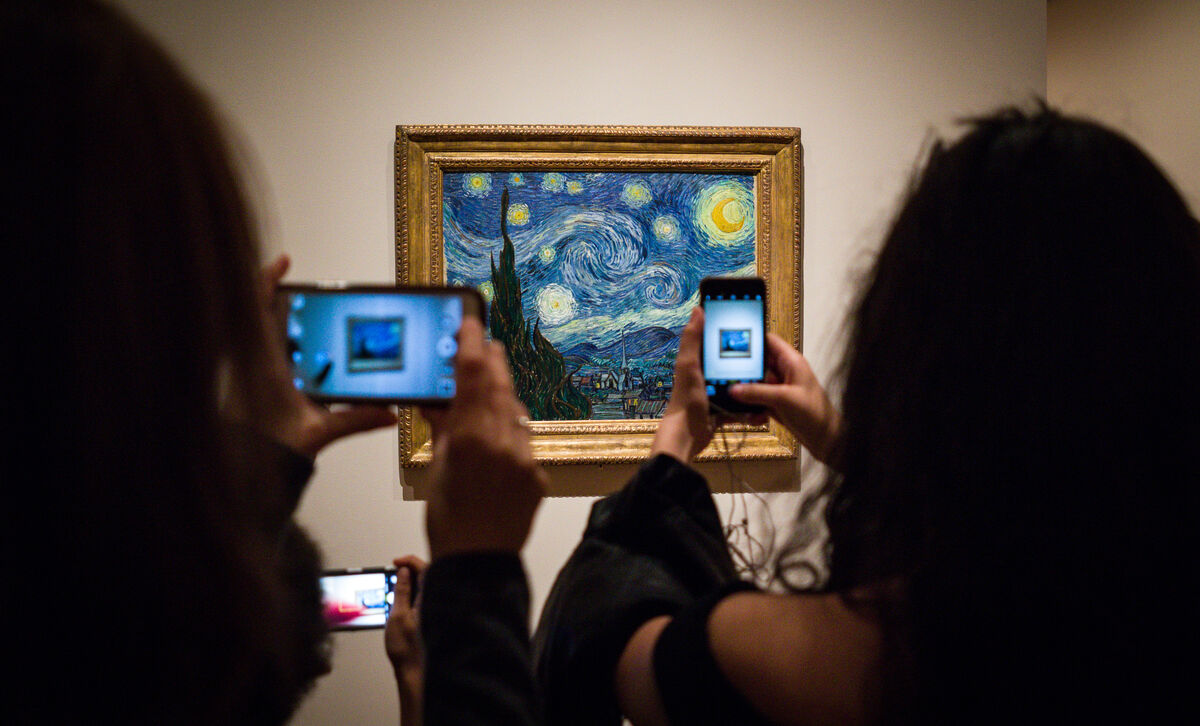
Photo by Phil Roeder, via Flickr.

Photo by Phil Roeder,  via Flickr,  via artsy.net

But there is definitely a dark side to allowing cell phones and cameras in public art spaces. As you have no doubt experienced, it’s no joy to navigate an obstacle course of selfie-takers, or to thread one’s way through a sea of upraised, photo-taking arms, hoping to enjoy an unobstructed view of an artwork you may well have traveled some distance to experience in person.

Robert Buck iPainting

iPainting (186230889), Robert Buck ©2016 Alert paint and acrylic on canvas  This is the painting as is, the image below includes the flash from my camera.

It’s the very clever artist who acknowledges our penchant for constant documentation, while simultaneously manipulating that tendency in such a way that it enhances not just his art, but the experience of viewing of it. Robert Buck’s iPainting and iPrints at the Helen Day Art Center’s current exhibition Love Letters, are a stunning example. Buck pairs his work with viewer-provided technology (camera flash), intentionally weaving both the art and the picture-snapping viewer together symbiotically. In fact, it is only when the two are integrated that he considers the work fully realized.

Robert Buck iPainting

iPainting (186230889), Robert Buck ©2016 Alert paint and acrylic on canvas             As noted on the gallery card beside the painting: “Buck’s iPaintings are made using a combination of acrylic and Alert paint, an oil-based industrial coating, which, due to an additive of minuscule glass beads, is highly reflective. Consequently, when the painting is illuminated by the flash of a camera, the Alert paint fluoresces and a fallow image appears…the completion of the piece comes in the moment the viewer is photographed in front of the work, thus haloed by the reflective light, becoming universally connected and filled with light.”

Not the greatest fan of cell phones and their interruptions, I find the idea of Buck’s work brilliant. Is it a gimmick? Maybe. But I am reminded of visiting the Uffizi Gallery in 2018. Anxious to get close enough to see and follow Botticelli’s brushstrokes in his monumental Primavera and Birth of Venus, I hung back while group after group took pictures of themselves with the work as their backdrop. I soon realized that it wasn’t so much the work itself that fascinated them, it was the idea of a picture of themselves next to it. With no break in sight, I finally decided to edge my way to the front so I wouldn’t miss an opportunity to see Botticelli’s genius up close. And truthfully, I don’t think my presence made the slightest difference to those whose attention was primarily trained on images of themselves. Imagine, however, if those paintings had somehow been affected as they snapped their pictures. Would such a effect have incurred a fuller sort of engagement? And how would that affect the experience of other nearby viewers?

Buck’s work makes me wonder how other artists will circumvent and/or incorporate technology in such a way that it will no longer be regarded as intrusive in an environment often reserved for meditative contemplation. Never discount the ability of the artistic mind to finding a way to mold reality, for better or for worse, to a higher – or should I say different – purpose.

See more of Robert Buck’s iPaintings.

Food for thought: This article considers how cell phones impact cognition and, more specifically, whether and how they affect one’s appreciation of art. It has some surprising revelations.