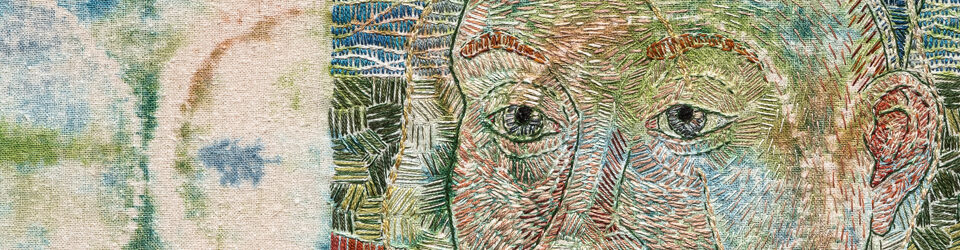
I’m half joking, but Warning! This post is long. Even still, there is so much to cover that I’m going to split it in half and will be back with Part 2 next time. Meanwhile, I’ve tried my best stay heavy on images, light on words. I’ve sprinkled in lots of links so you can explore further.
✷
My head is spinning on the heels of our recent trip to Scotland – there was inspiration everywhere! So many of my favorite things: textiles, portraits, gardens and more! I always come home from being away feeling like my brain got a good airing out. The best souvenir is plenty of fresh things to think and read about, setting the stage for, if not a reset, at least additional perspectives to bring back to the studio.
Here we go…
Tapestries:
The Great Tapestry of Scotland
Dovecot Studios
The Hunt for the Unicorn at Stirling Castle
The Great Tapestry of Scotland is housed in its own museum, about an hour south of Edinburgh in the Scottish Borders textile town of Galashiels. Created by 1000 stitchers, it’s no exaggeration to say it is a 160-panel masterpiece that covers the broad scope of Scottish history, along with everyday stories of the Scottish people.

We went directly to Galashiels to see the Tapestry after our red-eye landed, albeit a bit bleary-eyed. However, no need for an energy boost once in the presence of all the amazing stitch-work. This is Panel #1.
First impressions: each panel is HUGE (about a meter square), most are brilliantly colorful and all are quite ingenious in their depiction of chosen subject. The panels were designed by Andrew Crummy, but the masterfully stitched intricacy, diversity and expertise are all a credit to the individual stitchers.

This detail of Panel 1 (seen in full above) is a mere taste of what is to follow.
Before we left Vermont, knowing how overwhelming it would be to try to take in such a massive display during one brief visit, I purchased Alistair Moffat’s The Great Tapestry of Scotland book which shows and describes each panel in detail. Pouring over and reading the particulars ahead of time gave me a chance to become better acquainted with the history and meaning behind the panels, including improvisations which were allowed stitchers in order to underline their personal connection with the event portrayed on the panel they stitched.

Panel 126 – “Fair Isle” As a knitter, I loved this panel. Fair Isle is known for a traditional style of knitting made popular when the Prince of Wales, later to reign briefly as Edward VIII, took to wearing Fair Isle knitted sleeveless jumpers to play golf in the early 1920s. Very colorful with finely worked horizontal geometric patterns, these designs were trending then, and still are.
Having a bit of a leg up allowed me to concentrate more fully on the stitchwork; the remarkable way in which various details were depicted was captivating.

Detail of Panel 64 – “The First School for Deaf and Dumb Children” Just look at the way the curls of this teacher’s wig, as well as his shirt sleeves and waistcoat, are realized!

Detail of Panel 74 – “James Hutton’s Theory of the Earth” That hair!

Detail of Panel 87 – “The Growth of Glasgow” So many details in this small section of panel. If you too are curious about the fish with the ring in its mouth, read on.
Beyond the artistry, the finished tapestry is a remarkable community accomplishment that includes the work of 1000 participants from the whole of Scotland. I could have written several posts on the Tapestry alone, but there’s more to see.

✷
Moving on…
Dovecot Studios in Edinburgh is a working tapestry studio and gallery. When I asked how their weavers were selected, I think the woman thought I was looking for a job. Ha! She told me that it had been 10 years since they last hired someone – only master weavers. The Studios support an apprenticeship program and I believe their weavers tend to come directly from that pool.

Looking down on a tapestry in progress from the viewing balcony, which also doubles as a gallery space. The monumental weavings on the far wall were created by Ptolemy Mann. The studio was silent, the weavers were in their own worlds, with headphones on.
As if seeing the working weavers wasn’t enough, we were also able to take in the current exhibition “The Scottish Colourists: Radical Perspectives” in the Dovecot Studios expansive lower gallery space. If you read Art & Object, perhaps you caught the accompanying review? My education never even touched upon Scottish art history, so this was a treat.

Jessica Dismorr, Landscape with Figures, 1911-12, Oil on Panel. So many wonderful works – this was the one I would have brought home, if allowed.
✷
The Hunt for the Unicorn is a set of 7 tapestries in the Queen’s Inner Hall of Stirling Castle. They are a recreation and reinterpretation of tapestries that appear in castle inventories from the 16th century. The recreation was a monumental 14-year endeavor which enlisted a team of 18 weavers from across the world.

This photo taken from the web shows the grandeur of the recreated tapestries. The colors and details are spectacular, giving one an idea of how awe-inspiring the originals would have been, especially to 16th century visitors. For more photos, follow this link.
Stirling Castle was the childhood home of Mary Queen of Scots and, with extensive research, the palace interiors have been recreated as they may have looked in the 1540s during the reign of Mary’s father, James V.

One can visit the on-site tapestry workshop where the modern version of The Hunt for the Unicorn was made. One can read extensive information there about the details of the tapestries’ creation, and see samples that were created in preparation. If you’re interested in going further into the weeds of this extensive project, read this.
And now…
Portraits:
The Scottish National Portrait Gallery
Stirling Heads at Stirling Castle
I am a huge fan of Sky Arts Portrait Artist of the Year, which can be streamed on Amazon. If you’ve watched it, then you will be aware that the grand prize is to paint a portrait of a figure of national importance for one of several UK Portrait Museums. After viewing it on the show, I was dying to see the Scottish National Portrait Gallery’s Great Hall. It is even more breath-taking in the flesh.

The Great Hall of the Scottish National Portrait Gallery in Edinburgh

Even the ceiling is magnificent!
Currently on view within the Gallery is “The Modern Portrait”. Considering the development of portraiture since the early 20th century, this exhibit shows evolving portraiture styles over the past 125 years. It was also a fascinating opportunity to learn about the paintings’ subjects – figures who have contributed significantly to Scottish life in numerous spheres.

The Unknown Man, detail, 2019, Ken Currie, 6.5’x9 feet, Oil on Canvas. This powerful and massive portrait (hence the detail) is of Dame Sue Black, forensic anthropologist.

Alexander Frederick Douglas-Home, 1988, Avigdor Arikha, Oil on canvas. What drew me to this one was the composition. As I’ve noted before, I am a fan images that hug the edge.

Tom Leonard, About 2004, Alex Main, Bronze I took this photo so I could paint it in my sketchbook later – I find the sense of form quite moving and a great opportunity for practice.
✷
The Stirling Heads, made of Polish oak, were a ceiling adornment in James V’s Inner Hall meant to display his status as monarch through reference to his royal bloodline, powerful connections and fashionable court. After having been dispersed in the late 18th century, some of the originals are reunited in a darkened gallery in the castle, while modern reproductions recreate their splendor, once again decorating the ceiling of the King’s Inner Hall.

The workmanship of the originals is spectacular.

Painted reproductions as they would have appeared originally are also a testament to the skills of modern artisans..
OK, time to stretch your legs – that is more than enough for now! Perhaps (I hope) you’ll have seen something that will send you down your own rabbit hole of discovery. I know there is a lot of reading I’m looking forward to.
Next time, Gardens and a touch of “oh my!” Till then.