Category Archives: Process

Organized Chaos

Self-Portrait

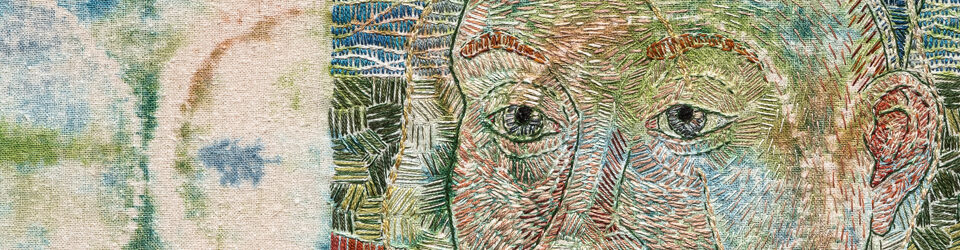
Self-Portrait ©2026 Elizabeth Fram, Gouache & Embroidery on paper, 6 x 8 inches   This represents a couple of firsts: my first time painting a face using gouache and a first self-portrait. While I think the stitched pattern works well in this case, what I’m ultimately aiming for is to find a way to more fully integrate pattern, stitching and paint with each other.

I have an uncle who wrote a regular newspaper column for years. During family get-togethers, including major holidays, he would inevitably sequester himself from the family group for a bit so he could meet his deadline. I was just a kid, but still peripherally aware that his challenge included what to write about week after week; it never occurred to me then how personal that memory might become.

Bowl and Cup

Bowl and Cup, in process ©2026 Elizabeth Fram  This piece shows my most exciting discovery to date. I absolutely LOVE the almost batik-like effect of the pattern which lies underneath this image. Gouache’s inherent nature to reactivate with water has worked to my advantage here. That said, it’s also a very tricky operation. I haven’t had a chance to add stitching to this piece, but I have ideas…

There are weeks when I really struggle with what to post here. It’s not that I lack things to share, but rather the challenge can be figuring out how to weave together my behind-the-scenes loose ends in a presentable and, hopefully, interesting way. It’s one thing to make the work, another altogether to write about it coherently, especially when it’s in a place of transition.

Underlay

Establishing an under-layer of pattern with paint as a first step.

Anyway, that’s the spot I find myself in this week – trying to articulate organized chaos. I’ve been plenty busy, but other than just showing you my progress, I lack a cohesive way to explain where I’m headed, especially since I’m not exactly sure yet where that might be. I’m puzzling my way through unknown territory and thus finding comfort in that discomfort.

Head-on Stare

In progress ©2026 Elizabeth Fram, Gouache on paper Look closely and you’ll see that I painted this portrait on top of the above under-layer. I learned a couple of important lessons to carry forward. Still planning to stitch on this one, but again, haven’t yet had time.

The one thing I know from experience is that the secrets I’m hoping to uncover will only float to the surface through doing the work. One has to venture down a lot of dead-ends before finding the road through.
I’ll have to ask my uncle if that’s how it worked for him too.

3 Vessels

3 Vessels ©2026 Elizabeth Fram, Gouache & Embroidery on paper, 8 x 4.5 inches  This one feels one step closer to where I want to go.

A colorful reminder that Spring is on its way.


Start to Finish

I use mid-process photos as an invaluable tool to help me work my way through most new pieces. Photos give me a chance to evaluate what I’ve already done and, also, looking back over my progress at any given point generates ideas for next steps. It’s a means toward perspective via distance.

Fram Sketch

Making such a detailed initial sketch is not how I usually work.
But I’m currently in the midst of feeling my way toward something new and this kind of notation serves as a potential roadmap as I get my sea legs. A sketch is a means of working through possibilities (look closely to see plenty of erasures) and of recording specific ideas to keep in mind for later. In this instance, I was thinking especially in terms of value.

,Resist

Laying out the major elements with outlines of gouache sets my bearings. Next, I painted resist in specific areas (seen as barely visible yellowish lines around the leaf shapes and as hash marks surrounding the tube of paint in the lower right). My aim with this step is to create visual texture by preserving the white of the paper in a way that would be hard to do with paint alone.

Palette

Learning about color is never-ending. Choosing a limited palette simplifies and unifies.

First Layers

Beginning layers of paint get things underway. Gouache’s opacity gives me elbow room to tweak colors and change my mind in a way that isn’t possible with watercolor. It’s quite liberating.

Value

Value is such an integral part of color. Using my phone’s black & white mono filter helps me stay on track in terms of value.

First Stitches

Once the painting is done and the resist is removed, the stitching begins. This photo highlights that the work itself, together with intuition, dictates my direction far more strongly than any initial sketch. Rather than merely filling in the whole area on the left with needle weaving, as originally intended, I realized mid-way that the varying thread colors really made the pink ground pop – so why cover it? Plus, by not filling the area completely with stitches, that pause of pink serves as a bridge which highlights the “conversation” between the stitched area and the white marks on the red ground.

Holding Substance

Holding Substance ©2026 Elizabeth Fram, Gouache and Stitch on paper, 8.5 x 6.5 inches

A stitched border extends the ideas found within the imagery, yet stands on its own. I’m attracted to the idea of wrapping common objects in pattern, texture and color to give them a sense of significance beyond their unassuming simplicity.

This Hyperallergic article by Damien Davis is worth considering if you regularly pay application fees when submitting your work to exhibitions. If nothing else, it’s food for thought.

The Other 50%

Some weeks I feel like a jack of all trades.
While painting, drawing & hand-stitching may be the face of what goes on here, plenty of other, behind-the-scenes activities are just as integral to keeping everything steaming along.

These past weeks I’ve been preparing for an upcoming solo show that will run throughout the month of June. My stitched paintings of elder women — 2-1/2 years of work — will be seen all together in one venue. I hope you’ll join me for the Opening Party on June 7th!

Framing

Meanwhile, lots of unsung chores surrounding the show are keeping me busy. I’ve been cutting mats & framing the remainder of the 19 pieces that will make up the exhibit while getting the associated paperwork and computer records in order. I’ve designed an announcement/invitation and have begun promotional outreach. Leading up to this point, I’ve spent hours writing artist statements, proposals, follow-ups and, as you may remember, assorted blog posts sharing the process of each piece over the past couple of years.

There is a general wisdom that artists only spend about 50% of their time actually making art; the rest is devoted to business, which is just as demanding. How very true.

With this in mind, please note that I am going to take a short break in early May. Look for my next post in 4 weeks, on May 22nd.

Invitation / Announcement

If you’re looking for a diversion, Austin Kleon’s Substack post this week is filled with all sorts of art-y goodness. It’s been a treat to slowly chip away at his links during my breaks. Each is a source of inspiration in its own way, especially “Art Thief: Lessons from Wayne Thiebaud”. But if you only have time for one thing and are looking for a sense of connection across time, and/or a source of hope, remember gardens and read Kleon’s 2017 post “Planting Iris”.
Planting season has arrived, time to get to it!

Iris

Iris   ©2019 Elizabeth Fram, Ink on paper, 11 x 8.5 inches


Words to Work By

I don’t have a whole lot to write about in this post since I’ve been busy pulling together my 3-times-a-year newsletter, which will go out early next week. I know a lot of you subscribe to both lists, so I’d like to spare you too much overlap. If you’re not a subscriber, you can sign up here.

Meanwhile, the one newsletter I consistently read every week is “3-2-1 Thursday“, written by James Clear (author of Atomic Habits). Each issue is comprised of 3 ideas from Clear himself, 2 quotes from others, and 1 question for readers to mull over. It’s short, sweet and, more often than not, hits a mark of some sort.

In January he threw out the following idea and it’s stayed in the back of my mind ever since:

“Nearly everything awesome takes longer than you think. Get started and don’t worry about the clock.”

Here’s a taste of what I’m working on – both are still in-process.

Pear Shadows

©2025 Elizabeth Fram, In-process


Memory Web

©2025 Elizabeth Fram, In-process  I’ve been learning about knotless netting – or looping – from Lissa Hunter. She sometimes uses this technique on the baskets and vessel forms she makes. I’m exploring what will happen by using irregular tension and am thinking about incorporating it as a layer that references memory – sometimes overwhelming and, in this instance, tangled. I’m still considering how much to add to this piece.

And finally, this one from last week is now finished; title yet to be determined.

Glass

©2025 Elizabeth Fram, Watercolor and stitching on paper, 8″H x 6″W

And now for something completely joyful:

I discovered the paintings of Carl Larsson when I was in college – and was smitten with his depictions of domestic interiors and use of line with watercolor. His inclusion of houseplants and details like the turned runner and the knitting in the painting below, enchanted me.

Carl Larsson

Carl Larsson

So I was thrilled yesterday, to come across the following article* in the NYTimes which includes many photographs of the interior of the summer home where Larsson and his wife Karin lived with their eight children. If you’re familiar with Larsson’s paintings, it’s immediately apparent how faithful his renditions were. But more impressive to me now is seeing how the Larssons bucked design trends of the time, creating a home in which every room was a personal artistic expression of themselves. The colors alone are swoon-worthy.

Karin Larsson

Try to look past the potted plant to a reproduction of Karin’s weaving “The Four Elements” behind, on display in her workroom.

An added bonus was discovering Karin’s textile work, which is evident in every room. She too was a painter at the time they met, but that discipline took a backseat once she started having children. She turned to textiles as a result – not an unfamiliar story – but her sense of color and design were impeccable. Please read more about her.

*(I’m gifting the article to you, so you shouldn’t have any problem opening the link). Hopefully you can also open this link to a video of Larsson’s great-great-great granddaughter giving a light-hearted tour of the house. If not, the video is part of the article.

Enjoy!


Steeped in Color

We’re having such a lovely, wintery winter this year.

Getting an inch or two of snow most days over the past weeks has resulted in a healthy accumulation, smoothing the rough edges of our landscape and keeping things visually subdued, restful even.

Sunrise

Our home is nestled between the Worcester and Green mountain ranges. Once the sun rises high enough to clear the Worcester range behind us, it shines on the Greens to our west, making for a bright start to the day.

That means there are days when the sunrise or the sunset offer our only fleeting glimpse of color in a 24 hour period, made all the more vibrant by our muted surroundings.

Sunset

The sky can be just as spectacular in the early evening

Never fear, there is always plenty of color in the studio. Lately I’ve been looking at specific palette combinations, aiming to grasp why it is they appeal to me at a gut level. I figure this is the best approach for leveraging what I then learn in order to create new palettes of my own.

Matisse / Zorah on the Terrace

Zorah on the Terrace, Henri Matisse, 1912.  Years ago I began clipping an assortment of visual references, often color-centric, (deposits, if you will) to fill a visual bank of spiral sketchbooks that I return to time and again for inspiration.

Right now, M. Matisse leads the way.
One might think just looking is enough, but I’m learning so much more by isolating and then trying to recreate the colors of favorite paintings and from collected resource photos, using the paints and drawing tools I have on hand.

Matisse sketch

A hasty copy of Matisse’s Zorah on the Terrace using colored pencils and Neocolor II’s helps me to understand some of the nuances of his color choices.

Painted Notes

Making color swatches solidifies my grasp of how this particular palette can be translated with my own mixes.

Playing around with mixtures or layering colors over each other to arrive at just the right hue helps me to more intimately know the colors I already own, while – bonus! – being a restful and meditative exercise unto itself.

It’s been very helpful to keep a devoted sketchbook for saving palette mixes as I go along. Not only can I reference what I learn from master painters, but it’s an easy way to retain the various mixes I discover from my own work, including color notations about specific locales (as shown in this post). This has been a game changer for narrowing down what colors to pack before a trip.

Spirit of SPA

Spirit of SPA ©2025, Elizabeth Fram, Watercolor and stitching on paper, 7-1/8″ x 7″. The palette of this latest piece was meant to reflect a mid-August afternoon, which was when I took the reference photo and had a delightful visit with my model. It’s all interwoven, isn’t it? Light affects color affects time affects light.

Working on this portrait last week, I was conscious of separating the colors so they could be seen as individual strokes and marks which come together in a palette that speaks to the specifics of the time I spent with my sitter. I still have plenty to learn in order to push this idea – but at least this offers a glimpse of what I’m aiming for.

Find of the week:
Patty Hudak’s Mokuhanga prints…stunning!


Patterns of Practice

Do you also find yourself curious about how other people approach their work – the distinctive quirks of process that they have developed for themselves?

Before the holidays, a friend gave me the huge (in both size and content) book The Work of Art: How Something Comes from Nothing by Adam Moss. At a richly illustrated 400+ pages, it’s the sort of volume one dips in and out of rather than reading all in one go. It’s perfect for easing into when you have a spare 15 or 20 minutes.

The Work of Art

Moss features more than 40 of today’s most accomplished creators — painters, writers, cartoonists, filmmakers, musicians, composers, fashion designers, chefs, etc. They share generously as he digs deeply into their various practices, sifting through their thought processes, their doubts, their constraints and, ultimately, their breakthroughs. In other words, all the things we can relate to as part of a creative practice regardless of how proficient or well-known one may be.

Strands of Wisdom, detail ©2025 Elizabeth Fram

Artists are a diverse crowd, but a tribe all the same. Personally, I find that sense of connection tremendously uplifting as I toil away in my remote corner. With all this in mind, I was intrigued lately to, somewhat coincidentally, happen upon a Substack post entitled “Know Your Creative Cycle”, written by Mason Currey, the author of Daily Rituals: How Artists Work.

Strands of Wisdom

Strands of Wisdom (I’ve Seen A Lot, Not All Of It Good) ©2025 Elizabeth Fram, Watercolor and embroidery on paper, 8.5 x 8.5 inches       This latest piece came together pretty quickly, which is the exception rather than the rule for me. My creative cycle usually involves a series of starts and stops. I get an idea and head out of the gates with a bang, but then something invariably crops up mid-stream to stop me in my tracks. Then I have to step away to figure out how to get around that stumbling block. Mostly, in-process decisions are a leap of faith which, thankfully, more times than not end up working out. That said, on-the-fly decisions directed this piece away from what I had originally planned. But the good news is, that just leaves me room to go back to my original idea in the future.

If you have a moment, try his exercise to identify how your individual practice ticks. I thought it was something of another tribal moment to discover that while the particular ups and downs of getting the work out of our heads and into the world may be somewhat different for everyone, we all have a pattern, and being aware of that pattern is power.

For those of you who aren’t on my separate art mailing list…

Please join me and other exhibitors
this Saturday, February 1st from 4-5:30pm at Studio Place Arts
for an Artist Social celebrating

Where’s My Hat?
January 22 – March 1, 2025

Secrets She Keeps

The Secrets She Keeps, detail ©2020 Elizabeth Fram, Stitched-resist dye and embroidery on silk, 24″ x 18″

Studio Place Arts
201 N. Main Street
Barre, VT 05641
802.479.7069   |   info@studioplacearts.com

Scroll down on this link to preview the show


Comfort in Discomfort

I don’t know about you, but I feel a lot more at ease delving into new projects once my slate has been cleaned of older ones. December and January are usually so consumed with juggling year-end evaluations and formulating plans for the months ahead, never mind all the holiday hoo-ha, that it takes a lot effort to keep my eye on the ball and to finish up whatever was already in the works.

If Only & It Was A Dream together

If Only ©2024 Elizabeth Fram and It Was a Dream ©2025, side by side. Reeling from November’s election, these two pieces were my way to address the concept of dreams that ultimately don’t pan out, and the hope that bolsters us in the face of such setbacks. Light vs dark, day vs night — reality is a full circle that necessarily encompasses both. BTW, I’m currently reading Judi Dench’s Shakespeare The Man Who Pays the Rent. So with my head in that space, I had to look to see what the Bard had to say on this subject. He never fails us: “The web of our life is of a mingled yarn, good and ill together” (All’s Well That Ends Well).

In early November I began a couple of “companion” pieces. I shared the first, If Only, in my post Something to Lean On. Today I’m showing its counterpart, It Was A Dream. The two were conceived together but are meant to work either in tandem or independently – viewer’s choice.

It Was a Dream

It Was a Dream ©2025 Elizabeth Fram, Watercolor and stitching on paper, 12″x9″

Now that they’re both finished, I can turn my attention to whatever may be next. I’ve decided I want to carve out time in 2025 to push some of my trusty processes and techniques in ways that will hopefully open the door to different outcomes. But that said, it’s a lot easier to come up with nebulous goals than it is to succinctly outline the specific steps to getting there, so I have some serious experimenting in front of me.

Dream detail, cards

It Was a Dream, detail ©2025 Elizabeth Fram

And while there’s no way to know at this point what the results might look like, I guess that’s exactly the point. If I knew where I was going I doubt there would be much growth, and I feel like I’m ready for a stretch. Meanwhile, I’m keeping in mind what my favorite fitness coach says: “find comfort in discomfort”.

It Was A Dream close up

It Was a Dream, detail ©2025 Elizabeth Fram

Carry On

Happy New Year!

My December break is over and I’m sure it won’t surprise you that removing this commitment from my plate during the busiest month of the year was revolutionary — enough so that I am planning to do it again next December. But with that said, it’s sweet to be back.

Watercolor Head

©2024 Elizabeth Fram, Watercolor, 14 x 12 inches. I’ve been working with watercolor during our live drawing sessions. It’s very humbling. I’ve learned from watching Portrait Artist of the Year that having a photo of the model during the session can be very helpful, if they’ll allow it. A picture on my phone allows me to zoom in on facial details – especially around the eyes – that I can’t see from 15-20 feet. Later, in the studio, having the photo gives me a shot at a second practice round, from which I often learn even more.

Before I go any further though, many thanks to those of you who sent notes in support of my pause and for expressing your hope that I would return. It meant more than you can know.

Head Layer 1

This and the following pictures follow a second attempt, this time back in the studio. Here, a quick wash maps out the general dark areas, giving me a basic structure to work from.

So now that we’ve all arrived on the fresh page of 2025, what’s up your sleeve for the year ahead? I’m sure you’ve been thinking and scheming about it.

Head Layer 2

I used a Pitt Oil-base extra soft pencil by Faber Castell to loosely rough in features. Its rich black marks are much like charcoal, yet glide on the paper and over the watercolor without any dust.

While I mull over my own future projects, most of which aren’t fully imagined yet, I’m glad to have a holdover piece to dive into post-holidays. It isn’t far enough along yet to share here now, but I’m hoping it will be finished by next time. Anyway, I wish I could remember which writer it was that coached it’s best, at the end of each day, to leave your work at least partially unfinished so that you know exactly what to do when you get back to your desk the next morning — a brilliant tip.

Head Layer 3

Adding Neocolor II’s over the previous pencil and watercolor layers, while judiciously running a wet brush over some of those marks, gives a sense of vibrancy and looseness that I quite like.

It’s a lot less intimidating after any respite to just carry on with something already in the works than it is to face the pressure of starting something completely new. And by the same token, it’s much easier to begin new work directly on the heels of finishing a previous piece, thus taking advantage of the full head of steam you already have underway. In other words, use momentum to maintain momentum.
And most importantly, keep going!

Head Layer 4

©2024 Elizabeth Fram, Watercolor, Oil base pencil, Neocolor II, 9.5 x 8.25 inches. The final shadow over the right side of his face makes the lighter areas pop. I’m coming to really love using Neocolors because they offer the best of all worlds: strong color, the ability to make energetic marks as well as to create a wash.  Even though the original watercolor was done in situ and this one in the studio, this second drawing feels a lot more immediate and successful.

On a completely different note: Dipping into Substack can be just as inviting as the idea of sitting down with a full box chocolates. There’s a lot of interesting and inspiring content to devour, but absolutely guilt-free. I am so happy to have found Canadian painter Harry Stooshinoff there. Love his work, love his ideas. I’ll leave you with this thought of his, which I think is a very apt way to begin the new year:

So much water under the bridge. At a certain point it doesn’t even matter if the work is good or bad. Obviously we try to make the best work, and move it in the direction we think it needs to go. It’s utterly stupid to do otherwise. But it doesn’t matter much how it is accepted, sorted, or judged. It matters only that it is made.


Small, Thoughtful Steps

Remember the painted detail of the birds that I shared in my last post?
Here is the full painting, now complete.

Time on the Wing

Time on the Wing    ©2024 Elizabeth Fram, Watercolor and stitching on paper, 9″H x 12″ W

I can’t necessarily explain this piece in the sense of telling a particular story, but I will say it’s a convergence of and meditation on a number of things: the passage of time, a feeling of grounding that is rooted in one’s sense of place, the idea of freedom in unrealized possibilities, and an overarching love for the changes that come with Autumn as the landscape readies for the dormancy of Winter. Hmmm – I guess even if it isn’t a story, that’s a lot to pack into 9″ x 12″.

Time on the Wing, one

Washi tape and masking fluid give me the ability to preserve various sections while working on others. Pencil lines rough in the suggestion of a background pattern in the upper right (which becomes more prominent as the piece evolves). If you look closely you can see that this pattern riffs off both the pointed house shape, which encloses the portrait, and the swooping lines of the hair.

While I always work on an entire painting all at once, I do toggle back and forth between elements because, as I move through each stage, every decision affects everything that comes after. An action taken in one area dictates the next step for another section.

Time on the Wing, two

Early layers of paint set up a backdrop

In other words, I depend upon a series of mindful steps that build upon each other. These images of the portrait within the painting give an idea of that progression.

Time on the Wing, three

Layers of Naples Yellow and Yellow Ochre connect the fore, mid, and background by adding dimension to the grasses, warming the tones of the face and carrying the sunset over from the left of the painting in the background. Washes and strokes of green link the hair, the eyes, the grasses and the field while offsetting the blue and yellow complementary undertones that had begun to dominate.

When sitting down to a freshly stretched sheet of paper, I may have a core idea of where I’m headed but I can always count on the fact that there will be plenty of changes and adjustments along the way, most of which relate to the nuts and bolts of process itself.

Time on the Wing, four

While initially I had planned to leave it out, adding a mouth soon felt necessary. The masking fluid that preserved the area for the sumac has been lifted in this picture. It’s always a relief to remove the washi tape or masking fluid so I can see the piece without the distraction of their strong colors.

In a way, every new piece is a wonderful sort of puzzle. Before the brush even touches paper, it’s necessary to think ahead to consider what might need to be done first (such as which elements to mask) and in what order each consecutive layer needs to be laid down. For the most part, the masking is really the only part of the process that rarely changes.

Masking the sumac branches and flowers in the foreground was the very first step after lightly penciling in the composition. Considering that masking fluid dries to a yellow-ish color, I had to consciously work to avoid letting it influence my surrounding color choices.

Time on the Wing, Five

The stitched roof was a late decision. Not only does it further accentuate the curving pattern in the background but, more importantly, the added 3-dimensionality of the house/portrait combo makes a lot more sense, sitting in a landscape as it does – even though it isn’t meant to be a “real” house.

Incorporating stitching is usually the last step, but an element I’ve been thinking about before the first pencil mark even hit the paper. However, it too is influenced by what goes before, as noted in the caption above, and sometimes ends up being completely different from what I’d initially imagined.

It’s these small, thoughtful steps along the way, many of which can’t be predicted, that make a piece what it ultimately becomes. For the most part, I’ve learned it’s worth being patient, and trusting that the piece itself will lead me in the right direction.

How many times have you read an article that challenges readers to name 3-5 women artists, correctly insinuating that it’s difficult to do in a culture that has historically ignored the accomplishments of women in our field?

Women Painters Book

When we were in Berkeley last month, I managed to find time — correction: I MADE time — to stop by Mrs. Dalloway’s – Literary and Garden Arts, a treasure of a local bookstore. I picked up a little gem that fit easily into my bag and that I think you might like too: An Opinionated Guide to Women Painters . It’s a concise compendium that covers, with images, “65 female artists from throughout history and across the world”. There are names you will recognize and plenty you won’t. The contributors have done their best to see that no one is stumped by the ‘name 5 female artists’ question again.

Field Trip

Vermont is in the midst of a roll of warm, sunny days.
And while we appear to be flirting with fall because daylight hours are getting noticeably shorter and the foliage is turning quickly, the past couple of weeks have felt decidedly more summer-like. Time for a field trip!

K. Grant Fine Art Gallery

K. Grant Fine Art, 37 Green St., Vergenne, VT   802.922.4399   kgrantfineart.com

Last week we ventured to the other side of the Green Mountains, destined for Vergennes, to check out “Soft Openings“, the inaugural show at K. Grant Fine Art which opened its doors in August.

With abundant natural light pouring in the front widow, the gallery feels at once both intimate and spacious – a credit both to the nature of the building that houses it and gallerist/owner Kristen Grant’s curatorial chops. I was charmed.

Megan Bogonovich

Three irrepressible ceramic floral sculptures by Norwich artist Megan Bogonovich; she characterizes her work as a lovechild of Pierre Bonnard and Tony Smith.  Bogonovich was featured on This is Colossal last May.

Cameron Davis and Pamela Fraser

A painting by  Cameron Davis’ that pulses with life,  flanked by Pamela Fraser’s ceramic sculptures which are presented and exist as moveable pairs.

Paying a visit was spurred by Alice Dodge’s glowing review in 7 Days which gives a rounded depiction of the five exhibiting artists, their work, and of Grant herself. The article was enough of a teaser to pull me in and I found the show to be as vibrant as promised. In fact, I’m not sure there’s much I can add to Dodge’s assessment other than a few photos.

Arista Alanis

Pattern is the undercurrent that runs through all the work in “Soft Openings”. Rooted in nature, the energetically improvised paintings by Arista Alanis offer a sense of organization through her inclusion of pattern.


Wylie Garcia & Pamela Fraser

Pamela Fraser’s spiked ceramic piece is an apt counterpoint to Wylie Garcia’s spiraling floral bower.

Even though I had my favorites among the exhibitors, I walked away feeling that each artist’s voice confidently held its own in conversation with its exhibition mates, remaining distinct as an individual entity. That’s no small accomplishment in a group show.
Soft Openings” closes on September 28th so there’s still a little more than a week to catch it if you can.

Bogonovich, Fraser, Garcia

Left to right: Megan Bogonovich, Pamela Fraser, Wylie Garcia

✦✦✦

Birds in flight WIP

WIP, detail     ©2024 Elizabeth Fram

Despite the warmth and sun, I have Fall on the mind. The daily changes in color and texture surrounding us are filtering into my sketchbooks as well as my latest painting, detail above, which is still unfinished on the board and remains to be stitched. I’ve been approaching it in a measured way – not necessarily slowly, but with deliberation – working to pull all the elements together and think ahead to how stitching will complete its circle.