Category Archives: Community Art

Tapestries, Portraits and Gardens – Oh My! (Part 1)

I’m half joking, but Warning! This post is long. Even still, there is so much to cover that I’m going to split it in half and will be back with Part 2 next time. Meanwhile, I’ve tried my best stay heavy on images, light on words. I’ve sprinkled in lots of links so you can explore further.

My head is spinning on the heels of our recent trip to Scotland – there was inspiration everywhere! So many of my favorite things: textiles, portraits, gardens and more! I always come home from being away feeling like my brain got a good airing out. The best souvenir is plenty of fresh things to think and read about, setting the stage for, if not a reset, at least additional perspectives to bring back to the studio.
Here we go…

Tapestries:
The Great Tapestry of Scotland
Dovecot Studios
The Hunt for the Unicorn at Stirling Castle

The Great Tapestry of Scotland is housed in its own museum, about an hour south of Edinburgh in the Scottish Borders textile town of Galashiels. Created by 1000 stitchers, it’s no exaggeration to say it is a 160-panel masterpiece that covers the broad scope of Scottish history, along with everyday stories of the Scottish people.

The Great Tapestry of Scotland

We went directly to Galashiels to see the Tapestry after our red-eye landed, albeit a bit bleary-eyed. However, no need for an energy boost once in the presence of all the amazing stitch-work. This is Panel #1.

First impressions: each panel is HUGE (about a meter square), most are brilliantly colorful and all are quite ingenious in their depiction of chosen subject. The panels were designed by Andrew Crummy, but the masterfully stitched intricacy, diversity and expertise are all a credit to the individual stitchers.

Detail of the above Panel 1.

This detail of Panel 1  (seen in full above) is a mere taste of what is to follow.

Before we left Vermont, knowing how overwhelming it would be to try to take in such a massive display during one brief visit, I purchased Alistair Moffat’s The Great Tapestry of Scotland book which shows and describes each panel in detail. Pouring over and reading the particulars ahead of time gave me a chance to become better acquainted with the history and meaning behind the panels, including improvisations which were allowed stitchers in order to underline their personal connection with the event portrayed on the panel they stitched.

Panel 126 Fair Isle

Panel 126 – “Fair Isle” As a knitter, I loved this panel. Fair Isle is known for a traditional style of knitting made popular when the Prince of Wales, later to reign briefly as Edward VIII, took to wearing Fair Isle knitted sleeveless jumpers to play golf in the early 1920s. Very colorful with finely worked horizontal geometric patterns, these designs were trending then, and still are.

Having a bit of a leg up allowed me to concentrate more fully on the stitchwork; the remarkable way in which various details were depicted was captivating.

Panel 64 Detail

Detail of Panel 64 – “The First School for Deaf and Dumb Children” Just look at the way the curls of this teacher’s wig, as well as his shirt sleeves and waistcoat, are realized!

Grey Hair, Panel 74

Detail of Panel 74“James Hutton’s Theory of the Earth” That hair!


Panel 87

Detail of Panel 87 – “The Growth of Glasgow” So many details in this small section of panel. If you too are curious about the fish with the ring in its mouth, read on.

Beyond the artistry, the finished tapestry is a remarkable community accomplishment that includes the work of 1000 participants from the whole of Scotland. I could have written several posts on the Tapestry alone, but there’s more to see.

Moving on…

Dovecot Studios  in Edinburgh is a working tapestry studio and gallery. When I asked how their weavers were selected, I think the woman thought I was looking for a job. Ha! She told me that it had been 10 years since they last hired someone – only master weavers. The Studios support an apprenticeship program and I believe their weavers tend to come directly from that pool.

Dovecot Studios

Looking down on a tapestry in progress from the viewing balcony, which also doubles as a gallery space. The monumental weavings on the far wall were created by Ptolemy Mann. The studio was silent, the weavers were in their own worlds, with headphones on.

As if seeing the working weavers wasn’t enough, we were also able to take in the current exhibition “The Scottish Colourists: Radical Perspectives” in the Dovecot Studios expansive lower gallery space. If you read Art & Object, perhaps you caught the accompanying review? My education never even touched upon Scottish art history, so this was a treat.

Jessica Dismorr

Jessica Dismorr, Landscape with Figures, 1911-12, Oil on Panel.  So many wonderful works – this was the one I would have brought home, if allowed.

The Hunt for the Unicorn is a set of 7 tapestries in the Queen’s Inner Hall of Stirling Castle. They are a recreation and reinterpretation of tapestries that appear in castle inventories from the 16th century. The recreation was a monumental 14-year endeavor which enlisted a team of 18 weavers from across the world.

Queen's Inner Hall

This photo taken from the web shows the grandeur of the recreated tapestries. The colors and details are spectacular, giving one an idea of how awe-inspiring the originals would have been, especially to 16th century visitors. For more photos, follow this link.

Stirling Castle was the childhood home of Mary Queen of Scots and, with extensive research, the palace interiors have been recreated as they may have looked in the 1540s during the reign of Mary’s father, James V.

Tapestry samples

One can visit the on-site tapestry workshop where the modern version of The Hunt for the Unicorn was made. One can read extensive information there about the details of the tapestries’ creation, and see samples that were created in preparation. If you’re interested in going further into the weeds of this extensive project, read this.

And now…
Portraits:
The Scottish National Portrait Gallery
Stirling Heads at Stirling Castle

I am a huge fan of Sky Arts Portrait Artist of the Year, which can be streamed on Amazon. If you’ve watched it, then you will be aware that the grand prize is to paint a portrait of a figure of national importance for one of several UK Portrait Museums. After viewing it on the show, I was dying to see the Scottish National Portrait Gallery’s Great Hall. It is even more breath-taking in the flesh.

The Great Hall

The Great Hall of the Scottish National Portrait Gallery in Edinburgh

Great Hall Ceiling

Even the ceiling is magnificent!

Currently on view within the Gallery is “The Modern Portrait”. Considering the development of portraiture since the early 20th century, this exhibit shows evolving portraiture styles over the past 125 years. It was also a fascinating opportunity to learn about the paintings’ subjects – figures who have contributed significantly to Scottish life in numerous spheres.

Detail, Dame Sue Black

The Unknown Man, detail, 2019, Ken Currie, 6.5’x9 feet, Oil on Canvas. This powerful and massive portrait (hence the detail) is of Dame Sue Black, forensic anthropologist.

Alexander Douglas-Home by Avigdor Arikha

Alexander Frederick Douglas-Home, 1988, Avigdor Arikha, Oil on canvas. What drew me to this one was the composition. As I’ve noted before, I am a fan images that hug the edge.

Tom Leonard

Tom Leonard, About 2004, Alex Main, Bronze  I took this photo so I could paint it in my sketchbook later – I find the sense of form quite moving and a great opportunity for practice.

The Stirling Heads, made of Polish oak, were a ceiling adornment in James V’s Inner Hall meant to display his status as monarch through reference to his royal bloodline, powerful connections and fashionable court. After having been dispersed in the late 18th century, some of the originals are reunited in a darkened gallery in the castle, while modern reproductions  recreate their splendor, once again decorating the ceiling of the King’s Inner Hall.

Stirling Heads

The workmanship of the originals is spectacular.

Stirling Ceiling

Painted reproductions as they  would have appeared originally are also a testament to the skills of modern artisans..

OK, time to stretch your legs – that is more than enough for now! Perhaps (I hope) you’ll have seen something that will send you down your own rabbit hole of discovery. I know there is a lot of reading I’m looking forward to.

Next time, Gardens and a touch of “oh my!” Till then.

Art, Fire, Music and Magic

I think it’s universal to want to believe in magic. Who among us hasn’t wished at one time or another to be able to return to the sense of enchantment that we remember from childhood? Our imaginations and the stories we had been told, or found within the pages of books, laid the groundwork for fanciful adventures played out in the woods, on the ledges of an island, or even in a tent made of bedspreads.

Sunset

Sunset on Millstone Hill  ©2016 Daniel Fram

This past weekend I found the closest thing to a portal back to that world. Fortunately, there are artists, musicians and people of vision who have kept that place alive and have made it possible for us to visit as well. The gateway opens once a year.  Unleash your imagination for a few minutes and let me bring you along.

Imagine it is the perfect summer evening, the sun has set and there is a gentle breeze. The mosquitoes must be sleeping as they are no where to be seen or heard, there is only the twinkling of fireflies and the soft sound of crickets to remind us of the insect world. We are standing in the middle of an open field. A huge bonfire crackles and smokes in front of us, sending a spray of sparks upward. Eyes rise to follow the flickering dance and then drop down again once the sparks dissolve into the night. From where we stand a stripe made of dozens of brightly lit glass votives bisects the field, beckoning us to follow it from the bonfire toward the edge of the woods. Who could resist?

Bonfire3

Sparks ©2016 Elizabeth Fram

Stepping into the trees we are swallowed in their darkness, but the votives reassuringly continue in a steady stream, cheerily urging us onward. The walkway undulates underfoot but is mostly clear of roots and is surprisingly easy to navigate in such limited light as we move deeper into the forest. Any worry about our footing is replaced by curiosity when we suddenly become aware of the sound of acoustic music in the distance. Each twist in the path brings us closer until finally we reach a candlelit clearing where a gypsy-like couple are playing soft strains of Italian folk music on guitar and accordion under a ceiling of stars.

After listening to their song we press on, following the seemingly endless votives. Soon we find ourselves stepping onto a narrow bridge, only wide enough to allow a single-file crossing. The bullfrogs greet us with their throaty plunks as floating paper lanterns, shaped like little boxes and edged in silver, gently illuminate their watery grass homes. Reluctantly, we keep walking. Leaving this beautiful setting and the bullfrogs to their evening song, the path of votives spurs us on as we continue back into the trees. Eventually the path emerges into a walled area where dozens of tiny, flickering candles are tucked into the crevices of piles of stones. There are several small campfires at the corners of this open chamber, lending a sense of significance and arrival. The stacked blocks of rock emit an uncharacteristic coolness for such a warm evening; the residual temperature they hold is evidence of harsher winter days, preserved by dense crowding and the shade that envelopes the piles during the day.

The votives persist. Guiding us up a wooded slope, they seem to merge with the stars in a way that could only be termed as magical. In time, we reach a gateway of sorts, two carved columns whose cracked and crumbled appearance suggests they are the last remains of an ancient ruin. More significantly, they signal our approach to what might be seen as an enchanted hallway. Gentle candle and torch light enhances the sense of mystery and reverence in this place; a corridor of granite carved with depictions of the wildlife that inhabit these woods, and reliefs reminiscent of prehistoric symbols. A dinosaur, and even a troll whose face is squeezing through the stone in an effort to free himself (or perhaps to catch a glimpse of us?) add a sense of humor to the spell that has overtaken us. The artwork is masterful, a physical reminder of the continuing heritage of stone-carving artistry that still exists in this part of the world. And all the while a guitar duo plays softly, accompanying and elucidating the wonder of this place and this evening.

Troll

Troll ©2016 Daniel Fram

After fully absorbing the spectacle, we descend, the votives steadfastly and safely escorting us past deep and dark water. You can smell its damp presence, yet in the low light there is no sound or sight to confirm its existence. In the distance we hear the low moans of what could be a whale, yet which we soon discover is in fact a fantastical instrument. Comprised of metal pipes of all widths and lengths, it emits mournful and eerie tones when played with a belching torch of fire that is held at intervals beneath the array of metal tubes. Beyond that, the path continues downward on its final leg. We pass one more guitarist, this time completely enrobed in darkness, sharing only the lilting sound of his instrument as we prepare to end our journey. In a suitable farewell from these mystical woods, the ever-present votives usher us out along a narrow lane that gently turns past young trees studded with colorful paper lanterns hanging from their branches. And then, as seamlessly as it began, the adventure ends as we reemerge back into the quiet open field that rests under a canopy of stars.

Pipes

Blowtorch Pipes ©2016 Daniel Fram

My retelling of our evening can’t begin to do justice to the magical experience that is Rockfire, a 2-mile walk / convergence of art, fire and music in Millstone Hill’s abandoned quarries above Barre, VT. Follow the above link to learn more and to see videos & photos of the event from previous years.

Town Meeting Day

During this contentious election season, while there is so much venomous talk from and between several of the presidential candidates, I can’t begin to say how reassuring it was to attend my local Town Meeting Day this week.

Older-Couple

Older Couple     ©2016 Elizabeth Fram                                                       These two were paying close attention to the meeting. They were subtle, but because I was drawing them, it soon became evident which way they leaned as arguments were made re: the issue at hand.

“Uplifting” is a word that comes to mind regarding this annual forum that demonstrates democracy at its best — government by the governed. Carrying on a 200 year-old tradition practiced nowhere outside of New England, the community comes together. Opposing viewpoints are voiced with conviction, but also within an atmosphere of civility that, considering our current state of politics, appears to be a dying art.

Mother

Young Mother     ©2016 Elizabeth Fram                                                     I was lucky to catch this young woman before her children ran over to give her hugs and leave their bulky coats on her lap.

In fact, in affirmation and endorsement of such courteous behavior, Vermont Town Meetings open with a Civil Invocation.*   We are lucky across this state; Town Meeting Day is an occasion to witness and participate in the very essence of community.

Packed-Bleachers

Packed Bleachers     ©2016 Elizabeth Fram                                                                                   The chairs on the gym floor were filled with attentive community members, as were the bleachers that were pulled out on either side of the room.

And, not to be discounted, it also provides a wonderful opportunity to bring a sketchpad and get in some drawing practice.

Select-Board

Select Board     ©2016 Elizabeth Fram

*Civil Invocation: “Welcome to Town Meeting. We have come together in civil assembly, as a community, in a tradition that is older than our state itself. We come together to make decisions about our community. As we deliberate, let us advocate for our positions, but not at the expense of others. Let us remember that there is an immense gap between saying ‘I am right’ and saying ‘I believe I am right.’ And that our neighbors with whom we disagree are good people with hopes and dreams as true and as high as ours. And let us always remember that, in the end, caring for each other, in this community, is of far greater importance than any difference we may have. Welcome.”

Knitters

Knitters     ©2016 Elizabeth Fram                                                             These two ladies were knitting non-stop, side-by-side as the discussions progressed.

Shining a Light on Community Art

I am so lucky to live in a place where both Community and Art are highly valued.
And when the two come together, it’s truly a thing of beauty.

RiverofLight

For the past 5 years, I’ve had a wonderful time participating in Waterbury’s River of Light Lantern Parade. Conceived of and organized in 2010 by artists Gowri Savoor & Angelo Arnold, along with local art teacher and community powerhouse MK Monley, it has grown steadily, dispelling the cold and dark of a December evening each year, with the magic and warmth of light and community spirit.

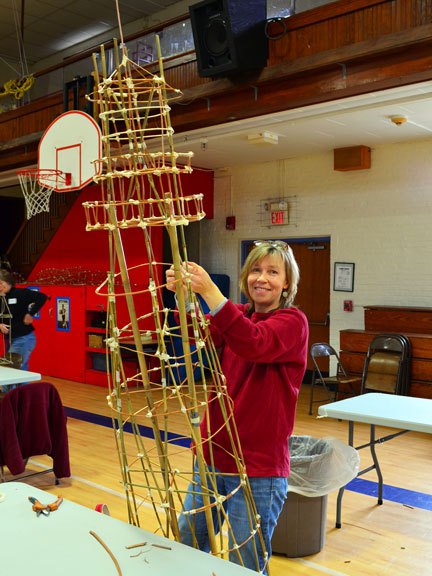
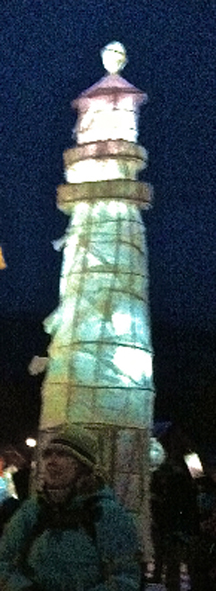
This year’s theme was “Our Town – Faces, Places and Buildings from Your Home-town”, and for me, that couldn’t be any other structure than Portland Head Light of Cape Elizabeth, Maine.

I count myself fortunate to be among local artists invited to participate. Early each November, we meet for a weekend-long workshop to craft large-scale lanterns to represent the chosen theme.  Up to our elbows in willow, masking tape, coffee filters and glue, it’s 2 full days of ideas, camaraderie, and good tunes. But the best part is getting to spend concentrated time with other artists.

Making the Lighthouse

Reinforcing my lighthouse                                          Photo credit: Gowri Savoor

Meanwhile, in the weeks leading up to the parade all students in the primary school are busy creating their own lanterns. Their pride and excitement is electric as everyone lines up; it’s a blast to be in the middle of their enthusiasm!

The end result is a vision of imagination; a true “river of light” that winds through the streets of Waterbury on the appointed evening. Observers full of good cheer, stand shoulder to shoulder, spirits heightened by the glowing lanterns and the steady beat and whistles of the drum bands that accompany the procession. The whole town is swept up in the joy of a community art event that has something for everyone.

Check out this short video by Ryan Mercer of the Burlington Free Press for a taste of the exicitement.

It really hammers home the idea that art can and should be accessible to everyone. I encourage you to see what opportunities might be available in your town for bringing together your community with art. The results may surprise you.

Lighthouse1